Hueston C M, Cryan J F, Nolan Y M
Department of Anatomy and Neuroscience, University College Cork, Cork, Ireland.
APC Microbiome Institute, University College Cork, Cork, Ireland.
Transl Psychiatry. 2017 Apr 4;7(4):e1081. doi: 10.1038/tp.2017.48.
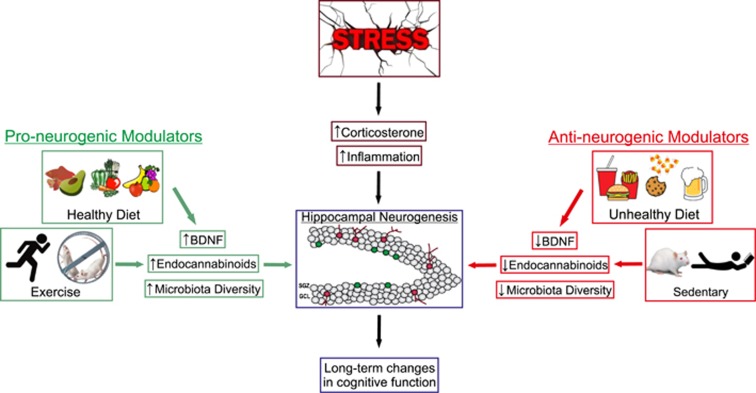
Adolescence is a critical period for brain maturation. Deciphering how disturbances to the central nervous system at this time affect structure, function and behavioural outputs is important to better understand any long-lasting effects. Hippocampal neurogenesis occurs during development and continues throughout life. In adulthood, integration of these new cells into the hippocampus is important for emotional behaviour, cognitive function and neural plasticity. During the adolescent period, maturation of the hippocampus and heightened levels of hippocampal neurogenesis are observed, making alterations to neurogenesis at this time particularly consequential. As stress negatively affects hippocampal neurogenesis, and adolescence is a particularly stressful time of life, it is important to investigate the impact of stressor exposure at this time on hippocampal neurogenesis and cognitive function. Adolescence may represent not only a time for which stress can have long-lasting effects, but is also a critical period during which interventions, such as exercise and diet, could ameliorate stress-induced changes to hippocampal function. In addition, intervention at this time may also promote life-long behavioural changes that would aid in fostering increased hippocampal neurogenesis and cognitive function. This review addresses both the acute and long-term stress-induced alterations to hippocampal neurogenesis and cognition during the adolescent period, as well as changes to the stress response and pubertal hormones at this time which may result in differential effects than are observed in adulthood. We hypothesise that adolescence may represent an optimal time for healthy lifestyle changes to have a positive and long-lasting impact on hippocampal neurogenesis, and to protect against stress-induced deficits. We conclude that future research into the mechanisms underlying the susceptibility of the adolescent hippocampus to stress, exercise and diet and the consequent effect on cognition may provide insight into why adolescence may be a vital period for correct conditioning of future hippocampal function.
青春期是大脑成熟的关键时期。弄清楚此时中枢神经系统的紊乱如何影响结构、功能和行为输出,对于更好地理解任何长期影响至关重要。海马体神经发生在发育过程中出现,并持续一生。在成年期,这些新细胞融入海马体对于情绪行为、认知功能和神经可塑性很重要。在青春期,观察到海马体成熟以及海马体神经发生水平升高,因此此时神经发生的改变尤为重要。由于压力会对海马体神经发生产生负面影响,而青春期是特别充满压力的人生阶段,所以研究此时应激源暴露对海马体神经发生和认知功能的影响很重要。青春期可能不仅是压力会产生长期影响的时期,也是一个关键时期,在此期间,诸如运动和饮食等干预措施可以改善压力引起的海马体功能变化。此外,此时进行干预还可能促进终身行为改变,有助于促进海马体神经发生增加和认知功能提升。这篇综述探讨了青春期急性和长期应激诱导的海马体神经发生和认知改变,以及此时应激反应和青春期激素的变化,这些变化可能导致与成年期不同的影响。我们假设青春期可能是健康生活方式改变对海马体神经发生产生积极且持久影响,并预防应激诱导缺陷的最佳时期。我们得出结论,未来对青少年海马体对应激、运动和饮食易感性的潜在机制以及对认知的后续影响的研究,可能会深入了解为什么青春期可能是未来海马体功能正确调节的关键时期。