Apolo Andrea B, Infante Jeffrey R, Balmanoukian Ani, Patel Manish R, Wang Ding, Kelly Karen, Mega Anthony E, Britten Carolyn D, Ravaud Alain, Mita Alain C, Safran Howard, Stinchcombe Thomas E, Srdanov Marko, Gelb Arnold B, Schlichting Michael, Chin Kevin, Gulley James L
Andrea B. Apolo and James L. Gulley, National Institutes of Health, Bethesda, MD; Jeffrey R. Infante, Sarah Cannon Research Institute/Tennessee Oncology, Nashville, TN; Ani Balmanoukian, The Angeles Clinic & Research Institute; Alain C. Mita, Cedars Sinai Medical Center, Los Angeles; Karen Kelly, University of California-Davis, Sacramento; Marko Srdanov, Dako North America, Carpinteria, CA; Manish R. Patel, Florida Cancer Specialists & Research Institute, Sarasota, FL; Ding Wang, Henry Ford Hospital, Detroit, MI; Anthony E. Mega, The Warren Alpert Medical School at Brown University; Howard Safran, The Miriam Hospital, Providence; Howard Safran, Newport Hospital, Newport, RI; Carolyn D. Britten, Medical University of South Carolina, Charleston, SC; Alain Ravaud, CHU de Bordeaux, Bordeaux, France; Thomas E. Stinchcombe, Duke University Medical Center, Durham, NC; Arnold B. Gelb and Kevin Chin, EMD Serono, Billerica, MA; and Michael Schlichting, Merck, Darmstadt, Germany.
J Clin Oncol. 2017 Jul 1;35(19):2117-2124. doi: 10.1200/JCO.2016.71.6795. Epub 2017 Apr 4.
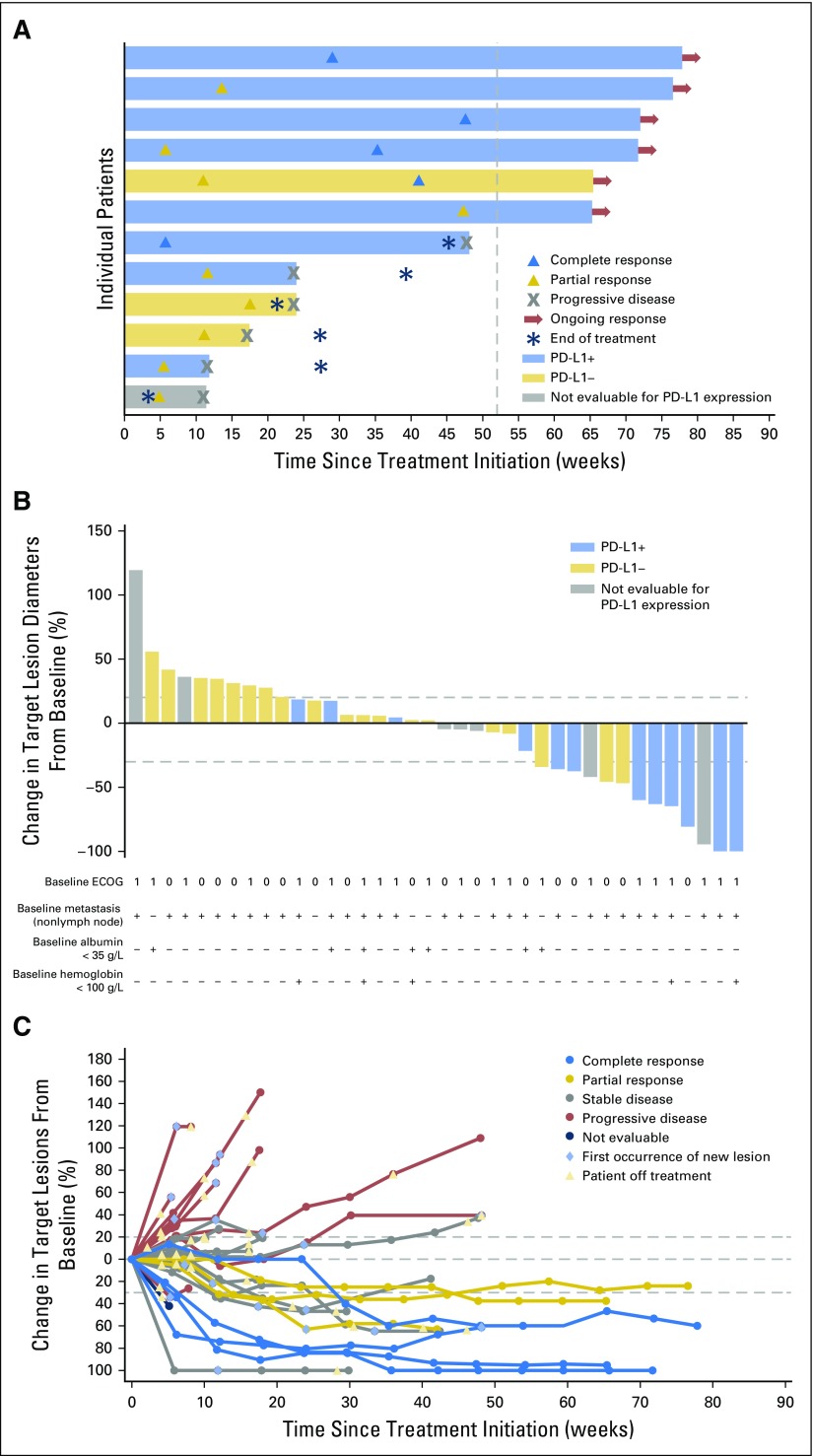
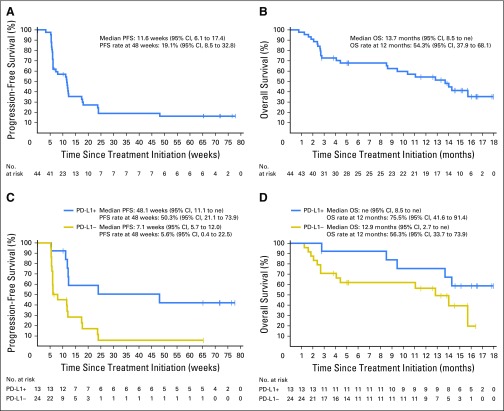
Purpose We assessed the safety and antitumor activity of avelumab, a fully human anti-programmed death-ligand 1 (PD-L1) IgG1 antibody, in patients with refractory metastatic urothelial carcinoma. Methods In this phase Ib, multicenter, expansion cohort, patients with urothelial carcinoma progressing after platinum-based chemotherapy and unselected for PD-L1 expression received avelumab 10 mg/kg intravenously every 2 weeks. The primary objectives were safety and tolerability. Secondary objectives included confirmed objective response rate (Response Evaluation Criteria in Solid Tumors [RECIST] version 1.1), progression-free survival, overall survival (OS), and PD-L1-associated clinical activity. PD-L1 positivity was defined as expression by immunohistochemistry on ≥ 5% of tumor cells. Results Forty-four patients were treated with avelumab and followed for a median of 16.5 months (interquartile range, 15.8 to 16.7 months). The data cutoff was March 19, 2016. The most frequent treatment-related adverse events of any grade were fatigue/asthenia (31.8%), infusion-related reaction (20.5%), and nausea (11.4%). Grades 3 to 4 treatment-related adverse events occurred in three patients (6.8%) and included asthenia, AST elevation, creatine phosphokinase elevation, and decreased appetite. The confirmed objective response rate by independent central review was 18.2% (95% CI, 8.2% to 32.7%; five complete responses and three partial responses). The median duration of response was not reached (95% CI, 12.1 weeks to not estimable), and responses were ongoing in six patients (75.0%), including four of five complete responses. Seven of eight responding patients had PD-L1-positive tumors. The median progression-free survival was 11.6 weeks (95% CI, 6.1 to 17.4 weeks); the median OS was 13.7 months (95% CI, 8.5 months to not estimable), with a 12-month OS rate of 54.3% (95% CI, 37.9% to 68.1%). Conclusion Avelumab was well tolerated and associated with durable responses and prolonged survival in patients with refractory metastatic UC.
目的 我们评估了阿维鲁单抗(一种全人源抗程序性死亡配体1 [PD-L1] IgG1抗体)在难治性转移性尿路上皮癌患者中的安全性和抗肿瘤活性。方法 在这项Ib期多中心扩展队列研究中,铂类化疗后病情进展且未选择PD-L1表达情况的尿路上皮癌患者每2周静脉注射10 mg/kg阿维鲁单抗。主要目标是安全性和耐受性。次要目标包括确认的客观缓解率(实体瘤疗效评价标准 [RECIST] 1.1版)、无进展生存期、总生存期(OS)以及与PD-L1相关的临床活性。PD-L1阳性定义为免疫组化显示≥5%的肿瘤细胞表达。结果 44例患者接受了阿维鲁单抗治疗,中位随访时间为16.5个月(四分位间距,15.8至16.7个月)。数据截止日期为2016年3月19日。任何级别的最常见治疗相关不良事件为疲劳/乏力(31.8%)、输液相关反应(20.5%)和恶心(11.4%)。3至4级治疗相关不良事件发生在3例患者(6.8%)中,包括乏力、AST升高、肌酸磷酸激酶升高和食欲下降。独立中心审查确认的客观缓解率为18.2%(95%CI,8.2%至32.7%;5例完全缓解和3例部分缓解)。中位缓解持续时间未达到(95%CI,12.1周至无法估计),6例患者(75.0%)的缓解仍在持续,包括5例完全缓解中的4例。8例缓解患者中有7例肿瘤为PD-L1阳性。中位无进展生存期为11.6周(95%CI,6.1至17.4周);中位OS为13.7个月(95%CI,8.5个月至无法估计),12个月OS率为54.3%(95%CI,37.9%至68.1%)。结论 阿维鲁单抗耐受性良好,与难治性转移性UC患者的持久缓解和生存期延长相关。