Turnbull Alison E, Sepulveda Kristin A, Dinglas Victor D, Chessare Caroline M, Bingham Clifton O, Needham Dale M
1Outcomes After Critical Illness and Surgery (OACIS) Group, Johns Hopkins University, Baltimore, MD. 2Division of Pulmonary and Critical Care Medicine, Department of Medicine, School of Medicine, Johns Hopkins University, Baltimore, MD. 3Department of Epidemiology, Bloomberg School of Public Health, Johns Hopkins University, Baltimore, MD. 4Divisions of Rheumatology and Allergy and Clinical Immunology, Department of Medicine, Johns Hopkins University, Baltimore, MD. 5Department of Physical Medicine and Rehabilitation, School of Medicine, Johns Hopkins University, Baltimore, MD.
Crit Care Med. 2017 Jun;45(6):1001-1010. doi: 10.1097/CCM.0000000000002435.
To identify the "core domains" (i.e., patient outcomes, health-related conditions, or aspects of health) that relevant stakeholders agree are essential to assess in all clinical research studies evaluating the outcomes of acute respiratory failure survivors after hospital discharge.
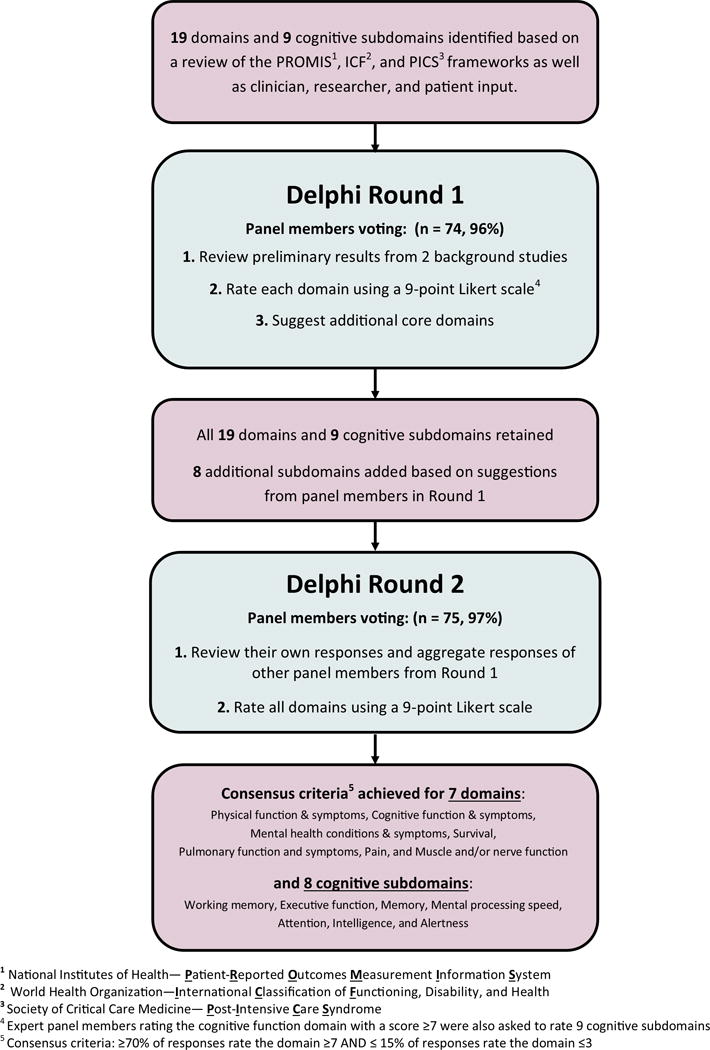
A two-round consensus process, using a modified Delphi methodology, with participants from 16 countries, including patient and caregiver representatives. Prior to voting, participants were asked to review 1) results from surveys of clinical researchers, acute respiratory failure survivors, and caregivers that rated the importance of 19 preliminary outcome domains and 2) results from a qualitative study of acute respiratory failure survivors' outcomes after hospital discharge, as related to the 19 preliminary outcome domains. Participants also were asked to suggest any additional potential domains for evaluation in the first Delphi survey.
Web-based surveys of participants representing four stakeholder groups relevant to clinical research evaluating postdischarge outcomes of acute respiratory failure survivors: clinical researchers, clinicians, patients and caregivers, and U.S. federal research funding organizations.
None.
None.
Survey response rates were 97% and 99% in round 1 and round 2, respectively. There were seven domains that met the a priori consensus criteria to be designated as core domains: physical function, cognition, mental health, survival, pulmonary function, pain, and muscle and/or nerve function.
This study generated a consensus-based list of core domains that should be assessed in all clinical research studies evaluating acute respiratory failure survivors after hospital discharge. Identifying appropriate measurement instruments to assess these core domains is an important next step toward developing a set of core outcome measures for this field of research.
确定“核心领域”(即患者结局、健康相关状况或健康方面),相关利益相关者一致认为在所有评估急性呼吸衰竭幸存者出院后结局的临床研究中,这些领域对于评估至关重要。
采用两轮共识达成过程,运用改良的德尔菲法,参与者来自16个国家,包括患者和护理者代表。在投票前,要求参与者审查:1)临床研究人员、急性呼吸衰竭幸存者及护理者的调查结果,这些调查对19个初步结局领域的重要性进行了评分;2)一项关于急性呼吸衰竭幸存者出院后结局的定性研究结果,该结果与19个初步结局领域相关。在第一轮德尔菲调查中,还要求参与者提出任何其他潜在的评估领域。
对代表与评估急性呼吸衰竭幸存者出院后结局的临床研究相关的四个利益相关者群体的参与者进行基于网络的调查:临床研究人员、临床医生、患者和护理者以及美国联邦研究资助机构。
无。
无。
第一轮和第二轮调查的回复率分别为97%和99%。有七个领域符合先验共识标准,被指定为核心领域:身体功能、认知、心理健康、生存、肺功能、疼痛以及肌肉和/或神经功能。
本研究得出了一份基于共识的核心领域清单,在所有评估急性呼吸衰竭幸存者出院后结局的临床研究中均应评估这些领域。确定合适的测量工具来评估这些核心领域是朝着为该研究领域制定一套核心结局测量指标迈出的重要下一步。