Robinson Karen A, Davis Wesley E, Dinglas Victor D, Mendez-Tellez Pedro A, Rabiee Anahita, Sukrithan Vineeth, Yalamanchilli Ramakrishna, Turnbull Alison E, Needham Dale M
Division of General Internal Medicine, Department of Medicine, Johns Hopkins University School of Medicine, 1830 East Monument Street, Baltimore, MD 21287, USA.
Division of Pulmonary and Critical Care Medicine, Department of Medicine, Johns Hopkins University School of Medicine, 1830 East Monument Street, Baltimore, MD 21287, USA; Outcomes After Critical Illness and Surgery (OACIS) Group, Johns Hopkins University School of Medicine, 1830 East Monument Street, Baltimore, MD 21287, USA.
J Clin Epidemiol. 2017 Feb;82:37-46. doi: 10.1016/j.jclinepi.2016.08.014. Epub 2016 Nov 16.
There is a growing number of studies evaluating the physical, cognitive, mental health, and health-related quality of life (HRQOL) outcomes of adults surviving critical illness. However, there is little consensus on the most appropriate instruments to measure these outcomes. To inform the development of such consensus, we conducted a systematic review of the performance characteristics of instruments measuring physical, cognitive, mental health, and HRQOL outcomes in adult intensive care unit (ICU) survivors.
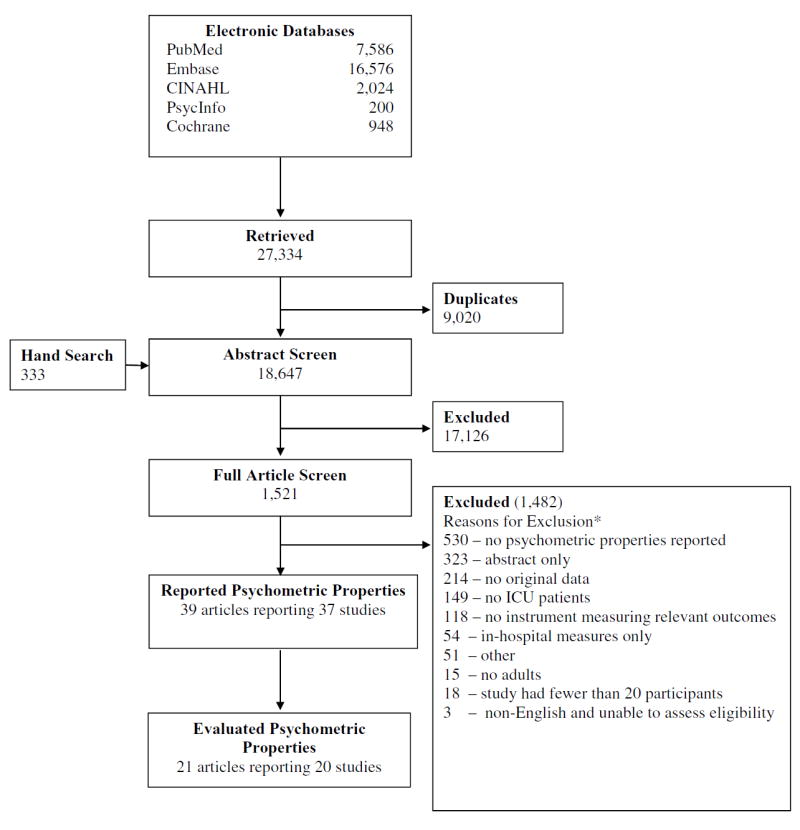
We searched PubMed, Embase, PsycInfo, Cumulative Index of Nursing and Allied Health Literature, and The Cochrane Library in March 2015. We also conducted manual searches of reference lists of eligible studies and relevant review articles. Two people independently selected studies, completed data abstraction, and assessed the quality of eligible studies using the COnsensus-based Standards for the selection of health Measurement Instruments (COSMIN) initiative checklist.
We identified 20 studies which explicitly evaluated measurement properties for 21 different instruments assessing outcomes in ICU survivors. Eleven of the instruments assessed quality of life, with few instruments assessing other domains. Of the nine measurement properties evaluated on the COSMIN checklist, six were assessed in <10% of the evaluations. Overall quality of eligible studies was generally poor to fair based on the COSMIN checklist.
Although an increasing number of studies measure physical, cognitive, mental health, and HRQOL outcomes in adult ICU survivors, data on the measurement properties of such instruments are sparse and generally of poor to fair quality. Empirical analyses evaluating the performance of instruments in adult ICU survivors are needed to advance research in this field.
评估危重症成年幸存者身体、认知、心理健康及健康相关生活质量(HRQOL)结局的研究日益增多。然而,对于测量这些结局的最合适工具,几乎没有达成共识。为形成此类共识提供依据,我们对测量成年重症监护病房(ICU)幸存者身体、认知、心理健康及HRQOL结局的工具的性能特征进行了系统评价。
我们于2015年3月检索了PubMed、Embase、PsycInfo、护理及相关健康文献累积索引和Cochrane图书馆。我们还对手选研究的参考文献列表和相关综述文章进行了手工检索。两人独立选择研究、完成数据提取,并使用基于共识的健康测量工具选择标准(COSMIN)倡议清单评估入选研究的质量。
我们确定了20项研究,这些研究明确评估了21种不同工具的测量属性,这些工具用于评估ICU幸存者的结局。其中11种工具评估了生活质量,评估其他领域的工具较少。在COSMIN清单上评估的9种测量属性中,有6种在不到10%的评估中被涉及。根据COSMIN清单,入选研究的总体质量普遍较差至中等。
尽管越来越多的研究测量成年ICU幸存者的身体、认知、心理健康及HRQOL结局,但关于此类工具测量属性的数据稀少,且质量普遍较差至中等。需要进行实证分析来评估工具在成年ICU幸存者中的性能,以推动该领域的研究。