Koopmans Bastijn, Smit August B, Verhage Matthijs, Loos Maarten
Sylics (Synaptologics BV), Amsterdam, The Netherlands.
Department of Molecular and Cellular Neurobiology, Center for Neurogenomics and Cognitive Research (CNCR), Amsterdam Neuroscience, VU University Amsterdam, Amsterdam, The Netherlands.
BMC Bioinformatics. 2017 Apr 4;18(1):200. doi: 10.1186/s12859-017-1612-1.
Systematic, standardized and in-depth phenotyping and data analyses of rodent behaviour empowers gene-function studies, drug testing and therapy design. However, no data repositories are currently available for standardized quality control, data analysis and mining at the resolution of individual mice.
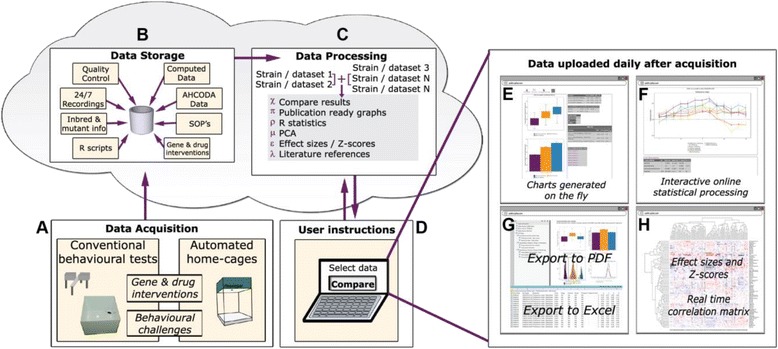
Here, we present AHCODA-DB, a public data repository with standardized quality control and exclusion criteria aimed to enhance robustness of data, enabled with web-based mining tools for the analysis of individually and group-wise collected mouse phenotypic data. AHCODA-DB allows monitoring in vivo effects of compounds collected from conventional behavioural tests and from automated home-cage experiments assessing spontaneous behaviour, anxiety and cognition without human interference. AHCODA-DB includes such data from mutant mice (transgenics, knock-out, knock-in), (recombinant) inbred strains, and compound effects in wildtype mice and disease models. AHCODA-DB provides real time statistical analyses with single mouse resolution and versatile suite of data presentation tools. On March 9th, 2017 AHCODA-DB contained 650 k data points on 2419 parameters from 1563 mice.
AHCODA-DB provides users with tools to systematically explore mouse behavioural data, both with positive and negative outcome, published and unpublished, across time and experiments with single mouse resolution. The standardized (automated) experimental settings and the large current dataset (1563 mice) in AHCODA-DB provide a unique framework for the interpretation of behavioural data and drug effects. The use of common ontologies allows data export to other databases such as the Mouse Phenome Database. Unbiased presentation of positive and negative data obtained under the highly standardized screening conditions increase cost efficiency of publicly funded mouse screening projects and help to reach consensus conclusions on drug responses and mouse behavioural phenotypes. The website is publicly accessible through https://public.sylics.com and can be viewed in every recent version of all commonly used browsers.
对啮齿动物行为进行系统、标准化和深入的表型分析及数据分析,有助于基因功能研究、药物测试和治疗设计。然而,目前尚无用于以个体小鼠分辨率进行标准化质量控制、数据分析和挖掘的数据存储库。
在此,我们展示了AHCODA-DB,这是一个具有标准化质量控制和排除标准的公共数据存储库,旨在提高数据的稳健性,并配备基于网络的挖掘工具,用于分析单独收集和分组收集的小鼠表型数据。AHCODA-DB能够监测从传统行为测试以及评估自发行为、焦虑和认知的自动笼内实验中收集的化合物的体内效应,且无需人工干预。AHCODA-DB包含来自突变小鼠(转基因、敲除、敲入)、(重组)近交系的数据,以及野生型小鼠和疾病模型中的化合物效应数据。AHCODA-DB提供单只小鼠分辨率的实时统计分析以及多功能的数据展示工具套件。2017年3月9日,AHCODA-DB包含来自1563只小鼠的2419个参数的65万个数据点。
AHCODA-DB为用户提供了工具,可在单只小鼠分辨率下,系统地探索已发表和未发表的、跨越时间和实验的、具有正向和负向结果的小鼠行为数据。AHCODA-DB中标准化(自动化)的实验设置和庞大的当前数据集(1563只小鼠)为行为数据和药物效应的解释提供了独特的框架。使用通用本体可将数据导出到其他数据库,如小鼠表型数据库。在高度标准化的筛选条件下获得的正向和负向数据的无偏呈现提高了公共资助的小鼠筛选项目的成本效益,并有助于就药物反应和小鼠行为表型达成共识性结论。该网站可通过https://public.sylics.com公开访问,并且可以在所有常用浏览器的每个最新版本中查看。