Aidley Jack, Rajopadhye Shweta, Akinyemi Nwanekka M, Lango-Scholey Lea, Jones Michael A, Bayliss Christopher D
Department of Genetics, University of Leicester, Leicester, United Kingdom.
Department of Genetics, University of Leicester, Leicester, United Kingdom
mBio. 2017 Apr 4;8(2):e02311-16. doi: 10.1128/mBio.02311-16.
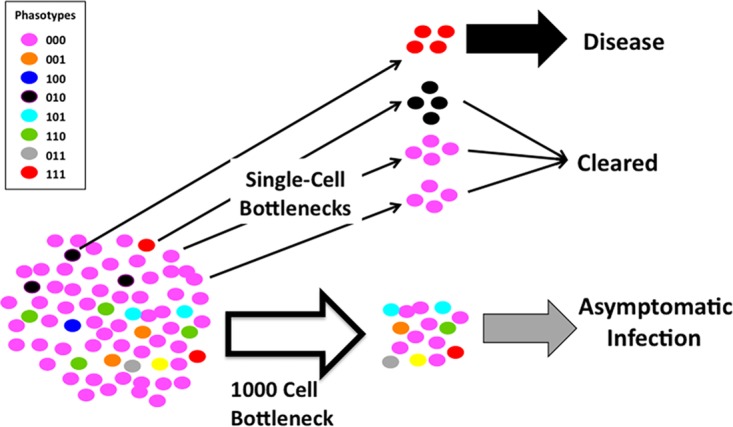
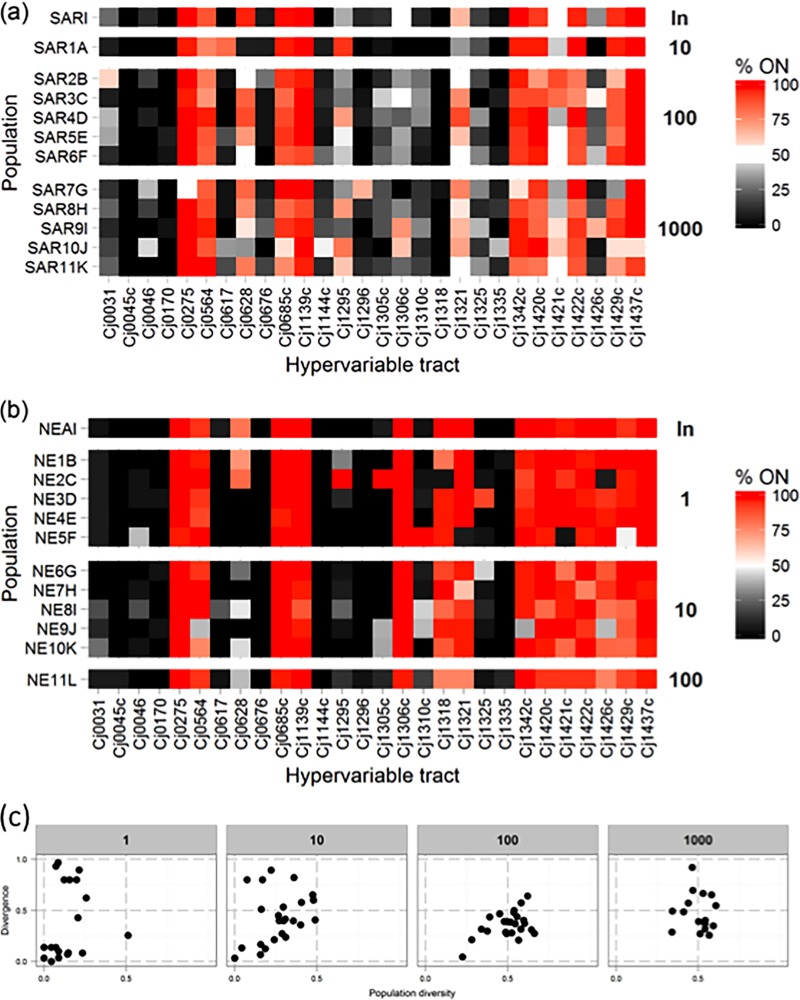
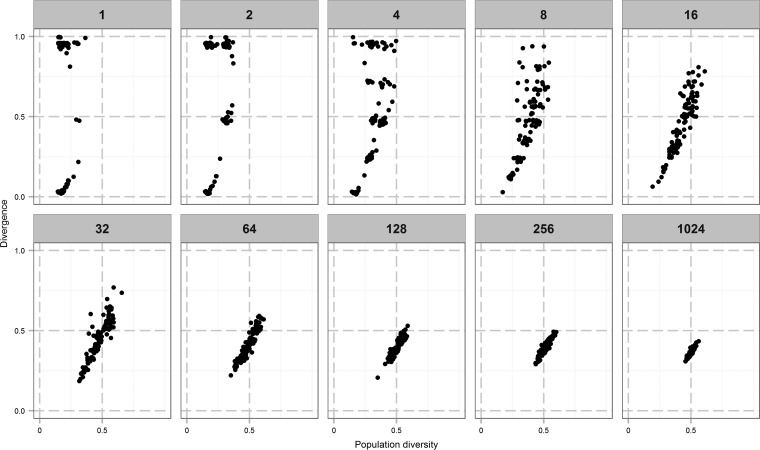
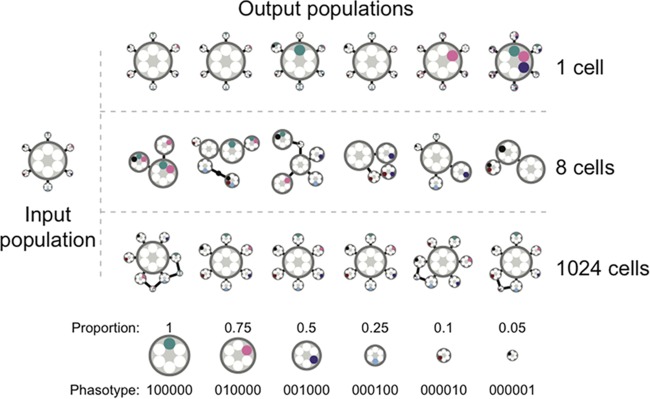
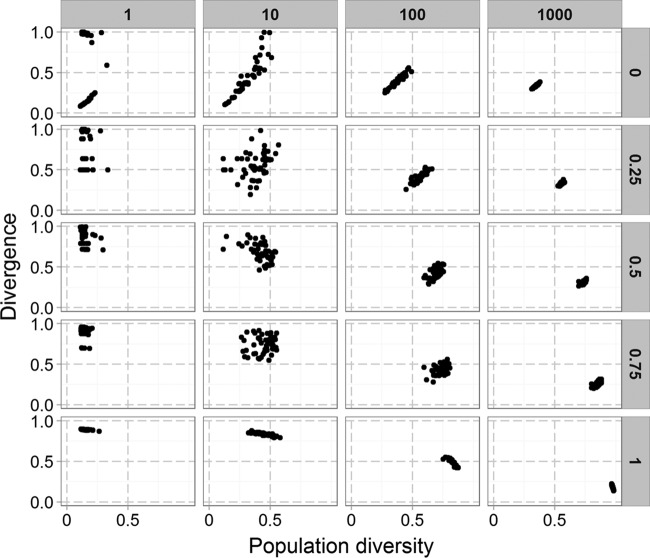
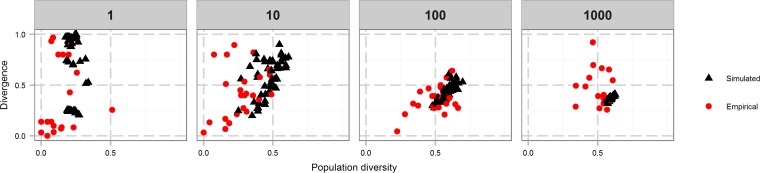
Phase variation occurs in many pathogenic and commensal bacteria and is a major generator of genetic variability. A putative advantage of phase variation is to counter reductions in variability imposed by nonselective bottlenecks during transmission. Genomes of , a widespread food-borne pathogen, contain multiple phase-variable loci whose rapid, stochastic variation is generated by hypermutable simple sequence repeat tracts. These loci can occupy a vast number of combinatorial expression states (phasotypes) enabling populations to rapidly access phenotypic diversity. The imposition of nonselective bottlenecks can perturb the relative frequencies of phasotypes, changing both within-population diversity and divergence from the initial population. Using both testing of populations and a simple stochastic simulation of phasotype change, we observed that single-cell bottlenecks produce output populations of low diversity but with bimodal patterns of either high or low divergence. Conversely, large bottlenecks allow divergence only by accumulation of diversity, while interpolation between these extremes is observed in intermediary bottlenecks. These patterns are sensitive to the genetic diversity of initial populations but stable over a range of mutation rates and number of loci. The qualitative similarities of experimental and modeling indicate that the observed patterns are robust and applicable to other systems where localized hypermutation is a defining feature. We conclude that while phase variation will maintain bacterial population diversity in the face of intermediate bottlenecks, narrow transmission-associated bottlenecks could produce host-to-host variation in bacterial phenotypes and hence stochastic variation in colonization and disease outcomes. Transmission and within-host spread of pathogenic organisms are associated with selective and nonselective bottlenecks that significantly reduced population diversity. In several bacterial pathogens, hypermutable mechanisms have evolved that mediate high-frequency reversible switching of specific phenotypes, such as surface structures, and hence counteract bottleneck-associated reductions in population diversity. Here, we investigated how combinations of hypermutable simple sequence repeats interact with nonselective bottlenecks by using a stochastic computer model and experimental data for , a food-borne pathogen. We find that bottleneck size qualitatively alters the output populations, with large bottlenecks maintaining population diversity while small bottlenecks produce dramatic shifts in the prevalence of particular variants. We conclude that narrow bottlenecks are capable of producing host-to-host variation in repeat-controlled bacterial phenotypes, leading to a potential for stochastic person-to-person variations in disease outcome for and other organisms with similar hypermutable mechanisms.
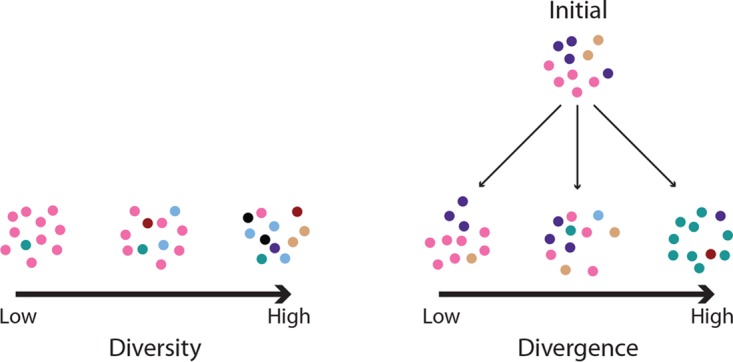
相变发生在许多致病性和共生细菌中,是遗传变异性的主要来源。相变的一个假定优势是抵消传播过程中非选择性瓶颈导致的变异性降低。一种广泛存在的食源性病原体的基因组包含多个相变可变位点,其快速、随机的变异由高度可变的简单序列重复序列产生。这些位点可以占据大量的组合表达状态(相型),使群体能够迅速获得表型多样性。非选择性瓶颈的施加会扰乱相型的相对频率,改变群体内部的多样性以及与初始群体的差异。通过对群体的测试以及相型变化的简单随机模拟,我们观察到单细胞瓶颈产生的输出群体多样性较低,但具有高差异或低差异的双峰模式。相反,大瓶颈仅通过多样性的积累允许差异,而在中间瓶颈中观察到这些极端情况之间的插值。这些模式对初始群体的遗传多样性敏感,但在一系列突变率和位点数范围内稳定。实验和建模的定性相似性表明,观察到的模式是稳健的,适用于其他以局部高突变作为定义特征的系统。我们得出结论,虽然相变在面对中间瓶颈时会维持细菌群体多样性,但与传播相关的狭窄瓶颈可能会导致细菌表型在宿主之间产生变异,从而导致定植和疾病结果的随机变异。致病生物体的传播和宿主内传播与显著降低群体多样性的选择性和非选择性瓶颈有关。在几种细菌病原体中,已经进化出高度可变机制,介导特定表型(如表面结构)的高频可逆转换,从而抵消与瓶颈相关的群体多样性降低。在这里,我们使用随机计算机模型和食源性病原体的实验数据,研究了高度可变的简单序列重复序列的组合如何与非选择性瓶颈相互作用。我们发现瓶颈大小在质量上改变了输出群体,大瓶颈维持群体多样性,而小瓶颈会导致特定变体的流行率发生巨大变化。我们得出结论,狭窄瓶颈能够在重复控制的细菌表型中产生宿主间变异,导致和其他具有类似高度可变机制的生物体在疾病结果方面可能出现随机的人际变异。