Pitt John I, Lange Lene, Lacey Alastair E, Vuong Daniel, Midgley David J, Greenfield Paul, Bradbury Mark I, Lacey Ernest, Busk Peter K, Pilgaard Bo, Chooi Yit-Heng, Piggott Andrew M
Commonwealth Scientific and Industrial Research Organisation, North Ryde, Australia.
Department of Chemical and Biochemical Engineering, Technical University of Denmark, Lyngby, Denmark.
PLoS One. 2017 Apr 5;12(4):e0170254. doi: 10.1371/journal.pone.0170254. eCollection 2017.
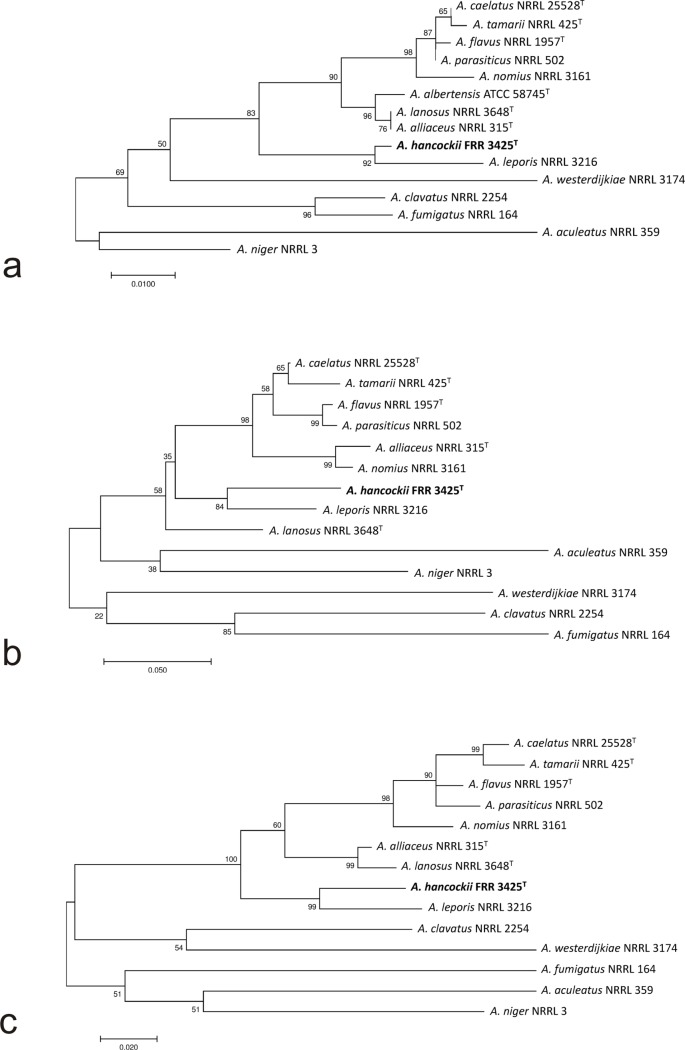
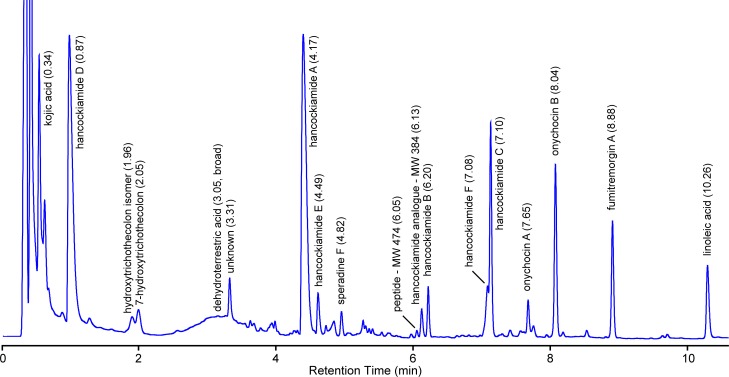
Aspergillus hancockii sp. nov., classified in Aspergillus subgenus Circumdati section Flavi, was originally isolated from soil in peanut fields near Kumbia, in the South Burnett region of southeast Queensland, Australia, and has since been found occasionally from other substrates and locations in southeast Australia. It is phylogenetically and phenotypically related most closely to A. leporis States and M. Chr., but differs in conidial colour, other minor features and particularly in metabolite profile. When cultivated on rice as an optimal substrate, A. hancockii produced an extensive array of 69 secondary metabolites. Eleven of the 15 most abundant secondary metabolites, constituting 90% of the total area under the curve of the HPLC trace of the crude extract, were novel. The genome of A. hancockii, approximately 40 Mbp, was sequenced and mined for genes encoding carbohydrate degrading enzymes identified the presence of more than 370 genes in 114 gene clusters, demonstrating that A. hancockii has the capacity to degrade cellulose, hemicellulose, lignin, pectin, starch, chitin, cutin and fructan as nutrient sources. Like most Aspergillus species, A. hancockii exhibited a diverse secondary metabolite gene profile, encoding 26 polyketide synthase, 16 nonribosomal peptide synthase and 15 nonribosomal peptide synthase-like enzymes.
汉考克曲霉新种(Aspergillus hancockii sp. nov.),归类于曲霉属(Aspergillus)环痕亚属(Circumdati)黄曲霉组(section Flavi),最初从澳大利亚昆士兰州东南部南伯内特地区昆比附近花生田的土壤中分离得到,此后在澳大利亚东南部的其他基质和地点也偶尔发现。它在系统发育和表型上与莱氏曲霉(A. leporis)最密切相关,但在分生孢子颜色、其他细微特征尤其是代谢产物谱方面存在差异。当以大米作为最佳基质培养时,汉考克曲霉产生了一系列多达69种的次生代谢产物。在15种最丰富的次生代谢产物中,有11种是新的,它们占粗提物高效液相色谱图曲线下总面积的90%。对汉考克曲霉约40 Mbp的基因组进行了测序,并挖掘了编码碳水化合物降解酶的基因,结果发现在114个基因簇中有超过370个基因,这表明汉考克曲霉有能力将纤维素、半纤维素、木质素、果胶、淀粉、几丁质、角质和果聚糖作为营养源进行降解。与大多数曲霉属物种一样,汉考克曲霉表现出多样的次生代谢产物基因谱,编码26种聚酮合酶、16种非核糖体肽合酶和15种非核糖体肽合酶样酶。