Baker Lauren A, Kirkpatrick Brian, Rosa Guilherme J M, Gianola Daniel, Valente Bruno, Sumner Julia P, Baltzer Wendy, Hao Zhengling, Binversie Emily E, Volstad Nicola, Piazza Alexander, Sample Susannah J, Muir Peter
Comparative Orthopaedic Research Laboratory, School of Veterinary Medicine, University of Wisconsin-Madison, Madison, Wisconsin, United States of America.
Department of Animal Sciences, College of Agricultural and Life Sciences, University of Wisconsin-Madison, Madison, Wisconsin, United States of America.
PLoS One. 2017 Apr 5;12(4):e0173810. doi: 10.1371/journal.pone.0173810. eCollection 2017.
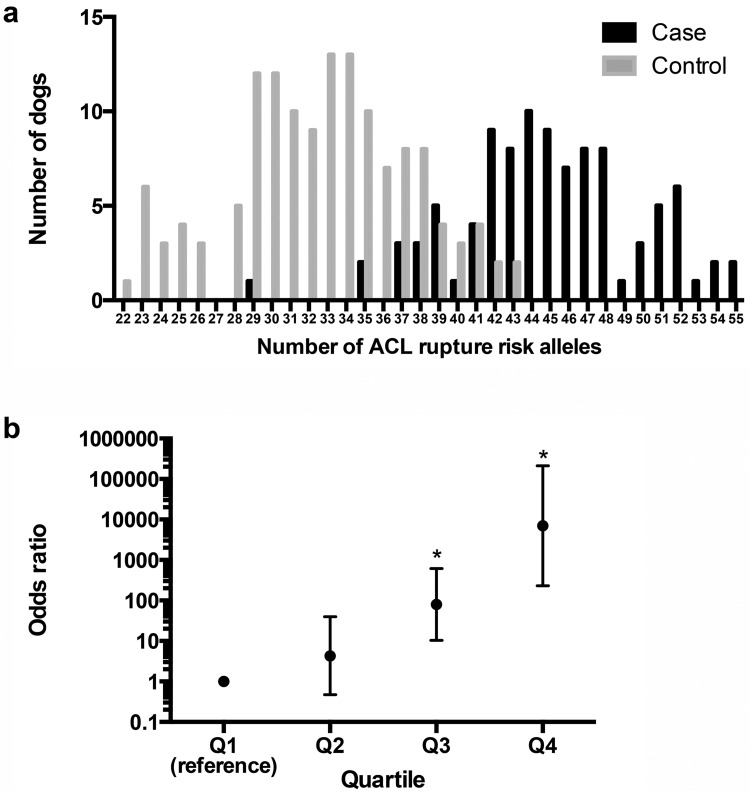
Anterior cruciate ligament (ACL) rupture is a common condition that can be devastating and life changing, particularly in young adults. A non-contact mechanism is typical. Second ACL ruptures through rupture of the contralateral ACL or rupture of a graft repair is also common. Risk of rupture is increased in females. ACL rupture is also common in dogs. Disease prevalence exceeds 5% in several dog breeds, ~100 fold higher than human beings. We provide insight into the genetic etiology of ACL rupture by genome-wide association study (GWAS) in a high-risk breed using 98 case and 139 control Labrador Retrievers. We identified 129 single nucleotide polymorphisms (SNPs) within 99 risk loci. Associated loci (P<5E-04) explained approximately half of phenotypic variance in the ACL rupture trait. Two of these loci were located in uncharacterized or non-coding regions of the genome. A chromosome 24 locus containing nine genes with diverse functions met genome-wide significance (P = 3.63E-0.6). GWAS pathways were enriched for c-type lectins, a gene set that includes aggrecan, a gene set encoding antimicrobial proteins, and a gene set encoding membrane transport proteins with a variety of physiological functions. Genotypic risk estimated for each dog based on the risk contributed by each GWAS locus showed clear separation of ACL rupture cases and controls. Power analysis of the GWAS data set estimated that ~172 loci explain the genetic contribution to ACL rupture in the Labrador Retriever. Heritability was estimated at 0.48. We conclude ACL rupture is a moderately heritable highly polygenic complex trait. Our results implicate c-type lectin pathways in ACL homeostasis.
前交叉韧带(ACL)断裂是一种常见病症,可能具有毁灭性且会改变生活,尤其是在年轻人中。非接触机制较为典型。对侧ACL断裂或移植修复处断裂导致的二次ACL断裂也很常见。女性的断裂风险会增加。ACL断裂在犬类中也很常见。在几个犬种中,该病患病率超过5%,比人类高出约100倍。我们通过全基因组关联研究(GWAS),对98只患ACL断裂的病例和139只对照拉布拉多猎犬这一高危犬种进行研究,以深入了解ACL断裂的遗传病因。我们在99个风险位点内鉴定出129个单核苷酸多态性(SNP)。相关位点(P<5E - 04)解释了ACL断裂性状中约一半的表型变异。其中两个位点位于基因组的未表征或非编码区域。一个位于24号染色体的位点包含九个功能各异的基因,达到了全基因组显著性水平(P = 3.63E - 06)。GWAS通路在c型凝集素方面富集,c型凝集素是一个基因集,包括聚集蛋白聚糖,一个编码抗菌蛋白的基因集,以及一个编码具有多种生理功能的膜转运蛋白的基因集。根据每个GWAS位点贡献的风险为每只犬估计的基因型风险显示,ACL断裂病例和对照有明显区分。对GWAS数据集的功效分析估计,约172个位点解释了拉布拉多猎犬ACL断裂的遗传贡献。遗传力估计为0.48。我们得出结论,ACL断裂是一种具有中等遗传性的高度多基因复杂性状。我们的结果表明c型凝集素通路与ACL的稳态有关。