Divisão de Ensino e Pesquisa, Instituto Nacional de Traumatologia e Ortopedia (INTO), Avenida Brasil, 500, Rio de Janeiro, 20940-070, Brazil.
Laboratório de Pesquisa de Ciências Farmacêuticas, Centro Universitário Estadual da Zona Oeste (UEZO), Rio de Janeiro, Brazil.
BMC Musculoskelet Disord. 2022 Feb 16;23(1):154. doi: 10.1186/s12891-022-05105-2.
Anterior cruciate ligament (ACL) rupture is a common and severe knee injury in sports and occurs mostly due to noncontact injuries. There is an increasing amount of evidence associating ACL rupture to single nucleotide polymorphisms (SNPs), and SNPs in the collagen type I genes can change its expression and tissue mechanical features. This study aimed to investigate the association between SNPs in COL1A1 and COL1A2 with sports-related ACL tears.
A total of 338 athletes from multiple sports modalities were analyzed: 146 were diagnosed with ACL rupture or underwent an ACL reconstruction surgery and 192 have no musculoskeletal injuries. SNPs were genotyped using validated TaqMan assays. The association of the polymorphisms with ACL rupture was evaluated by a multivariable logistic regression model, using odds ratios (OR) and 95% confidence intervals (CI).
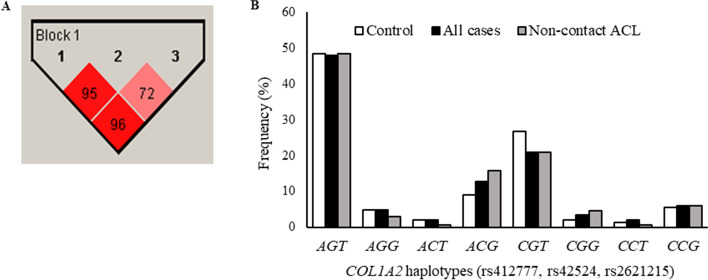
The age, sport modality, and training location were associated with an increased risk of a non-contact ACL tear. COL1A2 SNPs (rs42524 CC and rs2621215 GG) were associated with an increased risk of non-contact ACL injury (6 and 4-fold, respectively). However, no significant differences were detected in the distribution of COL1A1 rs1107946 and COL1A2 rs412777 SNPs between cases and controls. There was a protective association with ACL rupture (OR = 0.25; 95% CI = 0.07-0.96) between COL1A1 rs1107946 (GT or TT) and the wildtype genotypes of the three COL1A2 (rs412777, rs42524, rs2621215). COL1A2 rs42524 and rs2621215 SNPs were associated with non-contact ACL risk.
The combined analysis of COL1A1-COL1A2 genotypes suggests a gene-gene interaction in ACL rupture susceptibility.
前交叉韧带(ACL)撕裂是运动中常见且严重的膝关节损伤,主要由非接触性损伤引起。越来越多的证据表明 ACL 撕裂与单核苷酸多态性(SNP)有关,而 I 型胶原基因中的 SNP 可以改变其表达和组织力学特性。本研究旨在探讨 COL1A1 和 COL1A2 基因中的 SNP 与运动相关 ACL 撕裂的关系。
共分析了 338 名来自多种运动方式的运动员:146 名被诊断为 ACL 撕裂或接受 ACL 重建手术,192 名无肌肉骨骼损伤。使用经过验证的 TaqMan 检测方法对 SNP 进行基因分型。采用多变量逻辑回归模型,使用比值比(OR)和 95%置信区间(CI)评估多态性与 ACL 撕裂的相关性。
年龄、运动方式和训练地点与非接触性 ACL 撕裂的风险增加有关。COL1A2 基因 SNP(rs42524 CC 和 rs2621215 GG)与非接触性 ACL 损伤的风险增加相关(分别为 6 倍和 4 倍)。然而,病例组和对照组之间 COL1A1 rs1107946 和 COL1A2 rs412777 SNP 的分布无显著差异。COL1A1 rs1107946(GT 或 TT)与 COL1A2 的三种基因型(rs412777、rs42524、rs2621215)的野生型之间存在 ACL 撕裂的保护相关性(OR=0.25;95%CI=0.07-0.96)。COL1A2 rs42524 和 rs2621215 SNP 与非接触性 ACL 风险相关。
COL1A1-COL1A2 基因型的综合分析表明 ACL 撕裂易感性存在基因-基因相互作用。