Ritter Alessandra Mileni Versuti, Faria Ana Paula Cabral de, Sabbatini Andrea, Corrêa Nathalia Batista, Brunelli Veridiana, Modolo Rodrigo, Moreno Heitor
Universidade Estadual de Campinas (UNICAMP), Campinas, SP - Brazil.
Arq Bras Cardiol. 2017 Apr;108(4):331-338. doi: 10.5935/abc.20170033. Epub 2017 Mar 30.
Hypertension is a chronic, low-grade inflammation process associated with the release of cytokines and development of target organ damage. Deregulated monocyte chemoattractant protein-1 (MCP-1) levels have been associated with high blood pressure and cardiovascular complications; however, the mechanisms involved are complex and not fully understood.
This study aimed to compare the levels of MCP-1 in patients with resistant (RH) versus mild-to-moderate (HTN) hypertension and their association with the presence or absence of left ventricular hypertrophy (LVH) in all hypertensive subjects.
We enrolled 256 hypertensive subjects: 120 RH and 136 HTN, investigating the relationship between circulating MCP-1 levels and blood pressure, biochemical data, hematologic profile, and cardiac damage within the RH and HTN groups. Plasma MCP-1 levels were measured by ELISA and LVH was assessed by echocardiography.
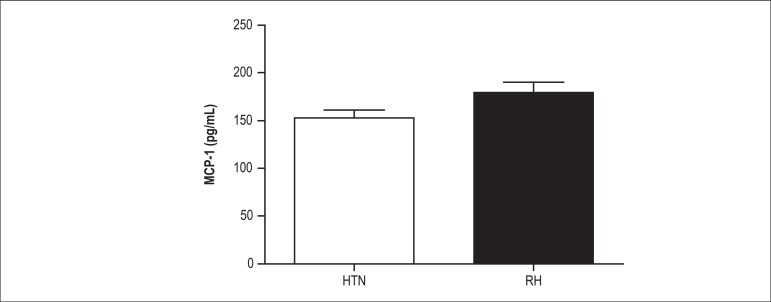
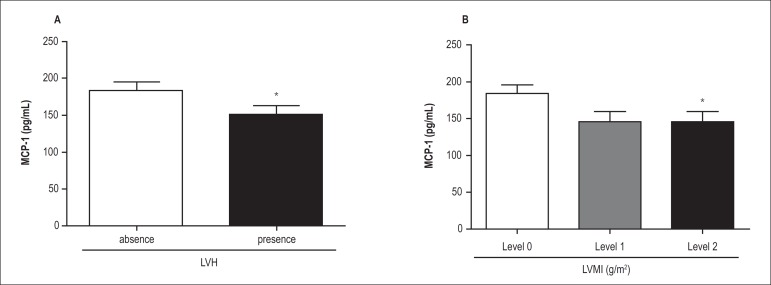
We found no difference in MCP-1 levels between RH and HTN subjects. On the other hand, we encountered lower MCP-1 levels in patients with LVH (105 pg/mL [100 - 260 pg/mL] versus 136 pg/mL (100 - 200 pg/mL), p = 0.005, respectively] compared with those without LVH. A logistic regression model adjusted for body mass index (BMI), age, race, aldosterone levels, and presence of diabetes and RH demonstrated that median levels of MCP-1 (2.55 pg/mL [1.22 - 5.2 pg/mL], p = 0.01) were independently associated with LVH in the entire hypertensive population.
Since MCP-1 levels were similar in both RH and HTN subjects and decreased in hypertensive patients with existing LVH, our study suggests a possible downregulation in MCP-1 levels in hypertensive individuals with LVH, regardless of hypertension strata.
高血压是一种慢性低度炎症过程,与细胞因子的释放和靶器官损伤的发展相关。单核细胞趋化蛋白-1(MCP-1)水平失调与高血压及心血管并发症有关;然而,其中涉及的机制复杂且尚未完全明确。
本研究旨在比较顽固性高血压(RH)患者与轻度至中度高血压(HTN)患者的MCP-1水平,以及在所有高血压患者中其与左心室肥厚(LVH)存在与否的关联。
我们纳入了256名高血压患者:120名RH患者和136名HTN患者,研究RH组和HTN组中循环MCP-1水平与血压、生化数据、血液学指标及心脏损伤之间的关系。采用酶联免疫吸附测定法(ELISA)测量血浆MCP-1水平,通过超声心动图评估LVH。
我们发现RH组和HTN组患者的MCP-1水平无差异。另一方面,与无LVH的患者相比,LVH患者的MCP-1水平较低(分别为105 pg/mL [100 - 260 pg/mL] 和136 pg/mL [100 - 200 pg/mL],p = 0.005)。一个经体重指数(BMI)、年龄、种族、醛固酮水平、糖尿病及RH校正的逻辑回归模型显示,在整个高血压人群中,MCP-1的中位数水平(2.55 pg/mL [1.22 - 5.2 pg/mL],p = 0.01)与LVH独立相关。
由于RH组和HTN组患者的MCP-1水平相似,且在已有LVH的高血压患者中MCP-1水平降低,我们的研究表明,无论高血压分层如何,LVH高血压个体的MCP-1水平可能下调。