Yi Fei, Guo Jia, Dabbagh Deemah, Spear Mark, He Sijia, Kehn-Hall Kylene, Fontenot Jacque, Yin Yan, Bibian Mathieu, Park Chul Min, Zheng Ke, Park Ha Jeung, Soloveva Veronica, Gharaibeh Dima, Retterer Cary, Zamani Rouzbeh, Pitt Margaret L, Naughton John, Jiang Yongjun, Shang Hong, Hakami Ramin M, Ling Binhua, Young John A T, Bavari Sina, Xu Xuehua, Feng Yangbo, Wu Yuntao
National Center for Biodefense and Infectious Diseases, George Mason University, Manassas, Virginia, USA.
Department of Laboratory Medicine, China Medical University, Shenyang, China.
J Virol. 2017 Jun 9;91(13). doi: 10.1128/JVI.02418-16. Print 2017 Jul 1.
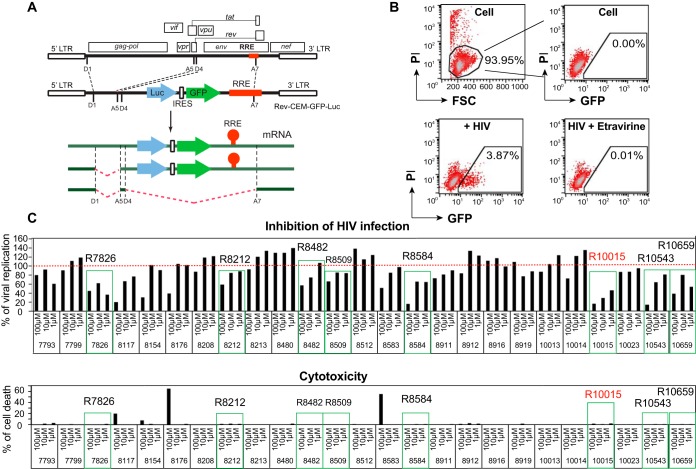
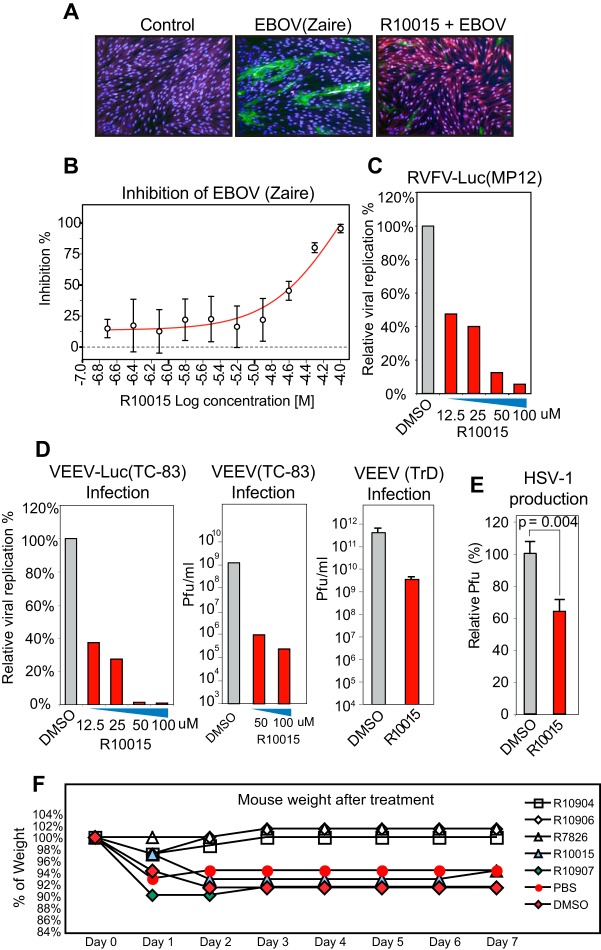
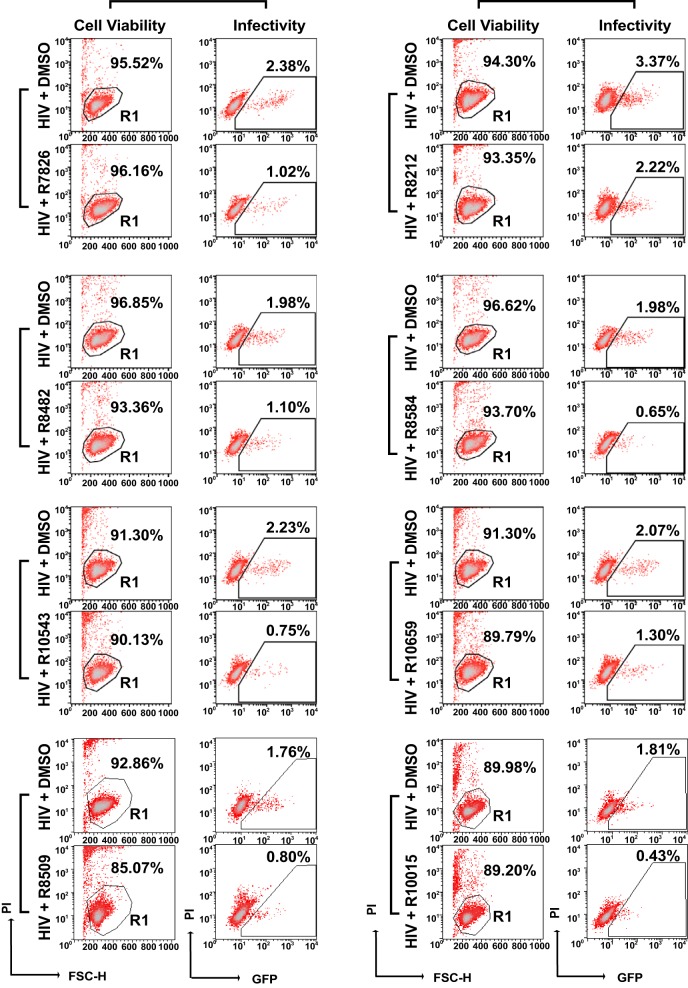
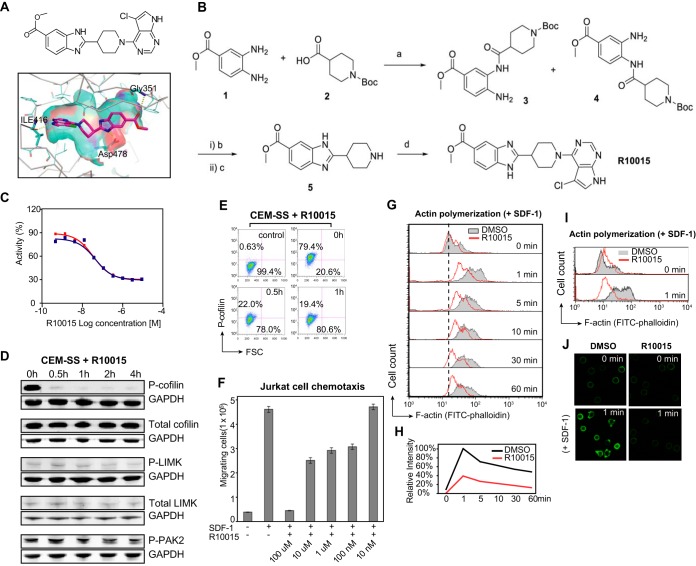
A dynamic actin cytoskeleton is necessary for viral entry, intracellular migration, and virion release. For HIV-1 infection, during entry, the virus triggers early actin activity by hijacking chemokine coreceptor signaling, which activates a host dependency factor, cofilin, and its kinase, the LIM domain kinase (LIMK). Although knockdown of human LIM domain kinase 1 (LIMK1) with short hairpin RNA (shRNA) inhibits HIV infection, no specific small-molecule inhibitor of LIMK has been available. Here, we describe the design and discovery of novel classes of small-molecule inhibitors of LIMK for inhibiting HIV infection. We identified R10015 as a lead compound that blocks LIMK activity by binding to the ATP-binding pocket. R10015 specifically blocks viral DNA synthesis, nuclear migration, and virion release. In addition, R10015 inhibits multiple viruses, including Zaire ebolavirus (EBOV), Rift Valley fever virus (RVFV), Venezuelan equine encephalitis virus (VEEV), and herpes simplex virus 1 (HSV-1), suggesting that LIMK inhibitors could be developed as a new class of broad-spectrum antiviral drugs. The actin cytoskeleton is a structure that gives the cell shape and the ability to migrate. Viruses frequently rely on actin dynamics for entry and intracellular migration. In cells, actin dynamics are regulated by kinases, such as the LIM domain kinase (LIMK), which regulates actin activity through phosphorylation of cofilin, an actin-depolymerizing factor. Recent studies have found that LIMK/cofilin are targeted by viruses such as HIV-1 for propelling viral intracellular migration. Although inhibiting LIMK1 expression blocks HIV-1 infection, no highly specific LIMK inhibitor is available. This study describes the design, medicinal synthesis, and discovery of small-molecule LIMK inhibitors for blocking HIV-1 and several other viruses and emphasizes the feasibility of developing LIMK inhibitors as broad-spectrum antiviral drugs.
动态肌动蛋白细胞骨架对于病毒进入、细胞内迁移和病毒粒子释放是必需的。对于HIV-1感染,在进入过程中,病毒通过劫持趋化因子共受体信号传导来触发早期肌动蛋白活性,这会激活宿主依赖性因子丝切蛋白及其激酶——LIM结构域激酶(LIMK)。虽然用短发夹RNA(shRNA)敲低人LIM结构域激酶1(LIMK1)可抑制HIV感染,但尚无LIMK的特异性小分子抑制剂。在此,我们描述了用于抑制HIV感染的新型LIMK小分子抑制剂的设计与发现。我们确定R10015为一种先导化合物,它通过与ATP结合口袋结合来阻断LIMK活性。R10015特异性地阻断病毒DNA合成、核迁移和病毒粒子释放。此外,R10015可抑制多种病毒,包括扎伊尔埃博拉病毒(EBOV)、裂谷热病毒(RVFV)、委内瑞拉马脑炎病毒(VEEV)和单纯疱疹病毒1型(HSV-1),这表明LIMK抑制剂可被开发为一类新型广谱抗病毒药物。肌动蛋白细胞骨架是一种赋予细胞形状和迁移能力的结构。病毒经常依赖肌动蛋白动力学来进入细胞和进行细胞内迁移。在细胞中,肌动蛋白动力学受激酶调节,如LIM结构域激酶(LIMK),它通过磷酸化肌动蛋白解聚因子丝切蛋白来调节肌动蛋白活性。最近的研究发现,LIMK/丝切蛋白被HIV-1等病毒靶向,以推动病毒在细胞内的迁移。虽然抑制LIMK1表达可阻断HIV-1感染,但尚无高度特异性的LIMK抑制剂。本研究描述了用于阻断HIV-1和其他几种病毒的小分子LIMK抑制剂的设计、药物合成及发现,并强调了开发LIMK抑制剂作为广谱抗病毒药物的可行性。