Wu Junlong, Wan Fangning, Sheng Haoyue, Shi Guohai, Shen Yijun, Lin Guowen, Dai Bo, Zhu Yiping, Ye Dingwei
Department of Urology, Fudan University Shanghai Cancer Center, Shanghai, 200032, China;; Department of Oncology, Shanghai Medical College, Fudan University, Shanghai, China.
J Cancer. 2017 Mar 7;8(5):852-860. doi: 10.7150/jca.17845. eCollection 2017.
Nuclear receptors (NRs) are a class of transcription factors that regulate many cellular functions through manipulation of gene expression and also play important roles in tumorigenesis, proliferation, progression and prognosis in various kinds of cancers according to recent studies. This work aimed to determine the predictive ability of NRs in muscle-invasive bladder cancer (MIBC).
A total of 308 MIBC patients with complete clinicopathological and RNASeq data from The Cancer Genome Atlas (TCGA) cohort were collected for filtration. Genes showed clear correlations with overall survival (OS) and recurrence free survival (RFS) were further validated in 123 MIBC patients recruited consecutively from 2008 to 2012 in Fudan University Shanghai Cancer Center (FUSCC) cohort. Cox proportional hazards regression model and Kaplan-Meier plot were used to assess the relative factors.
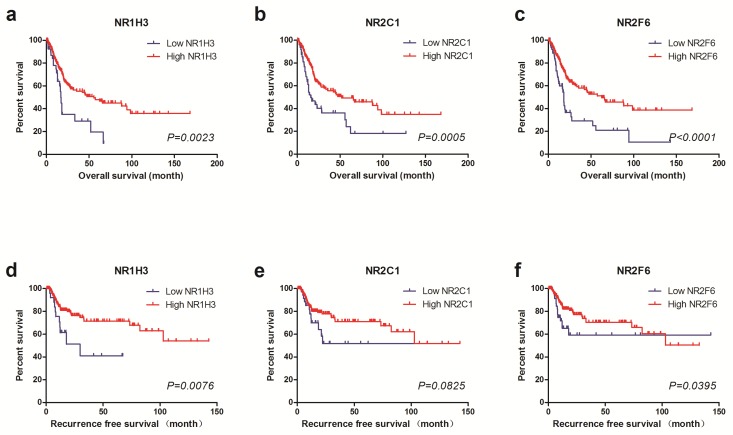
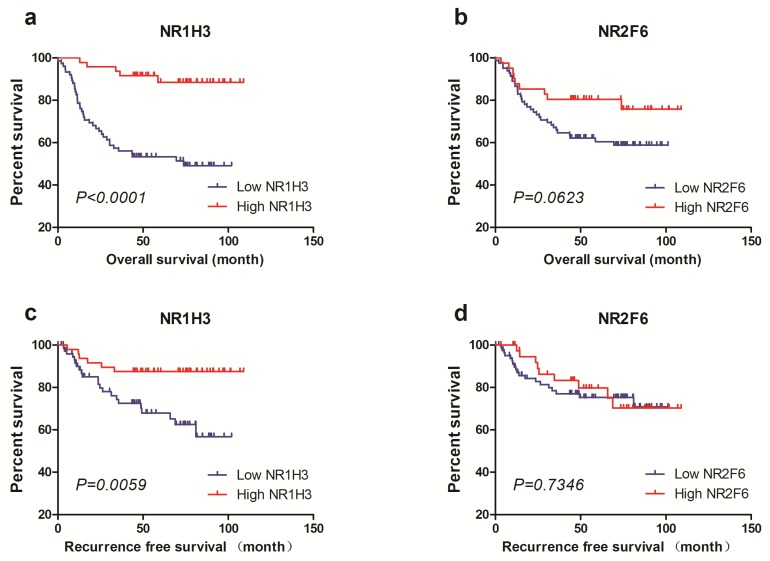
In TCGA cohort, we found that high NR1H3 (HR=0.779, 95% CI: 0.634 - 0.957), NR2C1 (HR=0.673, 95% CI: 0.458 - 0.989) and NR2F6 (HR=0.750, 95% CI: 0.574 - 0.980) expressions were independent factors of favorable OS, while only low NR1H3 (log-rank test, P=0.0076) and NR2F6 (log-rank test, P=0.0395) expressions had the ability to predict poor prognosis for RFS. Further, in FUSCC validating cohort, we confirmed that low NR1H3 expression level was independent factor of poor OS (HR=1.295, 95% CI: 1.064 - 1.576) and it had the ability to predict poor RFS (log-rank test, P=0.0059).
Low NR1H3 expression level is an independent prognostic factor of poor OS, and can also predict worse RFS in MIBC patients. Our "TCGA filtrating and local database validating" model can help reveal more prognostic biomarkers and cast a new light in understanding certain gene function in MIBC.
核受体(NRs)是一类转录因子,通过操纵基因表达来调节多种细胞功能,并且根据最近的研究,在各种癌症的肿瘤发生、增殖、进展和预后中也发挥着重要作用。这项工作旨在确定核受体在肌肉浸润性膀胱癌(MIBC)中的预测能力。
收集了来自癌症基因组图谱(TCGA)队列的308例具有完整临床病理和RNA测序数据的MIBC患者进行筛选。对在2008年至2012年期间从复旦大学附属肿瘤医院(FUSCC)队列中连续招募的123例MIBC患者进一步验证与总生存期(OS)和无复发生存期(RFS)有明确相关性的基因。采用Cox比例风险回归模型和Kaplan-Meier曲线来评估相关因素。
在TCGA队列中,我们发现高NR1H3(HR = 0.779,95% CI:0.634 - 0.957)、NR2C1(HR = 0.673,95% CI:0.458 - 0.989)和NR2F6(HR = 0.750,95% CI:0.574 - 0.980)表达是OS良好的独立因素,而只有低NR1H3(对数秩检验,P = 0.0076)和NR2F6(对数秩检验,P = 0.0395)表达具有预测RFS不良预后的能力。此外,在FUSCC验证队列中,我们证实低NR1H3表达水平是OS不良的独立因素(HR = 1.295,95% CI:1.064 - 1.576),并且它具有预测RFS不良的能力(对数秩检验,P = 0.0059)。
低NR1H3表达水平是MIBC患者OS不良的独立预后因素,并且还可以预测更差的RFS。我们的“TCGA筛选和本地数据库验证”模型有助于揭示更多预后生物标志物,并为理解MIBC中某些基因功能提供新的思路。