Nyfløt Lill Trine, Stray-Pedersen Babill, Forsén Lisa, Vangen Siri
Division of Gynecology and Obstetrics, Oslo University Hospital, Oslo, Norway.
Institute of Clinical Medicine, Faculty of Medicine, University of Oslo, Oslo, Norway.
PLoS One. 2017 Apr 6;12(4):e0175306. doi: 10.1371/journal.pone.0175306. eCollection 2017.
Our main objective was to investigate the association between duration of active labor and severe postpartum hemorrhage. We examined the effect of the total duration of active labor, the effect of each stage of active labor, and the gradient effect of duration of labor on severe postpartum hemorrhage.
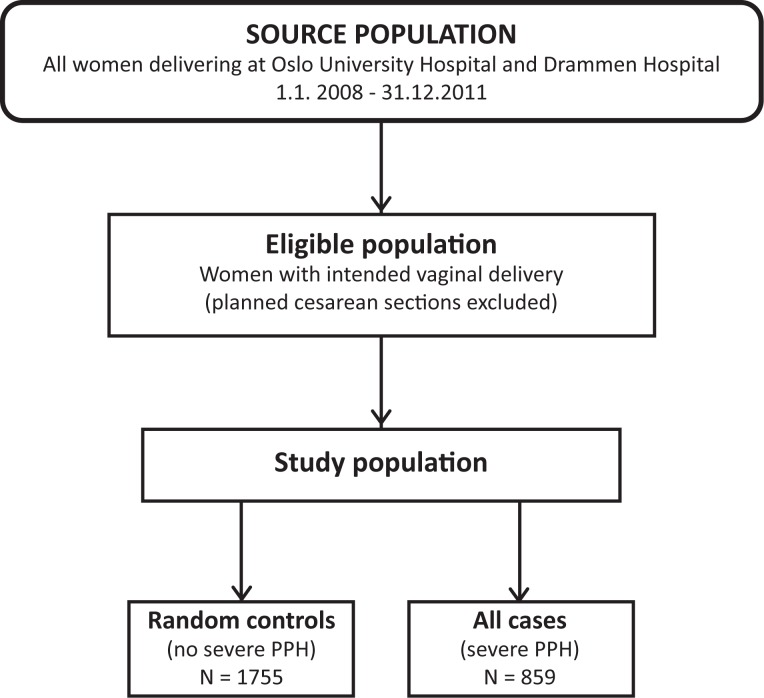
A case-control study was generated from a source population of all women admitted for delivery at Oslo University Hospital and Drammen Hospital in Buskerud municipality during the time period January 1, 2008 to December 31, 2011. The study population included all cases of severe postpartum hemorrhage (n = 859) and a random sample of controls (n = 1755). Severe postpartum hemorrhage was defined as postpartum blood loss ≥1500 mL or need for blood transfusion. Prolonged labor was defined as duration of active labor >12 hours according to the definition of the World Health Organization. We used logistic multivariable regression in the analysis.
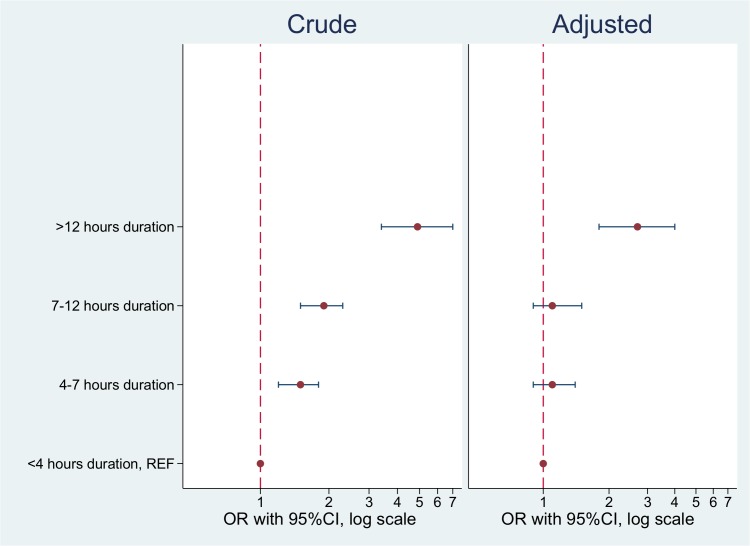
We observed a significantly longer mean duration of labor in women who experienced severe postpartum hemorrhage compared to controls (5.4 versus 3.8 hours, p<0.001). Women with severe postpartum hemorrhage also had a longer duration of all stages of active labor compared to controls. The association between the duration of active labor and severe postpartum changed from a linear dose-response association to a threshold association after adjusting for augmentation with oxytocin, induction of labor, primiparity, and fever during labor. Compared to controls, women with severe postpartum hemorrhage were more likely to have a prolonged labor >12 hours (adjusted odds ratio = 2.44, 95% confidence interval: 1.69-3.53, p< 0.001).
Prolonged active labor (duration >12 hours) was associated with severe postpartum hemorrhage. Increased vigilance seems required when the labor is prolonged to reduce the risk of severe postpartum hemorrhage.
我们的主要目的是研究活跃期分娩时长与严重产后出血之间的关联。我们考察了活跃期分娩总时长的影响、活跃期各阶段的影响以及分娩时长的梯度效应与严重产后出血的关系。
一项病例对照研究来自于2008年1月1日至2011年12月31日期间在布斯克吕德郡奥斯陆大学医院和德拉门医院住院分娩的所有女性这一源人群。研究人群包括所有严重产后出血病例(n = 859)以及对照组的随机样本(n = 1755)。严重产后出血定义为产后失血≥1500 mL或需要输血。根据世界卫生组织的定义,产程延长定义为活跃期分娩时长>12小时。我们在分析中使用了逻辑多变量回归。
我们观察到,与对照组相比,经历严重产后出血的女性平均分娩时长显著更长(5.4小时对3.8小时,p<0.001)。与对照组相比,严重产后出血的女性活跃期各阶段的时长也更长。在调整了缩宫素加强、引产、初产和分娩期间发热因素后,活跃期分娩时长与严重产后出血之间的关联从线性剂量反应关联变为阈值关联。与对照组相比,严重产后出血的女性更有可能产程延长>12小时(调整后的优势比 = 2.44,95%置信区间:1.69 - 3.53,p<0.001)。
活跃期分娩延长(时长>12小时)与严重产后出血相关。当产程延长时,似乎需要提高警惕以降低严重产后出血的风险。