Yu Jianping, Xiong Haiyan, Zhu Xiaoyang, Zhang Hongliang, Li Huihui, Miao Jinli, Wang Wensheng, Tang Zuoshun, Zhang Zhanying, Yao Guoxin, Zhang Qiang, Pan Yinghua, Wang Xin, Rashid M A R, Li Jinjie, Gao Yongming, Li Zhikang, Yang Weicai, Fu Xiangdong, Li Zichao
Key Laboratory of Crop Heterosis and Utilization, Ministry of Education/Beijing Key Laboratory of Crop Genetic Improvement, China Agricultural University, Beijing, 100193, China.
Institute of Crop Sciences, Chinese Academy of Agricultural Sciences, Beijing, China.
BMC Biol. 2017 Apr 6;15(1):28. doi: 10.1186/s12915-017-0365-7.
Most agronomic traits in rice are complex and polygenic. The identification of quantitative trait loci (QTL) for grain length is an important objective of rice genetic research and breeding programs.
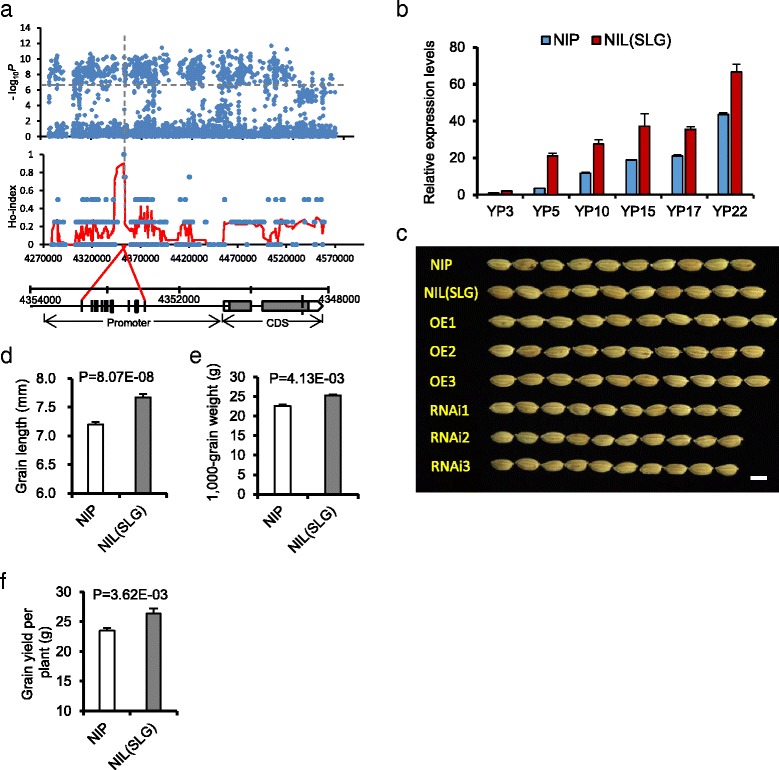
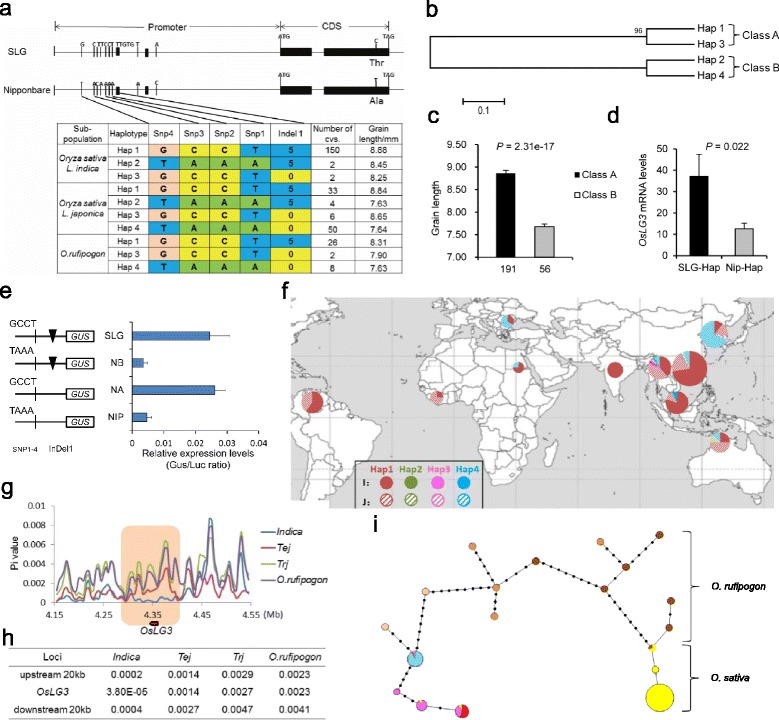
Herein, we identified 99 QTL for grain length by GWAS based on approximately 10 million single nucleotide polymorphisms from 504 cultivated rice accessions (Oryza sativa L.), 13 of which were validated by four linkage populations and 92 were new loci for grain length. We scanned the Ho (observed heterozygosity per locus) index of coupled-parents of crosses mapping the same QTL, based on linkage and association mapping, and identified two new genes for grain length. We named this approach as Ho-LAMap. A simulation study of six known genes showed that Ho-LAMap could mine genes rapidly across a wide range of experimental variables using deep-sequencing data. We used Ho-LAMap to clone a new gene, OsLG3, as a positive regulator of grain length, which could improve rice yield without influencing grain quality. Sequencing of the promoter region in 283 rice accessions from a wide geographic range identified four haplotypes that seem to be associated with grain length. Further analysis showed that OsLG3 alleles in the indica and japonica evolved independently from distinct ancestors and low nucleotide diversity of OsLG3 in indica indicated artificial selection. Phylogenetic analysis showed that OsLG3 might have much potential value for improvement of grain length in japonica breeding.
The results demonstrated that Ho-LAMap is a potential approach for gene discovery and OsLG3 is a promising gene to be utilized in genomic assisted breeding for rice cultivar improvement.
水稻的大多数农艺性状都是复杂的多基因性状。鉴定控制粒长的数量性状位点(QTL)是水稻遗传研究和育种计划的一个重要目标。
在此,我们基于来自504份栽培稻(Oryza sativa L.)的约1000万个单核苷酸多态性,通过全基因组关联研究(GWAS)鉴定出99个控制粒长的QTL,其中13个通过四个连锁群体得到验证,92个是粒长的新位点。我们基于连锁和关联图谱扫描了定位相同QTL的杂交组合中亲本品系的Ho(每个位点的观察杂合度)指数,并鉴定出两个控制粒长的新基因。我们将这种方法命名为Ho-LAMap。对六个已知基因的模拟研究表明,Ho-LAMap可以利用深度测序数据在广泛的实验变量范围内快速挖掘基因。我们使用Ho-LAMap克隆了一个新基因OsLG3,它是粒长的正向调控因子,可以在不影响稻米品质的情况下提高水稻产量。对来自广泛地理区域的283份水稻材料的启动子区域进行测序,鉴定出四种单倍型,它们似乎与粒长有关。进一步分析表明,籼稻和粳稻中的OsLG3等位基因从不同的祖先独立进化而来,籼稻中OsLG3的低核苷酸多样性表明受到了人工选择。系统发育分析表明,OsLG3在粳稻育种中对改善粒长可能具有很大的潜在价值。
结果表明,Ho-LAMap是一种潜在的基因发现方法,OsLG3是一个有望用于水稻品种改良的基因组辅助育种的基因。