Sun Emily W, de Fontgalland Dayan, Rabbitt Philippa, Hollington Paul, Sposato Luigi, Due Steven L, Wattchow David A, Rayner Christopher K, Deane Adam M, Young Richard L, Keating Damien J
Discipline of Human Physiology and Centre for Neuroscience, Flinders University, Adelaide, South Australia, Australia.
Discipline of Surgery, Flinders University, Adelaide, South Australia, Australia.
Diabetes. 2017 Aug;66(8):2144-2149. doi: 10.2337/db17-0058. Epub 2017 Apr 6.
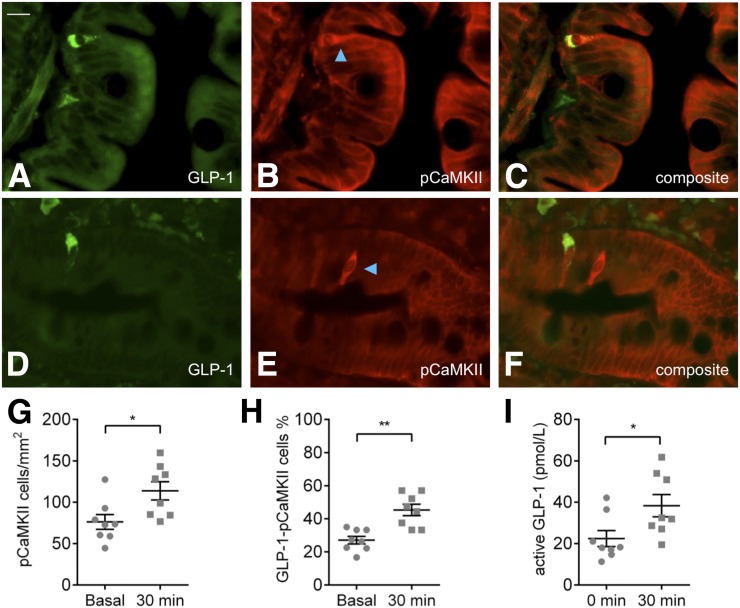
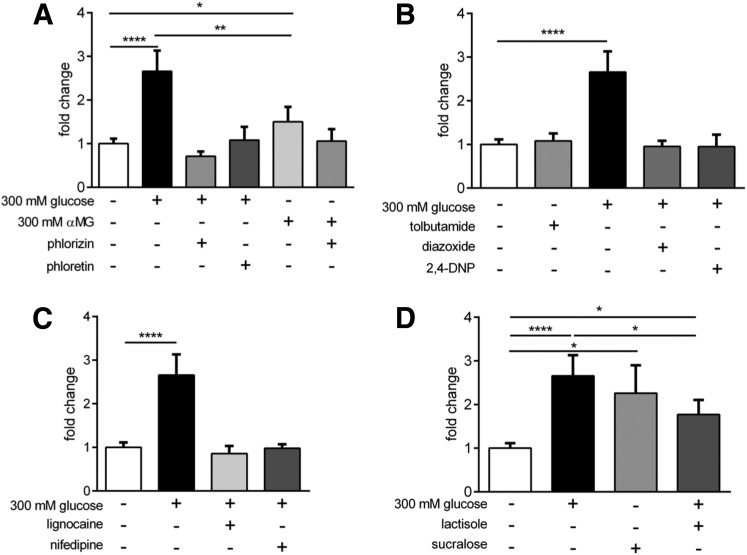
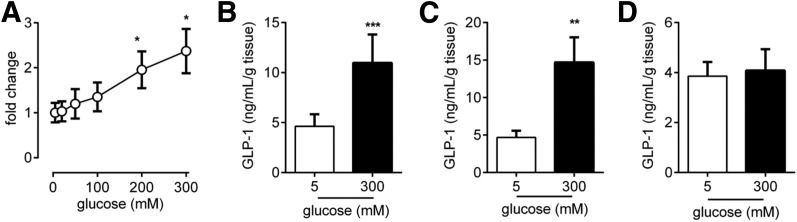
Intestinal glucose stimulates secretion of the incretin hormone glucagon-like peptide 1 (GLP-1). The mechanisms underlying this pathway have not been fully investigated in humans. In this study, we showed that a 30-min intraduodenal glucose infusion activated half of all duodenal L cells in humans. This infusion was sufficient to increase plasma GLP-1 levels. With an ex vivo model using human gut tissue specimens, we showed a dose-responsive GLP-1 secretion in the ileum at ≥200 mmol/L glucose. In ex vivo tissue from the duodenum and ileum, but not the colon, 300 mmol/L glucose potently stimulated GLP-1 release. In the ileum, this response was independent of osmotic influences and required delivery of glucose via GLUT2 and mitochondrial metabolism. The requirement of voltage-gated Na and Ca channel activation indicates that membrane depolarization occurs. K channels do not drive this, as tolbutamide did not trigger release. The sodium-glucose cotransporter 1 (SGLT1) substrate α-MG induced secretion, and the response was blocked by the SGLT1 inhibitor phlorizin or by replacement of extracellular Na with -methyl-d-glucamine. This is the first report of the mechanisms underlying glucose-induced GLP-1 secretion from human small intestine. Our findings demonstrate a dominant role of SGLT1 in controlling glucose-stimulated GLP-1 release in human ileal L cells.
肠道葡萄糖可刺激肠促胰岛素激素胰高血糖素样肽1(GLP-1)的分泌。该途径的潜在机制在人类中尚未得到充分研究。在本研究中,我们发现,30分钟的十二指肠内葡萄糖输注激活了人类所有十二指肠L细胞的一半。这种输注足以提高血浆GLP-1水平。利用人体肠道组织标本的离体模型,我们发现,在葡萄糖浓度≥200 mmol/L时,回肠中GLP-1的分泌呈剂量依赖性。在十二指肠和回肠而非结肠的离体组织中,300 mmol/L的葡萄糖能有效刺激GLP-1释放。在回肠中,这种反应与渗透影响无关,且需要通过GLUT2转运葡萄糖并进行线粒体代谢。电压门控钠通道和钙通道的激活表明发生了膜去极化。钾通道并不驱动这种情况,因为甲苯磺丁脲不会触发释放。钠-葡萄糖协同转运蛋白1(SGLT1)的底物α-甲基葡萄糖诱导分泌,且该反应被SGLT1抑制剂根皮苷或用甲基-d-葡糖胺替代细胞外钠所阻断。这是关于人类小肠葡萄糖诱导GLP-1分泌潜在机制的首次报道。我们的研究结果表明,SGLT1在控制人类回肠L细胞中葡萄糖刺激的GLP-1释放方面起主要作用。