Margolis Lee M, McClung Holly L, Murphy Nancy E, Carrigan Christopher T, Pasiakos Stefan M
Military Nutrition Division, US Army Research Institute of Environmental MedicineNatick, MA, USA; Oak Ridge Institute for Science and EducationOak Ridge, TN, USA.
Military Nutrition Division, US Army Research Institute of Environmental Medicine Natick, MA, USA.
Front Physiol. 2017 Mar 23;8:182. doi: 10.3389/fphys.2017.00182. eCollection 2017.
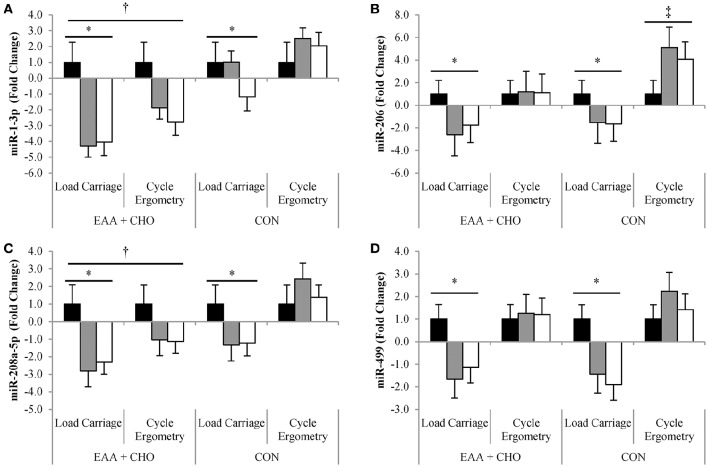
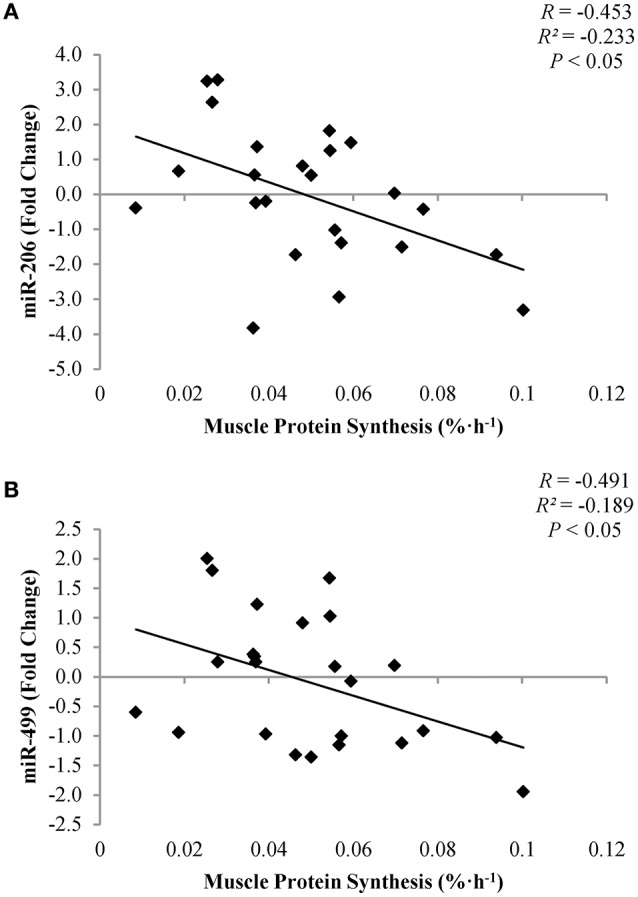
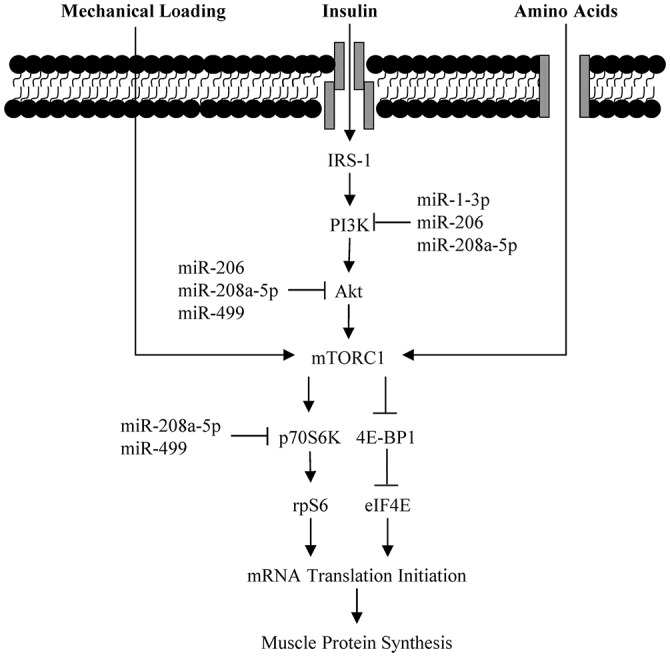
Skeletal muscle microRNAs (myomiR) expression is modulated by exercise, however, the influence of endurance exercise mode, combined with essential amino acid and carbohydrate (EAA+CHO) supplementation are not well defined. This study determined the effects of weighted versus non-weighted endurance exercise, with or without EAA+CHO ingestion on myomiR expression and their association with muscle protein synthesis (MPS). Twenty five adults performed 90 min of metabolically-matched (2.2 VO L·m) load carriage (LC; performed on a treadmill wearing a vest equal to 30% of individual body mass) or cycle ergometry (CE) exercise, during which EAA+CHO (10 g EAA and 46 g CHO) or non-nutritive control (CON) drinks were consumed. Expression of myomiR (RT-qPCR) were determined at rest (PRE), immediately post-exercise (POST), and 3 h into recovery (REC). Muscle protein synthesis (H-phenylalanine) was measured during exercise and recovery. Relative to PRE, POST, and REC expression of miR-1-3p, miR-206, miR-208a-5, and miR-499 was lower ( < 0.05) for LC compared to CE, regardless of dietary treatment. Independent of exercise mode, miR-1-3p and miR-208a-5p expression were lower ( < 0.05) after ingesting EAA+CHO compared to CON. Expression of miR-206 was highest for CE-CON than any other treatment (exercise-by-drink, < 0.05). Common targets of differing myomiR were identified as markers within mTORC1 signaling, and miR-206 and miR-499 were inversely associated with MPS rates immediately post-exercise. These findings suggest the alterations in myomiR expression between exercise mode and EAA+CHO intake may in part be due to differing MPS modulation immediately post-exercise.
骨骼肌微小RNA(myomiR)的表达受运动调节,然而,耐力运动模式以及必需氨基酸和碳水化合物(EAA+CHO)补充剂的影响尚不清楚。本研究确定了负重与非负重耐力运动,以及摄入或不摄入EAA+CHO对myomiR表达的影响及其与肌肉蛋白质合成(MPS)的关联。25名成年人进行了90分钟代谢匹配(2.2 VO₂L·min⁻¹)的负重行走(LC;在跑步机上穿着相当于个体体重30%的背心进行)或自行车测功(CE)运动,期间饮用EAA+CHO(10克EAA和46克CHO)或无营养对照(CON)饮料。在运动前(PRE)、运动后即刻(POST)和恢复3小时(REC)测定myomiR(RT-qPCR)的表达。在运动和恢复期间测量肌肉蛋白质合成(³H-苯丙氨酸)。与PRE相比,无论饮食处理如何,LC组运动后即刻(POST)和恢复3小时(REC)时miR-1-3p、miR-206、miR-208a-5p和miR-499的表达均低于CE组(P<0.05)。与运动模式无关,摄入EAA+CHO后,miR-1-3p和miR-208a-5p的表达低于CON组(P<0.05)。CE-CON组的miR-206表达高于其他任何处理组(运动×饮料,P<0.05)。不同myomiR的共同靶点被确定为mTORC1信号通路中的标志物,miR-206和miR-499与运动后即刻的MPS速率呈负相关。这些发现表明,运动模式和EAA+CHO摄入之间myomiR表达的变化可能部分归因于运动后即刻不同的MPS调节。