Epidemiology, Biostatistics and Prevention Institute, University of Zurich, Hirschengraben 84, 8001, Zurich, Switzerland.
Department of Internal Medicine and Nephrology, Medizinisches Kompetenzzentrum für ADPKD, Suisse ADPKD, Hirslanden, Zurich, Switzerland.
J Nephrol. 2018 Feb;31(1):87-94. doi: 10.1007/s40620-017-0396-8. Epub 2017 Apr 6.
Previous in vitro experiments of human polycystic kidney disease (PKD) cells reported that caffeine is a risk factor for the promotion of cyst enlargement in patients with autosomal dominant PKD (ADPKD). The relentless progression of ADPKD inclines the majority of physicians to advocate minimization of caffeine consumption despite the absence of clinical data supporting such a recommendation so far. This is the first clinical study to assess prospectively the association between coffee consumption and disease progression in a longitudinal ADPKD cohort.
Information on coffee consumption and disease progression was collected at each follow-up visit using standardized measurement methods. The main model for the outcomes, kidney size (height-adjusted total kidney volume, htTKV) and kidney function (estimated glomerular filtration rate, eGFR), was a linear mixed model. Patients entered the on-going Swiss ADPKD study between 2006 and June 2014 and had at least 1 visit every year. The sample size of the study population was 151 with a median follow-up of 4 visits per patient and a median follow-up time of 4.38 years.
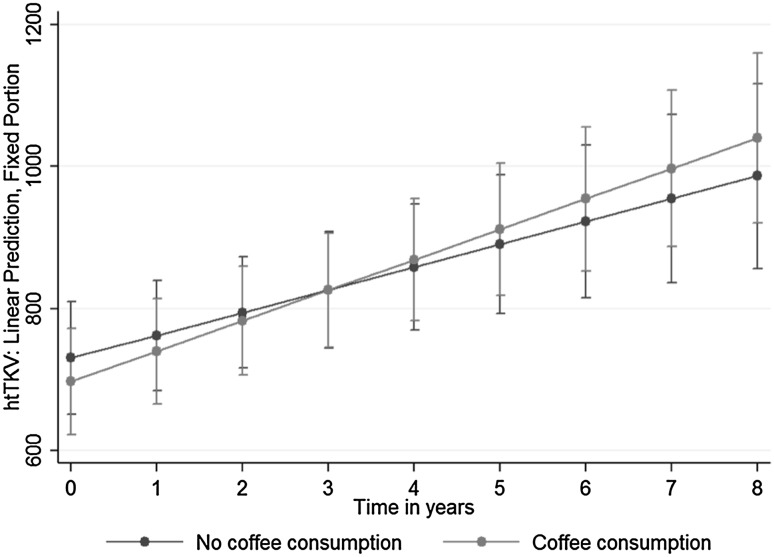
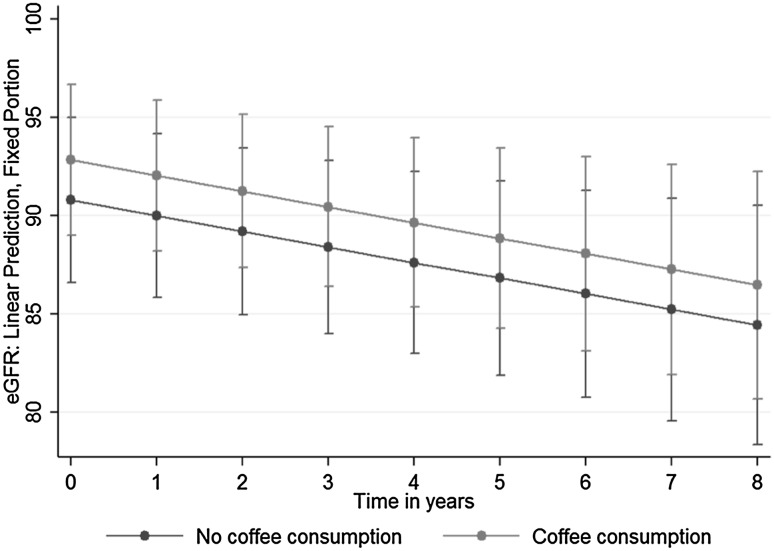
After multivariate adjustment for age, smoking, hypertension, sex, body mass index and an interaction term (coffee*visit), coffee drinkers did not have a statistically significantly different kidney size compared to non-coffee drinkers (difference of -33.03 cm height adjusted TKV, 95% confidence interval (CI) from -72.41 to 6.34, p = 0.10). After the same adjustment, there was no statistically significant difference in eGFR between coffee and non-coffee drinkers (2.03 ml/min/1.73 m, 95% CI from -0.31 to 4.31, p = 0.089).
Data derived from our prospective longitudinal study do not confirm that drinking coffee is a risk factor for ADPKD progression.
先前针对多囊肾病(PKD)患者的人源 PKD 细胞的体外实验表明,咖啡因是促进常染色体显性多囊肾病(ADPKD)患者囊肿增大的一个风险因素。ADPKD 的持续进展使大多数医生倾向于尽量减少咖啡因的摄入,尽管目前为止还没有临床数据支持这种建议。这是第一项前瞻性评估咖啡摄入与长程 ADPKD 队列中疾病进展之间关联的临床研究。
采用标准化的测量方法,在每次随访时收集关于咖啡摄入和疾病进展的信息。主要结局模型为肾脏大小(身高校正后的总肾体积,htTKV)和肾功能(估算肾小球滤过率,eGFR),采用线性混合模型。患者于 2006 年至 2014 年 6 月间进入正在进行的瑞士 ADPKD 研究,每年至少随访一次。研究人群样本量为 151 例,每位患者的中位随访次数为 4 次,中位随访时间为 4.38 年。
经过多变量调整,包括年龄、吸烟、高血压、性别、体重指数和咖啡*访视的交互项,与不喝咖啡者相比,咖啡饮用者的肾脏大小无统计学显著差异(身高校正 TKV 差值-33.03cm,95%置信区间(CI)为-72.41 至 6.34,p=0.10)。在进行相同的调整后,咖啡饮用者和不饮用者的 eGFR 无统计学显著差异(2.03ml/min/1.73m,95%CI 为-0.31 至 4.31,p=0.089)。
本前瞻性纵向研究的数据不支持喝咖啡是 ADPKD 进展的风险因素。