Department of Clinical Sciences Malmö, Lund University, Jan Waldenströms Gata 35 Malmö, 214 28 Malmo, Sweden.
Unit of Internal Medicine, Department of Medicine, University Hospital of Lausanne, Rue du Bugnon 21, 1011 Lausanne, Switzerland.
Nutrients. 2023 Oct 18;15(20):4422. doi: 10.3390/nu15204422.
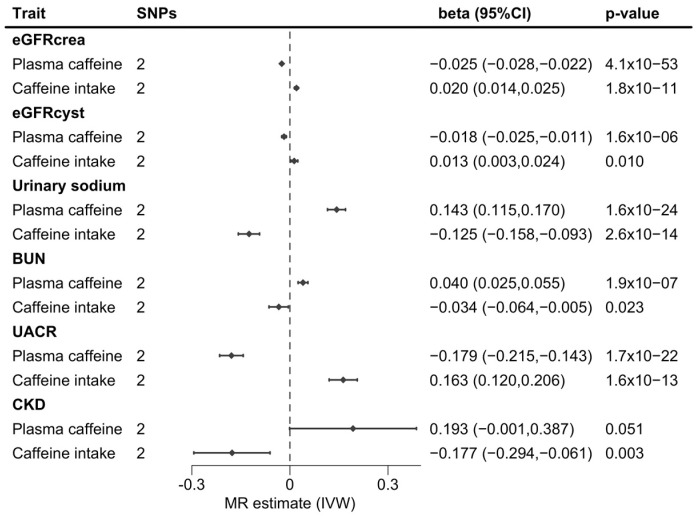
Caffeine is a psychoactive substance widely consumed worldwide, mainly via sources such as coffee and tea. The effects of caffeine on kidney function remain unclear. We leveraged the genetic variants in the and genes via the two-sample Mendelian randomization (MR) framework to estimate the association of genetically predicted plasma caffeine and caffeine intake on kidney traits. Genetic association summary statistics on plasma caffeine levels and caffeine intake were taken from genome-wide association study (GWAS) meta-analyses of 9876 and of >47,000 European ancestry individuals, respectively. Genetically predicted plasma caffeine levels were associated with a decrease in estimated glomerular filtration rate (eGFR) measured using either creatinine or cystatin C. In contrast, genetically predicted caffeine intake was associated with an increase in eGFR and a low risk of chronic kidney disease. The discrepancy is likely attributable to faster metabolizers of caffeine consuming more caffeine-containing beverages to achieve the same pharmacological effect. Further research is needed to distinguish whether the observed effects on kidney function are driven by the harmful effects of higher plasma caffeine levels or the protective effects of greater intake of caffeine-containing beverages, particularly given the widespread use of drinks containing caffeine and the increasing burden of kidney disease.
咖啡因是一种广泛存在于世界各地的精神活性物质,主要来源于咖啡和茶等饮品。目前,咖啡因对肾功能的影响仍不明确。本研究利用 和 基因中的遗传变异,通过两样本孟德尔随机化(MR)框架,评估了遗传预测的血浆咖啡因和咖啡因摄入量与肾脏特征之间的关联。血浆咖啡因水平和咖啡因摄入量的遗传关联汇总统计数据分别来自对 9876 名欧洲血统个体和超过 47000 名个体的全基因组关联研究(GWAS)荟萃分析。遗传预测的血浆咖啡因水平与使用肌酐或胱抑素 C 测量的估算肾小球滤过率(eGFR)降低相关。相比之下,遗传预测的咖啡因摄入量与 eGFR 升高和慢性肾脏病风险降低相关。这种差异可能归因于咖啡因代谢较快的人群为了达到相同的药理效果而摄入更多含咖啡因的饮料。鉴于含咖啡因饮料的广泛使用以及肾脏疾病负担的增加,有必要进一步研究以区分对肾功能的观察到的影响是由更高的血浆咖啡因水平的有害影响还是更多摄入含咖啡因饮料的保护作用所驱动。