Wigby Kristen, Twigg Stephen R F, Broderick Ryan, Davenport Katherine P, Wilkie Andrew O M, Bickler Stephen W, Jones Marilyn C
Department of Pediatrics, University of California San Diego and Rady Children's Hospital - San Diego, San Diego, California.
Clinical Genetics Group, Weatherall Institute of Molecular Medicine, University of Oxford, Oxford, UK.
Am J Med Genet A. 2017 Jun;173(6):1586-1592. doi: 10.1002/ajmg.a.38232. Epub 2017 Apr 6.
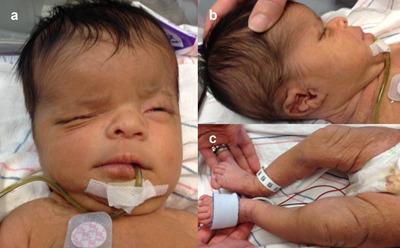
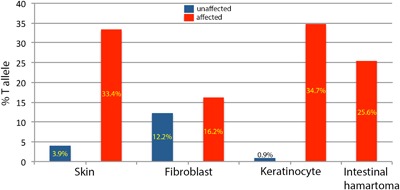
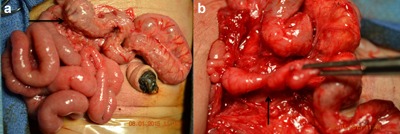
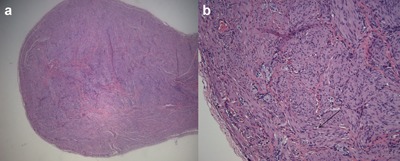
Curry-Jones syndrome (CJS) is a pattern of malformation that includes craniosynostosis, pre-axial polysyndactyly, agenesis of the corpus callosum, cutaneous and gastrointestinal abnormalities. A recurrent, mosaic mutation of SMO (c.1234 C>T; p.Leu412Phe) causes CJS. This report describes the gastrointestinal and surgical findings in a baby with CJS who presented with abdominal obstruction and reviews the spectrum of gastrointestinal malformations in this rare disorder. A 41-week, 4,165 g, female presented with craniosynostosis, pre-axial polysyndactyly, and cutaneous findings consistent with a clinical diagnosis of CJS. The infant developed abdominal distension beginning on the second day of life. Surgical exploration revealed an intestinal malrotation for which she underwent a Ladd procedure. Multiple small nodules were found on the surface of the small and large bowel in addition to an apparent intestinal duplication that seemed to originate posterior to the pancreas. Histopathology of serosal nodules revealed bundles of smooth muscle with associated ganglion cells. Molecular analysis demonstrated the SMO c.1234 C>T mutation in varying amounts in affected skin (up to 35%) and intestinal hamartoma (26%). Gastrointestinal features including structural malformations, motility disorders, and upper GI bleeding are major causes of morbidity in CJS. Smooth muscle hamartomas are a recognized feature of children with CJS typically presenting with abdominal obstruction requiring surgical intervention. A somatic mutation in SMO likely accounts for the structural malformations and predisposition to form bowel hamartomas and myofibromas. The mutation burden in the involved tissues likely accounts for the variable manifestations.
库里-琼斯综合征(CJS)是一种畸形模式,包括颅缝早闭、轴前多指畸形、胼胝体发育不全、皮肤和胃肠道异常。SMO基因的复发性嵌合突变(c.1234 C>T;p.Leu412Phe)导致CJS。本报告描述了一名患有CJS的婴儿出现肠梗阻时的胃肠道和手术发现,并回顾了这种罕见疾病中胃肠道畸形的范围。一名41周、体重4165克的女婴出现颅缝早闭、轴前多指畸形以及与CJS临床诊断相符的皮肤表现。婴儿在出生第二天开始出现腹胀。手术探查发现肠道旋转不良,为此她接受了Ladd手术。除了明显的似乎起源于胰腺后方的肠道重复畸形外,在小肠和大肠表面还发现了多个小结节。浆膜下结节的组织病理学显示有平滑肌束和相关的神经节细胞。分子分析表明,在受影响的皮肤(高达35%)和肠道错构瘤(26%)中存在不同数量的SMO基因c.1234 C>T突变。包括结构畸形、运动障碍和上消化道出血在内的胃肠道特征是CJS发病的主要原因。平滑肌错构瘤是CJS患儿的一个公认特征,通常表现为需要手术干预的肠梗阻。SMO基因的体细胞突变可能是导致结构畸形以及易形成肠道错构瘤和肌纤维瘤的原因。受累组织中的突变负荷可能是导致表现各异的原因。