Chebouti Issam, Kuhlmann Jan Dominik, Buderath Paul, Weber Stephan, Wimberger Pauline, Bokeloh Yvonne, Hauch Siegfried, Kimmig Rainer, Kasimir-Bauer Sabine
Department of Gynecology and Obstetrics, University Hospital Essen, Essen, Germany.
German Cancer Consortium (DKTK), Dresden and German Cancer Research Center (DKFZ), Heidelberg, Germany.
Oncotarget. 2017 Apr 11;8(15):24303-24313. doi: 10.18632/oncotarget.13286.
We recently showed that the presence of ERCC1+CTCs is an independent predictive biomarker for platinum-resistance and poor prognosis of ovarian cancer. The goal of our current research was to determine how the auxiliary assessment of ERCC1-transcripts influences overall CTC-detection rate. We extended this investigation from an initially predictive setting to paired pre- and post-therapeutic blood analysis in order to see, whether ERCC1+CTCs dynamics mirror response to chemotherapy.
65 Paired blood samples (10ml) of primary ovarian cancer patients at primary diagnosis and after chemotherapy were studied for CTCs with the AdnaTest Ovarian Cancer (QIAGEN Hannover GmbH). We analyzed the tumor-associated transcripts EpCAM, MUC-1 and CA-125. ERCC1-transcripts were investigated in a separate approach by singleplex RT-PCR.
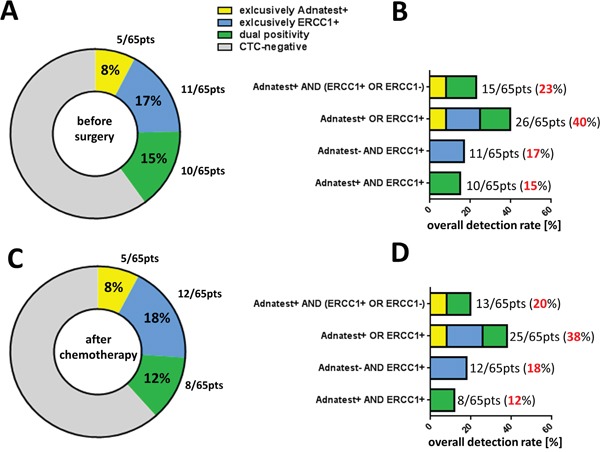
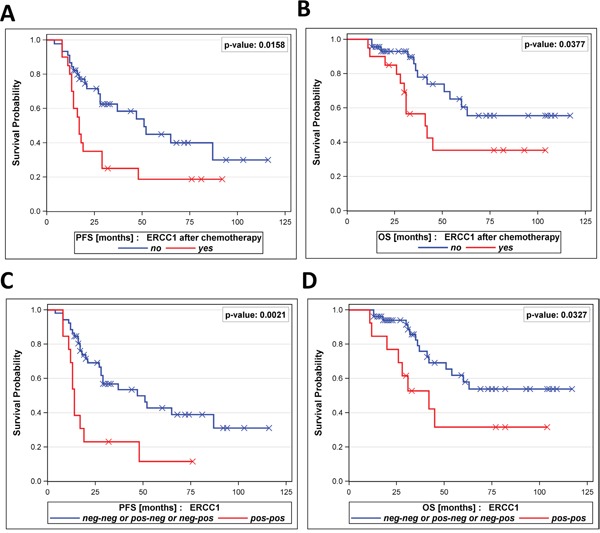
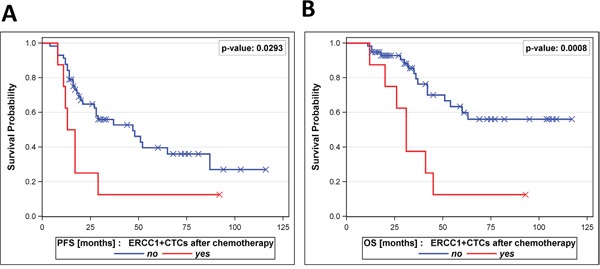
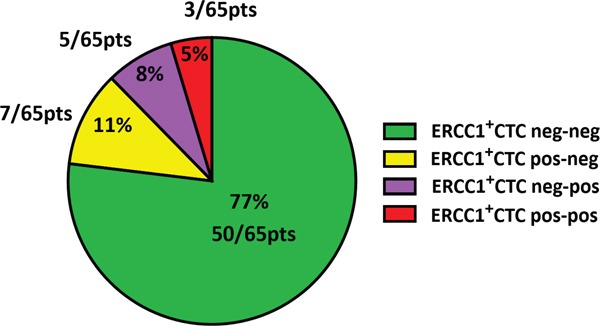
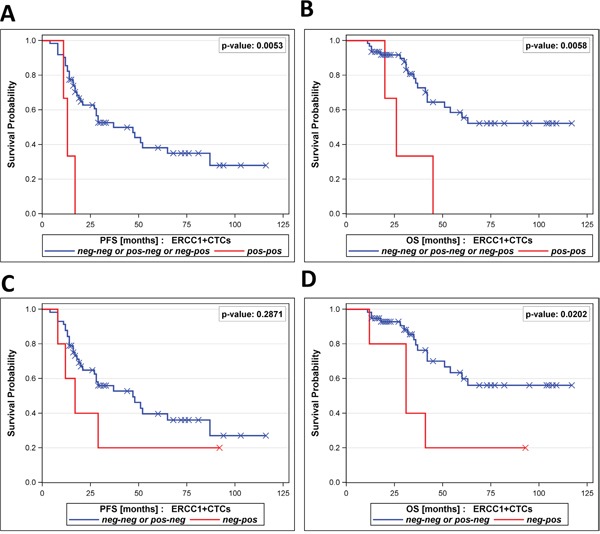
Auxiliary assessment of ERCC1-transcripts enhanced the overall CTC-detection rate up to 17%. ERCC1+CTCs (defined as positive for one of the AdnaTest markers plus ERCC1-positivity) were detected in 15% of patients at primary diagnosis and in 12% after chemotherapy. The presence of ERCC1+CTCs after chemotherapy correlated with platinum-resistance (P=0.01), reduced PFS (P=0.0293) and OS (P=0.0008) and their persistence indicated poor post-therapeutic outcome (PFS: P=0.005; OS: P=0.0058). Interestingly, the assessment of ERCC1-transcripts alone was sufficient for the detection of prognostic relevant ERCC1-expressing CTCs.
Auxiliary assessment of ERCC1-transcripts expands the phenotypic spectrum of CTC detection and defines an additional overlapping fraction of ERCC1-expressing CTCs, which are potentially selected by platinum-based chemotherapy. Specifically, we suggest that ERCC1+CTCs could additionally be useful as a surrogate for monitoring platinum-based chemotherapy and to assess the post-therapeutic outcome of ovarian cancer.
我们最近发现,ERCC1阳性循环肿瘤细胞(CTCs)的存在是卵巢癌铂耐药和预后不良的独立预测生物标志物。我们当前研究的目的是确定ERCC1转录本的辅助评估如何影响总体CTCs检测率。我们将这项研究从最初的预测性研究扩展到治疗前后配对血液分析,以观察ERCC1阳性CTCs的动态变化是否反映对化疗的反应。
采用AdnaTest卵巢癌检测试剂盒(QIAGEN汉诺威有限公司)对65例原发性卵巢癌患者初诊时及化疗后的配对血样(10ml)进行CTCs检测。我们分析了肿瘤相关转录本EpCAM、MUC-1和CA-125。通过单重逆转录聚合酶链反应(RT-PCR)以单独的方法研究ERCC1转录本。
ERCC1转录本的辅助评估使总体CTCs检测率提高了17%。初诊时15%的患者检测到ERCC1阳性CTCs(定义为AdnaTest标志物之一阳性加ERCC1阳性),化疗后为12%。化疗后ERCC1阳性CTCs的存在与铂耐药相关(P=0.01),无进展生存期(PFS)缩短(P=0.0293),总生存期(OS)缩短(P=0.0008),其持续存在表明治疗后预后不良(PFS:P=0.0