Hou Xiaobin, Wen Jiaxin, Ren Zhipeng, Zhang Guoliang
Department of Thoracic Surgery, PLA General Hospital, Beijing, China.
Medical Science Weekly, Beijing, China.
Oncotarget. 2017 Jun 27;8(26):43571-43578. doi: 10.18632/oncotarget.16721.
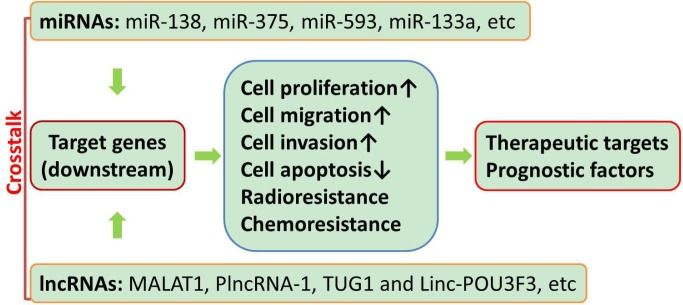
Esophageal cancer is one of the most common gastrointestinal malignant diseases and there is still no effective treatment. The incidence of esophageal cancer in the world is relatively high and on the increase year by year. Thus, the elaboration on the carcinogenesis of esophageal cancer and the identification of new biomarkers and therapeutic targets is quite beneficial to optimizing the current therapeutic regimen for treating such deadly disease. More and more evidence has shown that non-coding RNAs play an important role in the development and progression of multiple human cancers, including esophageal cancer. microRNAs (miRNAs) and long non-coding RNAs (lncRNAs) are two functional kinds of non-coding RNAs that have been well investigated. They exert tumor suppressive or promoting effect by specifically regulating the expression of certain downstream target genes, which is tumor specific. It is also proved that miRNAs and lncRNAs level in tissue and plasma from esophageal cancer patients are closely correlated with the survival and disease progression, which could be used as a prognostic factor and therapeutic target for esophageal cancer.
食管癌是最常见的胃肠道恶性疾病之一,目前仍缺乏有效的治疗方法。世界范围内食管癌的发病率相对较高且逐年上升。因此,深入研究食管癌的致癌机制并鉴定新的生物标志物和治疗靶点,对于优化当前治疗这种致命疾病的方案非常有益。越来越多的证据表明,非编码RNA在包括食管癌在内的多种人类癌症的发生和发展中发挥着重要作用。微小RNA(miRNA)和长链非编码RNA(lncRNA)是两类已得到充分研究的功能性非编码RNA。它们通过特异性调节某些下游靶基因的表达发挥抑癌或促癌作用,且具有肿瘤特异性。研究还证实,食管癌患者组织和血浆中的miRNA和lncRNA水平与生存及疾病进展密切相关,可作为食管癌的预后因素和治疗靶点。