Department of Medical Parasitology, Faculty of Medicine, Umm Al-Qura University, Makkah, Saudi Arabia.
Department of Medical Parasitology, Faculty of Medicine, El-Minia University, El-Minia, Egypt.
Parasit Vectors. 2017 Apr 7;10(1):174. doi: 10.1186/s13071-017-2114-8.
Blastocystis is a group of cosmopolitan gastrointestinal parasite of humans and a wide variety of animals. These anaerobic protozoans include more than 17 specific small-subunit ribosomal RNA subtypes, of which nine are found in humans with a variable geographical distribution. Until now, no study has described the Blastocystis subtypes present in Saudi Arabia.
In total, 1,262 faecal samples were collected from patients with gastrointestinal complaints and asymptomatic individuals visiting two major hospitals. All samples were analysed by F1/R1 diagnostic PCR, microscopy and culture methods. The subtypes of Blastocystis sp. isolates were determined by the sequenced-tagged site (STS)-based method.
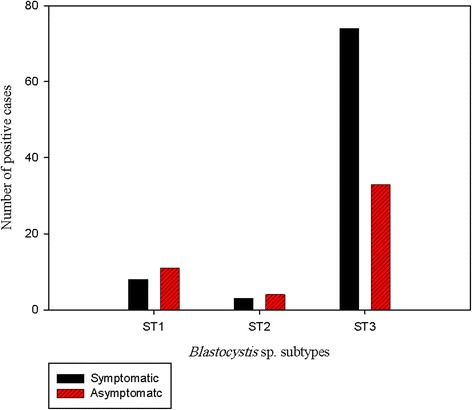
One-hundred-thirty-three positive cases were detected by F1/R1 diagnostic PCR, of which 122 were also positive by the culture method and 83 by direct microscopy. The sensitivities of direct microscopy and the culture method were 62% and 92%, respectively. Subtype (ST3) was the most prevalent (80.5%), followed by ST1 (14.5%) and ST2 (5%). ST4, ST5, ST6 and ST7 were not detected in this study. ST3 infections were significantly predominant (P < 0.05) among symptomatic patients.
To our knowledge, this study provides the first run-through information on Blastocystis sp. epidemiology in Makkah city, revealing a rather moderate prevalence of 10.5% and the presence of three subtypes, ST1, ST2, and ST3. ST3 was the most predominant, particularly among symptomatic patients.
芽囊原虫是一组广泛存在于人类和多种动物中的肠道寄生虫。这些厌氧原生动物包括超过 17 种特定的小亚基核糖体 RNA 亚型,其中 9 种存在于具有不同地理分布的人类中。到目前为止,还没有研究描述过沙特阿拉伯存在的芽囊原虫亚型。
共收集了 1262 份来自有胃肠道症状和无症状个体的粪便样本,这些个体分别来自两家大医院。所有样本均通过 F1/R1 诊断 PCR、显微镜和培养方法进行分析。芽囊原虫分离株的亚型通过测序标记位点(STS)-基于方法确定。
通过 F1/R1 诊断 PCR 检测到 133 例阳性病例,其中 122 例通过培养方法和 83 例通过直接显微镜检查也是阳性的。直接显微镜检查和培养方法的灵敏度分别为 62%和 92%。亚型(ST3)最为普遍(80.5%),其次是 ST1(14.5%)和 ST2(5%)。在本研究中未检测到 ST4、ST5、ST6 和 ST7。ST3 感染在有症状患者中明显更为普遍(P < 0.05)。
据我们所知,这项研究首次提供了麦加市芽囊原虫流行病学的详细信息,显示出相当中等的流行率为 10.5%,存在三种亚型,ST1、ST2 和 ST3。ST3 是最主要的亚型,特别是在有症状的患者中。