Ratner Paul, Andrews Charles P, Hampel Frank C, Martin Bruce, Mohar Dale E, Bourrelly Denis, Danaietash Parisa, Mangialaio Sara, Dingemanse Jasper, Hmissi Abdel, van Bavel Jay
Sylvana Research Associates, 7711 Louis Pasteur Drive, Suite 406, San Antonio, TX 78229 USA.
Diagnostics Research Group, San Antonio, TX USA.
Allergy Asthma Clin Immunol. 2017 Apr 4;13:18. doi: 10.1186/s13223-017-0183-z. eCollection 2017.
Antagonism of chemoattractant receptor-homologous molecule on T-helper type-2 cells (CRTH2), a G-protein coupled receptor for prostaglandin D2, could be beneficial for treating allergic disorders. We present findings on the efficacy and safety/tolerability of a CRTH2 antagonist (setipiprant) in participants with seasonal allergic rhinitis (AR) in a real-life setting over 2 weeks.
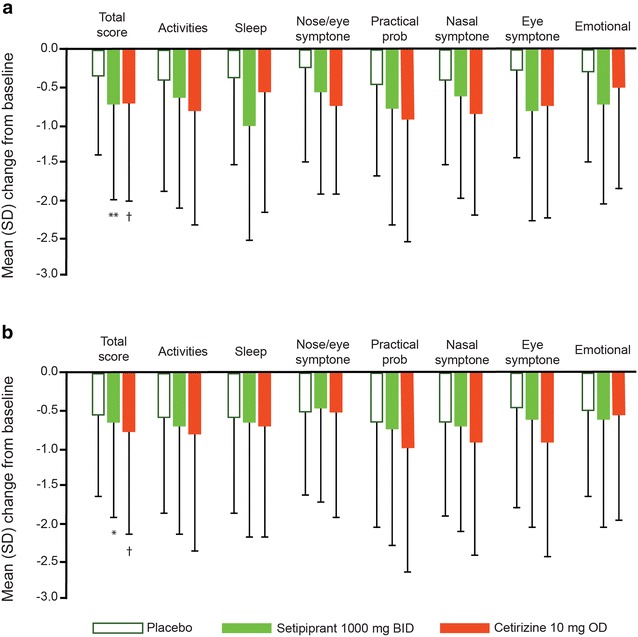
A Phase 2 trial and a Phase 3 trial were conducted at seven centers in Texas, USA during the Mountain Cedar pollen season. Both were prospective, randomized, double-blind, placebo- and active-referenced (cetirizine) studies. The Phase 2 trial assessed setipiprant 100-1000 mg b.i.d. and 1000 mg o.d. versus placebo in adult and elderly participants. The Phase 3 trial assessed setipiprant 1000 mg b.i.d. in adolescent, adult, and elderly participants. Efficacy was assessed using daytime nasal symptom scores (DNSS), night-time nasal symptom scores (NNSS) and daytime eye symptom scores (DESS).
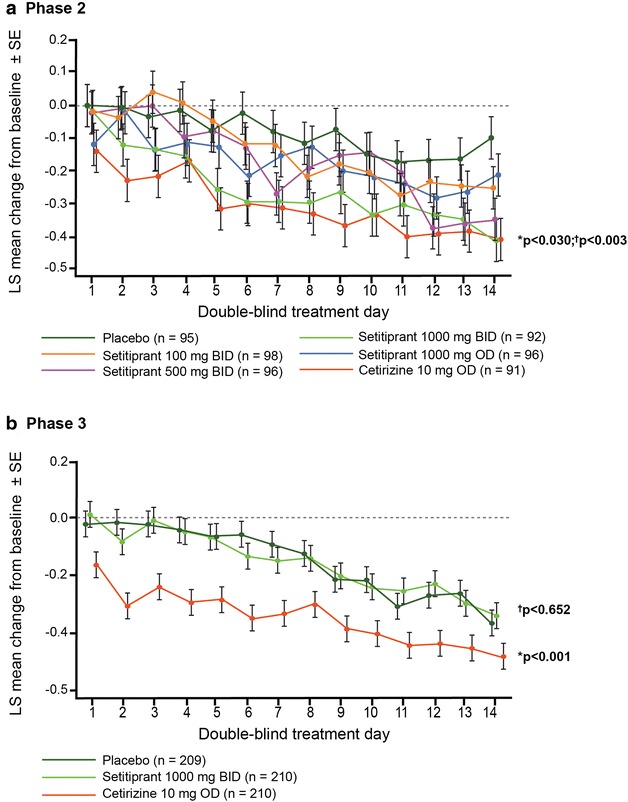
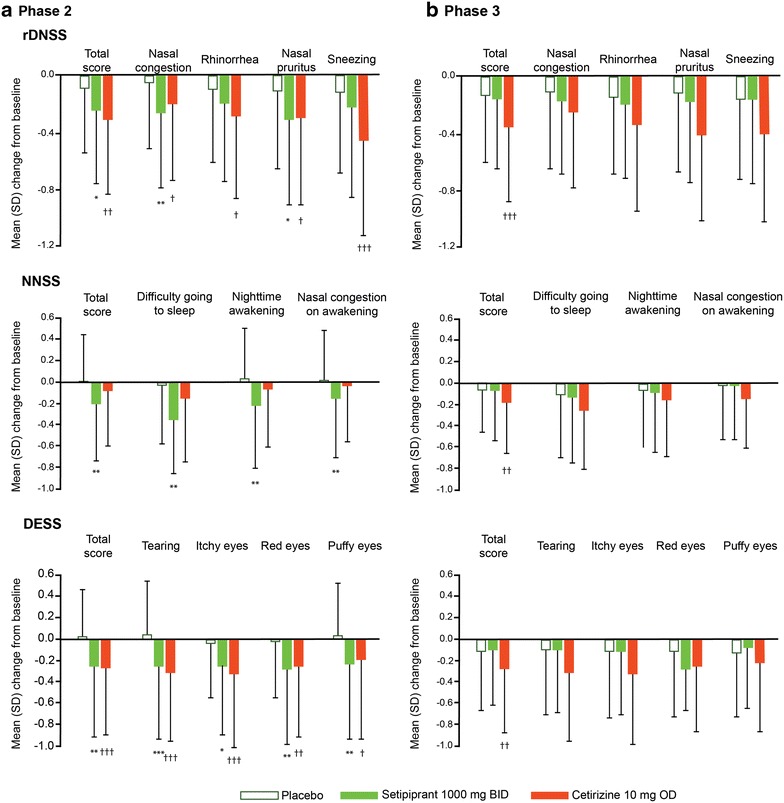
579 participants were randomized in the Phase 2 trial (mean age 41.6-43.4 years); 630 were randomized in the Phase 3 trial (mean age 37.5-40.7 years). A statistically significant, dose-related improvement in mean change from baseline DNSS was observed over 2 weeks with setipiprant 1000 mg b.i.d. versus placebo in the Phase 2 trial (-0.15 [95% CI -0.29, -0.01]; p = 0.030). Setipiprant 1000 mg b.i.d. had no significant effect on this endpoint in the Phase 3 trial (-0.02 [95% CI -0.12, 0.07]; p = 0.652). Total and individual NNSS and DESS symptom scores were significantly improved with setipiprant 1000 mg b.i.d. versus placebo in the Phase 2 but not the Phase 3 trial. Setipiprant showed a favorable safety/tolerability profile.
The Phase 2 trial was the first large clinical study to assess a CRTH2 antagonist in seasonal AR in a real-life setting. Setipiprant dose-related efficacy in the Phase 2 trial was not confirmed during Phase 3. Setipiprant was well tolerated in both studies. NCT01241214 and NCT01484119.
T辅助2型细胞(Th2)上的趋化因子受体同源分子(CRTH2)是一种前列腺素D2的G蛋白偶联受体,拮抗该受体可能对治疗过敏性疾病有益。我们呈现了在现实环境中,CRTH2拮抗剂(司替哌兰特)对季节性变应性鼻炎(AR)患者进行为期2周治疗的疗效及安全性/耐受性的研究结果。
在美国得克萨斯州的7个中心,于山雪松花粉季节期间开展了一项2期试验和一项3期试验。两项试验均为前瞻性、随机、双盲、安慰剂对照及活性药物对照(西替利嗪)研究。2期试验评估了成年和老年受试者中,每日两次服用100 - 1000 mg司替哌兰特、每日一次服用1000 mg司替哌兰特与安慰剂的效果对比。3期试验评估了青少年、成年和老年受试者中,每日两次服用1000 mg司替哌兰特的效果。疗效通过日间鼻部症状评分(DNSS)、夜间鼻部症状评分(NNSS)和日间眼部症状评分(DESS)进行评估。
2期试验中有579名受试者被随机分组(平均年龄41.6 - 43.4岁);3期试验中有630名受试者被随机分组(平均年龄37.5 - 40.7岁)。在2期试验中,与安慰剂相比,每日两次服用1000 mg司替哌兰特,在2周内观察到从基线DNSS的平均变化有统计学显著的剂量相关改善(-0.15 [95%置信区间 -0.29, -0.01];p = 0.030)。在3期试验中,每日两次服用1000 mg司替哌兰特对该终点无显著影响(-0.02 [95%置信区间 -0.12, 0.07];p = 0.652)。在2期试验中,与安慰剂相比,每日两次服用1000 mg司替哌兰特可使总NNSS和个体NNSS及DESS症状评分显著改善,但在3期试验中未出现此情况。司替哌兰特显示出良好的安全性/耐受性。
2期试验是首次在现实环境中评估CRTH2拮抗剂治疗季节性AR的大型临床研究。3期试验未证实2期试验中司替哌兰特的剂量相关疗效。在两项研究中,司替哌兰特的耐受性均良好。临床试验注册号:NCT01241214和NCT01484119。