Jayanti Anuradha, Foden Philip, Mitra Sandip
Department of Nephrology, Central Manchester Hospitals NHS Trust, Manchester, UK.
Department of Biostatistics, University of Manchester, Manchester, UK.
Clin Kidney J. 2017 Apr;10(2):269-275. doi: 10.1093/ckj/sfw124. Epub 2017 Feb 1.
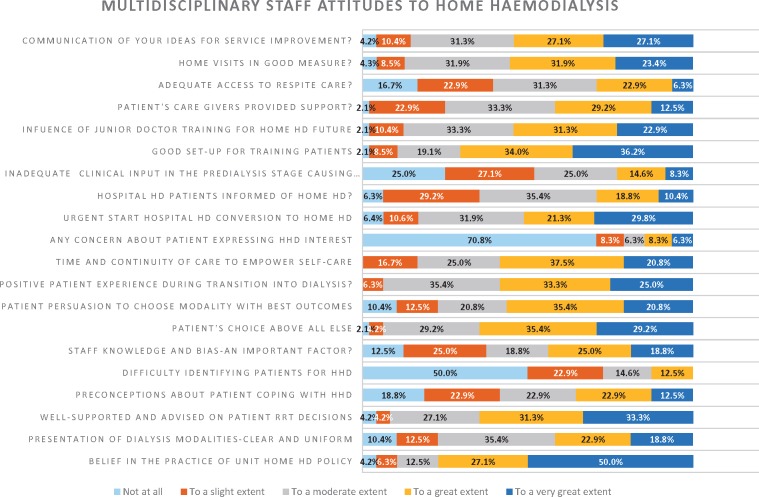
More than a decade after the National Institute for Health and Clinical Excellence recommendation of home haemodialysis (home HD) for 10-15% of those needing renal replacement therapy, the uptake across different regions in the UK remains uneven. This survey is part of the Barriers to Successful Implementation of Care in Home Haemodialysis (BASIC-HHD) study, an observational study of patient and organizational factor barriers and enablers of home HD uptake, in the UK. The study centres had variable prevalence of home HD by design [low: <3% (2), medium: 5-8% (2) and high: >8% (1)]. This survey was administered electronically in 2013, and had 20 questions pertaining to home HD beliefs and practices. A total of 104 members of staff across five study centres were approached to complete the survey. The response rate was 46%, mostly from experienced HD practitioners. Most believed in the benefits of home HD therapy. Across all centres, respondents believed that preconceptions about patients' and carers' ability to cope with home HD (35% to a great or very great extent) and staff knowledge and bias influenced offer of home HD therapy (45%). Also, compared with respondents from high prevalence (HP) centre, those from low prevalence (LP) centres felt that display and presentation of dialysis information lacked clarity and uniformity (44% versus 18%), and that a better set-up for training patients for self-care HD was required (72.8% versus 33.3%). A greater proportion of respondents from the HP centre expressed concerns over caregiver support and respite care for patients on home HD (63.7% versus 33.3%). Survey results indicate that across all centres in the study, there is an appetite for growing home HD. There are some differences in attitudes and practice between LP and HP centres. There are other domains where all centres have expressed concern and addressing these will be influential in navigating change from the current course.
在英国国家卫生与临床优化研究所建议将家庭血液透析(家庭血透)用于10% - 15%需要肾脏替代治疗的患者十多年后,英国不同地区的接受情况仍然不均衡。这项调查是家庭血液透析成功实施护理障碍(BASIC - HHD)研究的一部分,该研究是一项关于英国患者和组织因素对家庭血透接受情况的障碍及促进因素的观察性研究。研究中心根据设计有不同的家庭血透患病率[低:<3%(2个),中:5% - 8%(2个),高:>8%(1个)]。这项调查于2013年通过电子方式进行,有20个与家庭血透信念和实践相关的问题。研究共联系了五个研究中心的104名工作人员来完成调查。回复率为46%,大多来自经验丰富的血液透析从业者。大多数人相信家庭血透治疗的益处。在所有中心,受访者认为对患者和护理人员应对家庭血透能力的先入之见(35%认为有很大或非常大的影响)以及工作人员的知识和偏见影响了家庭血透治疗的提供(45%)。此外,与高患病率(HP)中心的受访者相比,低患病率(LP)中心的受访者认为透析信息的展示和呈现缺乏清晰度和一致性(44%对18%),并且需要更好地为患者进行自我护理血透培训做准备(72.8%对33.3%)。HP中心的受访者中有更大比例对家庭血透患者的护理人员支持和临时护理表示担忧(63.7%对33.3%)。调查结果表明,在该研究的所有中心,都有扩大家庭血透的意愿。LP和HP中心在态度和实践上存在一些差异。在其他方面,所有中心都表达了担忧,解决这些问题将对引导从当前状况的转变产生影响。