Zeestraten E A, Gudbrandsen M C, Daly E, de Schotten M T, Catani M, Dell'Acqua F, Lai M-C, Ruigrok A N V, Lombardo M V, Chakrabarti B, Baron-Cohen S, Ecker C, Murphy D G M, Craig M C
Department of Forensic and Neurodevelopmental Sciences, Institute of Psychiatry, Psychology and Neuroscience, King's College London, London, UK.
Autism Research Centre, Department of Psychiatry, University of Cambridge, Cambridge, UK.
Transl Psychiatry. 2017 Apr 11;7(4):e1090. doi: 10.1038/tp.2017.9.
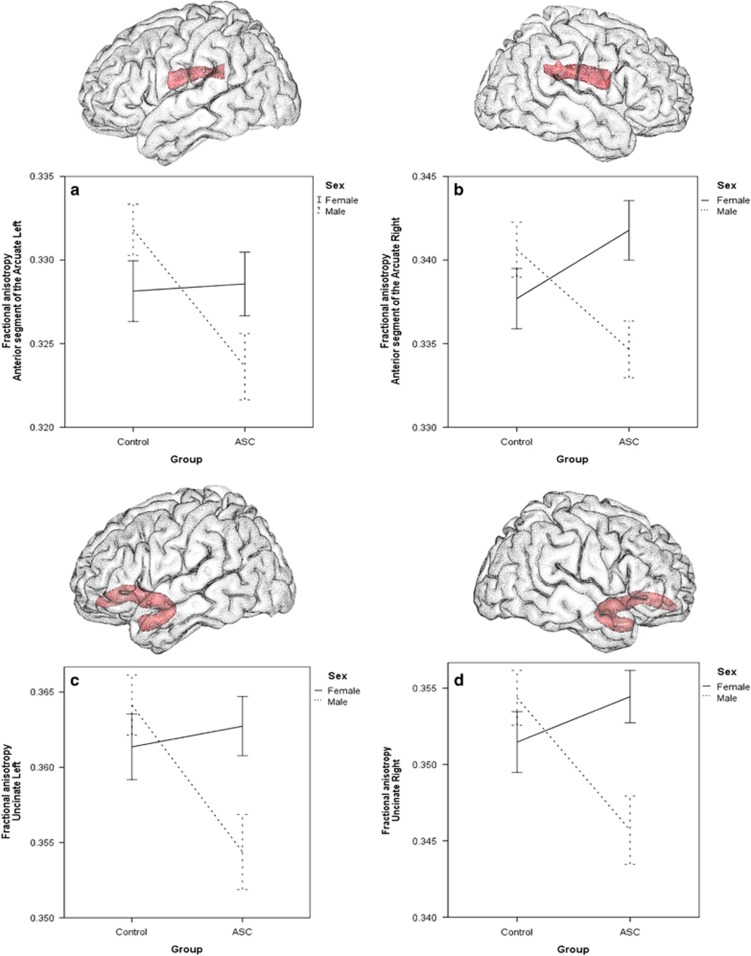
Autism spectrum conditions (ASC) are more prevalent in males than females. The biological basis of this difference remains unclear. It has been postulated that one of the primary causes of ASC is a partial disconnection of the frontal lobe from higher-order association areas during development (that is, a frontal 'disconnection syndrome'). Therefore, in the current study we investigated whether frontal connectivity differs between males and females with ASC. We recruited 98 adults with a confirmed high-functioning ASC diagnosis (61 males: aged 18-41 years; 37 females: aged 18-37 years) and 115 neurotypical controls (61 males: aged 18-45 years; 54 females: aged 18-52 years). Current ASC symptoms were evaluated using the Autism Diagnostic Observation Schedule (ADOS). Diffusion tensor imaging was performed and fractional anisotropy (FA) maps were created. Mean FA values were determined for five frontal fiber bundles and two non-frontal fiber tracts. Between-group differences in mean tract FA, as well as sex-by-diagnosis interactions were assessed. Additional analyses including ADOS scores informed us on the influence of current ASC symptom severity on frontal connectivity. We found that males with ASC had higher scores of current symptom severity than females, and had significantly lower mean FA values for all but one tract compared to controls. No differences were found between females with or without ASC. Significant sex-by-diagnosis effects were limited to the frontal tracts. Taking current ASC symptom severity scores into account did not alter the findings, although the observed power for these analyses varied. We suggest these findings of frontal connectivity abnormalities in males with ASC, but not in females with ASC, have the potential to inform us on some of the sex differences reported in the behavioral phenotype of ASC.
自闭症谱系障碍(ASC)在男性中比在女性中更为普遍。这种差异的生物学基础尚不清楚。据推测,ASC的主要原因之一是发育过程中额叶与高级联合区域的部分断开连接(即额叶“断开连接综合征”)。因此,在本研究中,我们调查了患有ASC的男性和女性之间的额叶连接性是否存在差异。我们招募了98名确诊为高功能ASC的成年人(61名男性:年龄在18 - 41岁之间;37名女性:年龄在18 - 37岁之间)和115名神经典型对照者(61名男性:年龄在18 - 45岁之间;54名女性:年龄在18 - 52岁之间)。使用自闭症诊断观察量表(ADOS)评估当前的ASC症状。进行了扩散张量成像并创建了分数各向异性(FA)图。确定了五个额叶纤维束和两个非额叶纤维束的平均FA值。评估了平均束FA的组间差异以及诊断与性别的交互作用。包括ADOS评分在内的其他分析让我们了解了当前ASC症状严重程度对额叶连接性的影响。我们发现,患有ASC的男性当前症状严重程度得分高于女性,并且与对照组相比,除了一个束之外,所有束的平均FA值均显著较低。患有ASC和未患有ASC的女性之间未发现差异。显著的诊断与性别效应仅限于额叶束。考虑当前ASC症状严重程度得分并没有改变研究结果,尽管这些分析的观察效能有所不同。我们认为,这些在患有ASC的男性而非女性中发现的额叶连接异常,有可能为我们揭示ASC行为表型中报告的一些性别差异。