Phuah Neoh Hun, Azmi Mohamad Nurul, Awang Khalijah, Nagoor Noor Hasima
Institute of Biological Sciences (Genetics and Molecular Biology), Faculty of Science, University of Malaya, 50603, Kuala Lumpur, Malaysia.
Centre for Natural Product Research and Drug Discovery (CENAR), Department of Chemistry, Faculty of Science, University of Malaya, 50603, Kuala Lumpur, Malaysia.
Mol Cells. 2017 Apr;40(4):291-298. doi: 10.14348/molcells.2017.2285. Epub 2017 Apr 12.
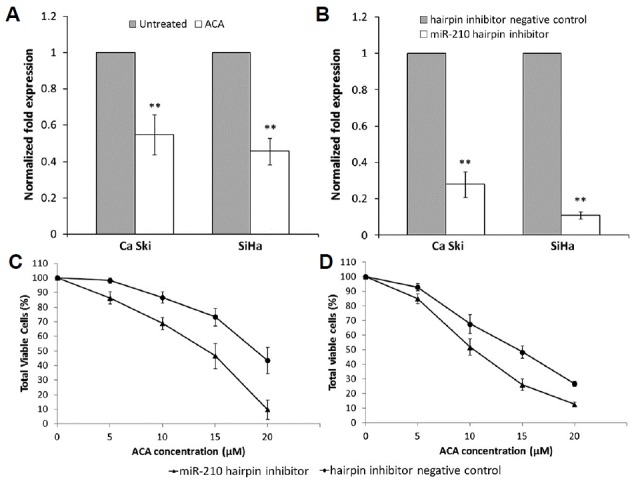
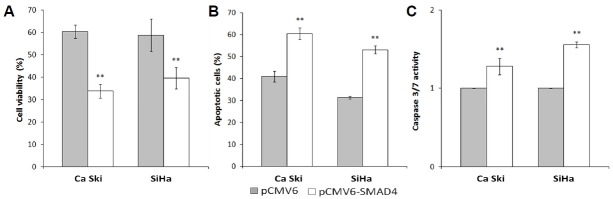
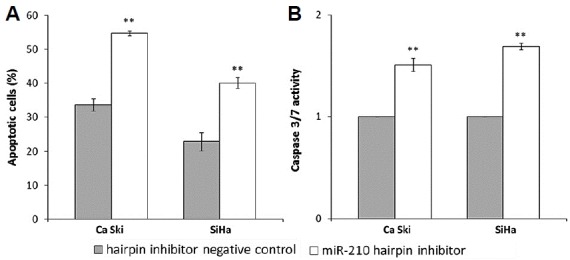
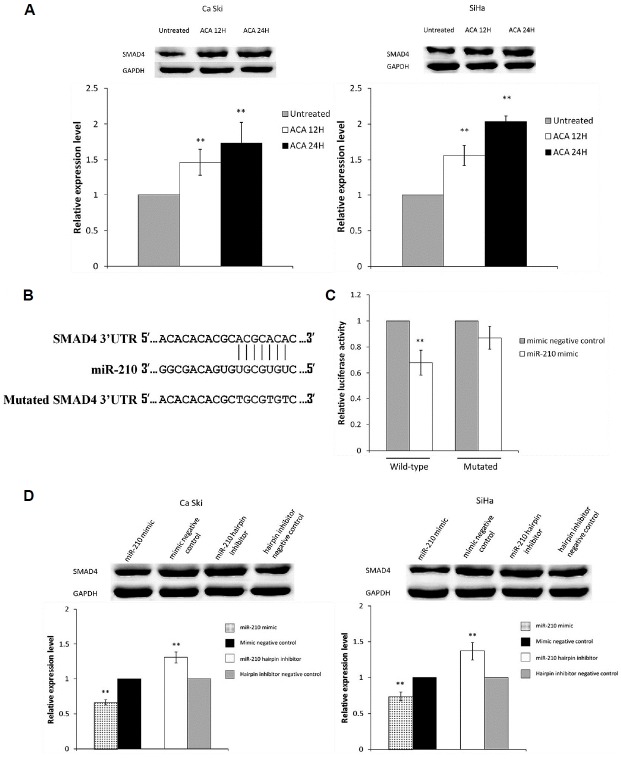
MicroRNAs (miRNAs) are short non-coding RNAs that regulate genes posttranscriptionally. Past studies have reported that miR-210 is up-regulated in many cancers including cervical cancer, and plays a pleiotropic role in carcinogenesis. However, its role in regulating response towards anti-cancer agents has not been fully elucidated. We have previously reported that the natural compound 1'S-1'-acetoxychavicol acetate (ACA) is able to induce cytotoxicity in various cancer cells including cervical cancer cells. Hence, this study aims to investigate the mechanistic role of miR-210 in regulating response towards ACA in cervical cancer cells. In the present study, we found that ACA down-regulated miR-210 expression in cervical cancer cells, and suppression of miR-210 expression enhanced sensitivity towards ACA by inhibiting cell proliferation and promoting apoptosis. Western blot analysis showed increased expression of mothers against decapentaplegic homolog 4 (SMAD4), which was predicted as a target of miR-210 by target prediction programs, following treatment with ACA. Luciferase reporter assay confirmed that miR-210 binds to sequences in 3'UTR of SMAD4. Furthermore, decreased in SMAD4 protein expression was observed when miR-210 was overexpressed. Conversely, SMAD4 protein expression increased when miR-210 expression was suppressed. Lastly, we demonstrated that overexpression of SMAD4 augmented the anti-proliferative and apoptosis-inducing effects of ACA. Taken together, our results demonstrated that down-regulation of miR-210 conferred sensitivity towards ACA in cervical cancer cells by targeting SMAD4. These findings suggest that combination of miRNAs and natural compounds could provide new strategies in treating cervical cancer.
微小RNA(miRNA)是一类短链非编码RNA,可在转录后水平调控基因。以往研究报道,miR-210在包括宫颈癌在内的多种癌症中表达上调,并在癌症发生过程中发挥多效性作用。然而,其在调节抗癌药物反应中的作用尚未完全阐明。我们之前报道过天然化合物1'S-1'-乙酰氧基胡椒酚乙酸酯(ACA)能够在包括宫颈癌细胞在内的多种癌细胞中诱导细胞毒性。因此,本研究旨在探讨miR-210在调节宫颈癌细胞对ACA反应中的机制性作用。在本研究中,我们发现ACA可下调宫颈癌细胞中miR-210的表达,抑制miR-210表达可通过抑制细胞增殖和促进凋亡增强对ACA的敏感性。蛋白质免疫印迹分析显示,在用ACA处理后,抗五聚体蛋白同源物4(SMAD4)的表达增加,通过靶标预测程序预测其为miR-210的靶标。荧光素酶报告基因检测证实miR-210与SMAD4的3'非翻译区(3'UTR)序列结合。此外,当miR-210过表达时,观察到SMAD4蛋白表达降低。相反,当miR-210表达被抑制时,SMAD4蛋白表达增加。最后,我们证明SMAD4的过表达增强了ACA的抗增殖和诱导凋亡作用。综上所述,我们的结果表明,miR-210的下调通过靶向SMAD4使宫颈癌细胞对ACA敏感。这些发现表明,miRNA与天然化合物的联合应用可为宫颈癌治疗提供新策略。