Han Dong-Xu, Sun Xu-Lei, Xu Ming-Qiang, Chen Cheng-Zhen, Jiang Hao, Gao Yan, Yuan Bao, Zhang Jia-Bao
Department of Laboratory Animals, College of Animal Sciences, Jilin University, Changchun, Jilin, P.R. China.
Oncotarget. 2017 May 30;8(22):36553-36565. doi: 10.18632/oncotarget.16615.
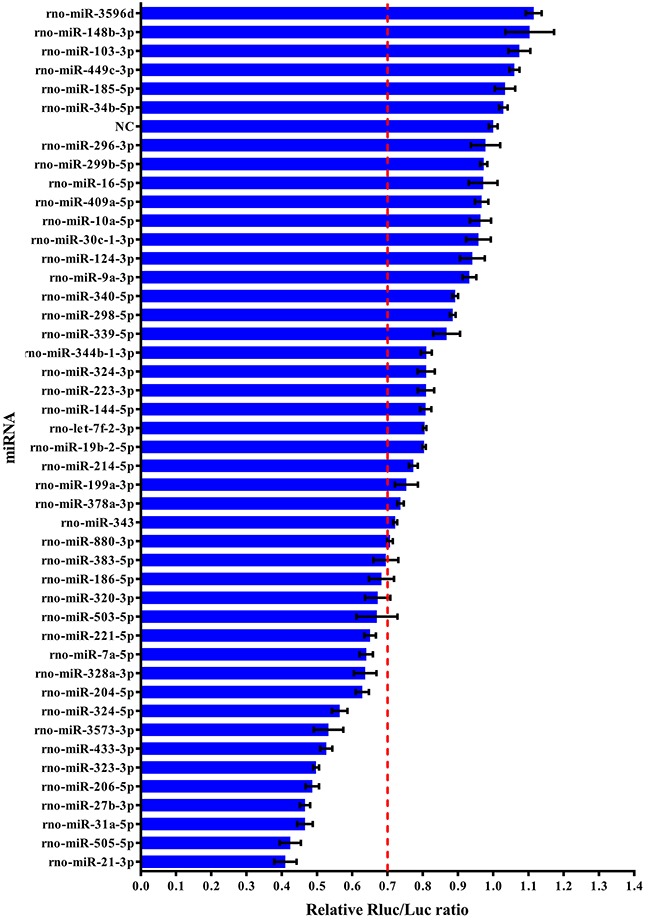
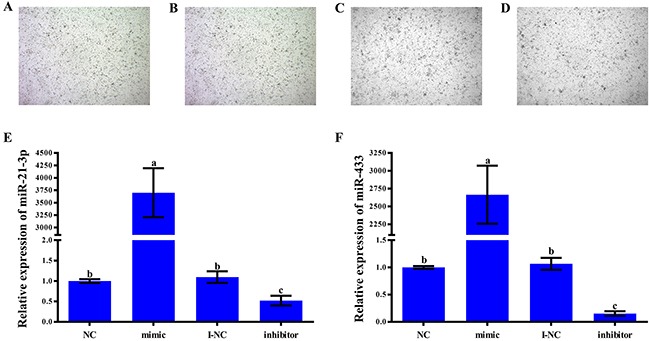
Follicle-stimulating hormone (FSH) secreted by adenohypophyseal cells plays an important role in the regulation of reproduction, but whether microRNAs (miRNAs) regulate the secretion of FSH remains unclear. In the present study, we predicted and screened miRNAs that might act on the follicle-stimulating hormone beta-subunit (FSHb) gene of rats using the TargetScan program and luciferase reporter assays, and the results identified two miRNAs, miR-21-3p and miR-433. We then transfected these miRNAs into rat anterior adenohypophyseal cells and assessed the FSHb expression levels in and FSH secretion by the transfected cells through quantitative PCR and ELISA. The results showed that both miR-21-3p and miR-433 down-regulated the expression levels of FSHb and resulted in the decrease of the secretion of FSH compared with the control group, and treatment with miR-21-3p and miR-433 inhibitors up-regulated the expression levels of FSHb and resulted in the increase of the secretion of FSH. Taken together, our results indicate that miR-21-3p and miR-433 can down-regulate the expression of FSHb by directly targeting the FSHb 3'UTR in rat primary pituitary cells. Our findings provide evidence that miRNAs can regulate FSHb expression and further affect the secretion of FSH and might contribute to the use of miRNAs for the regulation of animal reproduction.
腺垂体细胞分泌的促卵泡激素(FSH)在生殖调节中起重要作用,但微小RNA(miRNA)是否调节FSH的分泌仍不清楚。在本研究中,我们使用TargetScan程序和荧光素酶报告基因检测预测并筛选了可能作用于大鼠促卵泡激素β亚基(FSHb)基因的miRNA,结果鉴定出两种miRNA,即miR-21-3p和miR-433。然后,我们将这些miRNA转染到大鼠垂体前叶细胞中,并通过定量PCR和ELISA评估转染细胞中FSHb的表达水平和FSH的分泌。结果表明,与对照组相比,miR-21-3p和miR-433均下调了FSHb的表达水平,并导致FSH分泌减少,而用miR-21-3p和miR-433抑制剂处理则上调了FSHb的表达水平,并导致FSH分泌增加。综上所述,我们的结果表明,miR-21-3p和miR-433可以通过直接靶向大鼠原代垂体细胞中的FSHb 3'UTR来下调FSHb的表达。我们的研究结果提供了证据,证明miRNA可以调节FSHb的表达,并进一步影响FSH的分泌,这可能有助于利用miRNA来调节动物繁殖。