Department of Neurobiology and Developmental Sciences, University of Arkansas for Medical Sciences, Little Rock, AR 72205, USA.
Int J Mol Sci. 2021 Mar 24;22(7):3312. doi: 10.3390/ijms22073312.
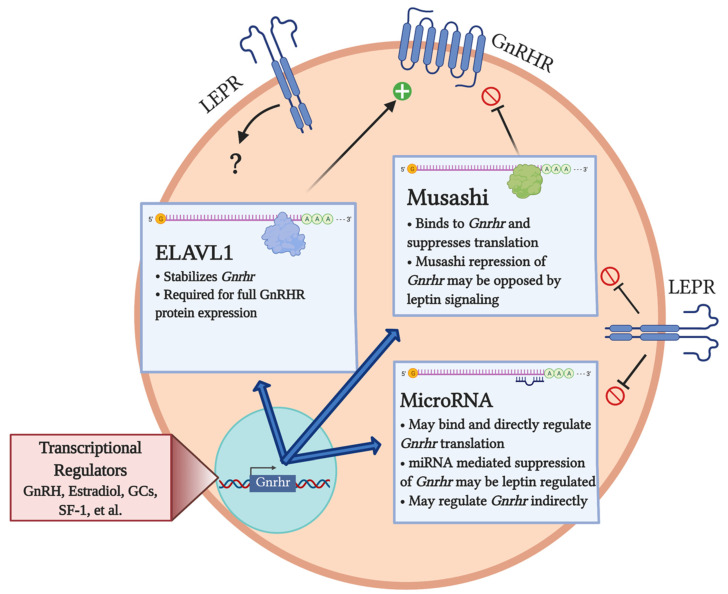
The proper expression of gonadotropin-releasing hormone receptors (GnRHRs) by pituitary gonadotropes is critical for maintaining maximum reproductive capacity. GnRH receptor expression must be tightly regulated in order to maintain the normal pattern of expression through the estrous cycle in rodents, which is believed to be important for interpreting the finely tuned pulses of GnRH from the hypothalamus. Much work has shown that expression is heavily regulated at the level of transcription. However, researchers have also discovered that is regulated post-transcriptionally. This review will discuss how RNA-binding proteins and microRNAs may play critical roles in the regulation of GnRHR expression. We will also discuss how these post-transcriptional regulators may themselves be affected by metabolic cues, specifically with regards to the adipokine leptin. All together, we present evidence that is regulated post-transcriptionally, and that this concept must be further explored in order to fully understand the complex nature of this receptor.
促性腺激素释放激素受体 (GnRHRs) 在垂体促性腺激素细胞中的正确表达对于维持最大生殖能力至关重要。为了维持啮齿动物发情周期中正常的表达模式,GnRH 受体的表达必须受到严格调控,人们认为这对于解释来自下丘脑的精细 GnRH 脉冲很重要。大量研究表明,表达在转录水平受到严格调控。然而,研究人员还发现,表达也受到转录后调控。这篇综述将讨论 RNA 结合蛋白和 microRNAs 如何在 GnRHR 表达的调控中发挥关键作用。我们还将讨论这些转录后调节剂如何受到代谢信号的影响,特别是关于脂肪因子瘦素。总之,我们提出证据表明表达受到转录后调控,为了充分理解这种受体的复杂性质,必须进一步探索这一概念。