González-Trejo Sagrario, Carrillo José F, Carmona-Herrera D Darlene, Baz-Gutiérrez Patricia, Herrera-Goepfert Roberto, Núñez Gloria, Ochoa-Carrillo Francisco J, Gallardo-Rincón Dolores, Aiello-Crocifoglio Vincenzo, Oñate-Ocaña Luis F
Subdirección de Investigación Clínica Subdirección de Cirugía Departamento de Hematología Departamento de Patología Departamento de Oncología Médica Departamento de Gastroenterología, Instituto Nacional de Cancerología (INCan) Facultad de Medicina, Universidad Autónoma Metropolitana (UAM) Facultad de Medicina, Universidad Nacional Autónoma de México (UNAM), Mexico City, Mexico.
Medicine (Baltimore). 2017 Apr;96(15):e6610. doi: 10.1097/MD.0000000000006610.
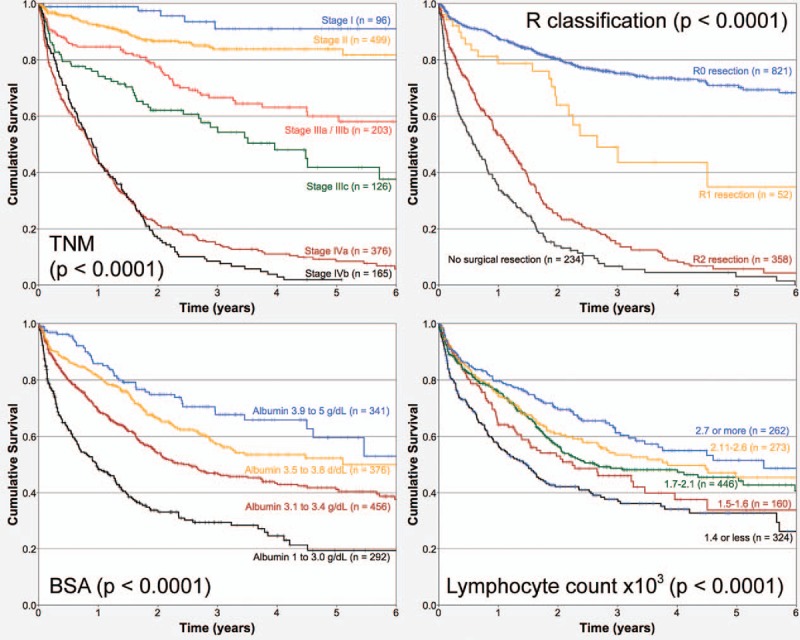
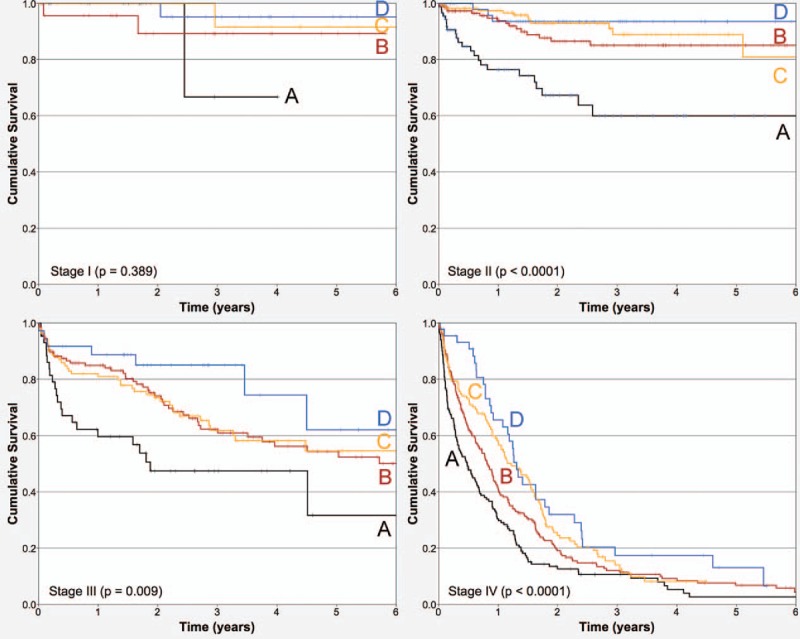
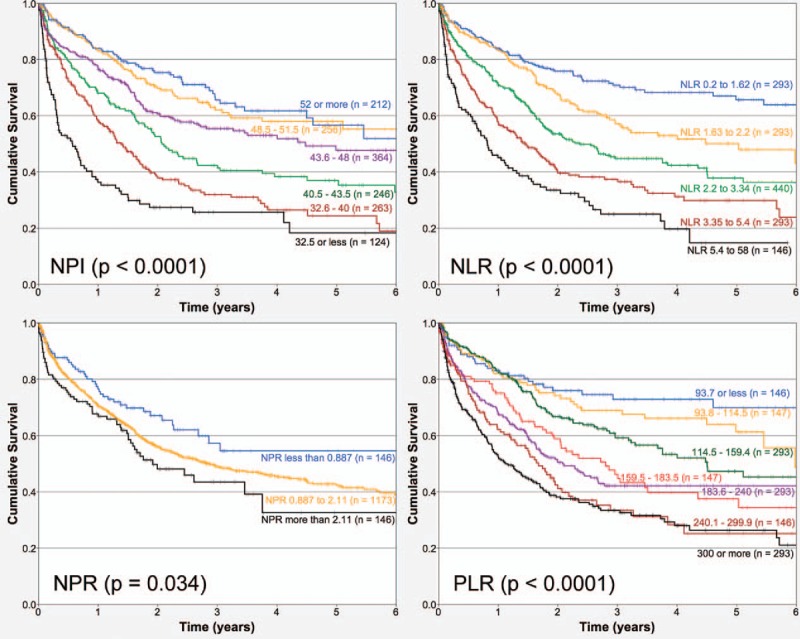
The aim of the present study was to define the prognostic role of baseline serum albumin (BSA) in colorectal cancer (CRC) across tumor-node-metastasis (TNM) stages and other well defined prognostic factors. Many prognostic models in medicine employ BSA to define or refine treatments in very specific settings; in CRC, BSA has been found to be a prognostic factor as well. A retrospective cohort study of consecutive patients with CRC demonstrated by biopsy, who attended a cancer center during a 7-year period. Multivariate analysis was utilized to define prognostic factors associated with overall survival (OS) employing the Cox model. In this retrospective cohort study, 1465 patients were included; 46.6% were females and 53.4% males (mean age, 59.1 years). Mean BSA was inversely correlated with TNM stages. By multivariate analysis, it was an independent explanatory variable. TNM stages, "R" classification, age, lymphocyte count, neutrophil/platelet ratio, neutrophil/lymphocyte ratio, platelet/lymphocyte ratio, postoperative morbidity, and BSA were independently associated with OS. Morbidities, surgery type, chemotherapy, and radiotherapy were considered confounders after adjusting by TNM stages. BSA is a significant and independent prognostic factor in patients with CRC, and its effect is maintained across TNM strata and other well known clinical prognostic factors. It can be easily used in prognostic models and should be employed to stratify prognosis in therapeutic randomized clinical trials.
本研究的目的是确定基线血清白蛋白(BSA)在结直肠癌(CRC)中跨越肿瘤-淋巴结-转移(TNM)分期及其他明确的预后因素时的预后作用。医学中的许多预后模型在非常特定的情况下使用BSA来定义或优化治疗方案;在结直肠癌中,BSA也被发现是一个预后因素。一项对连续的经活检证实的结直肠癌患者进行的回顾性队列研究,这些患者在7年期间就诊于一家癌症中心。采用Cox模型进行多变量分析以确定与总生存期(OS)相关的预后因素。在这项回顾性队列研究中,纳入了1465例患者;其中46.6%为女性,53.4%为男性(平均年龄59.1岁)。平均BSA与TNM分期呈负相关。通过多变量分析,它是一个独立的解释变量。TNM分期、“R”分类、年龄、淋巴细胞计数、中性粒细胞/血小板比值、中性粒细胞/淋巴细胞比值、血小板/淋巴细胞比值、术后发病率和BSA均与OS独立相关。在根据TNM分期进行调整后,发病率、手术类型、化疗和放疗被视为混杂因素。BSA是结直肠癌患者一个重要的独立预后因素,其作用在TNM各分层以及其他众所周知的临床预后因素中均保持不变。它可以很容易地应用于预后模型中,并且应该用于治疗性随机临床试验中的预后分层。