Yiming Gulinuer, Zhou Xianhui, Lv Wenkui, Peng Yi, Zhang Wenhui, Cheng Xinchun, Li Yaodong, Xing Qiang, Zhang Jianghua, Zhou Qina, Zhang Ling, Lu Yanmei, Wang Hongli, Tang Baopeng
Pacing and Electrophysiological Department, The First Affiliated Hospital of Xinjiang Medical University, Urumqi, Xinjiang, China.
Department of Cardiac Function, The First Affiliated Hospital of Xinjiang Medical University, Urumqi, Xinjiang, China.
PLoS One. 2017 Apr 12;12(4):e0171737. doi: 10.1371/journal.pone.0171737. eCollection 2017.
Brachial-ankle pulse wave velocity (baPWV), a direct measure of aortic stiffness, has increasingly become an important assessment for cardiovascular risk. The present study established the reference and normal values of baPWV in a Central Asia population in Xinjiang, China.
We recruited participants from a central Asia population in Xinjiang, China. We performed multiple regression analysis to investigate the determinants of baPWV. The median and 10th-90th percentiles were calculated to establish the reference and normal values based on these categories.
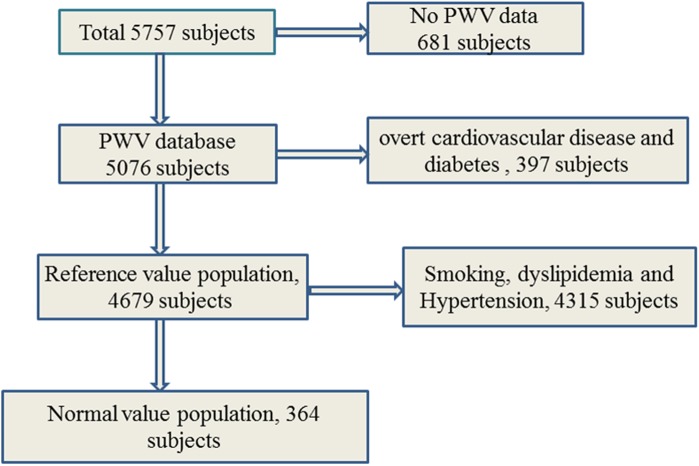
In total, 5,757 Han participants aged 15-88 years were included in the present study. Spearman correlation analysis showed that age (r = 0.587, p < 0.001) and mean blood pressure (MBP, r = 0.599, p <0.001) were the major factors influencing the values of baPWV in the reference population. Furthermore, in the multiple linear regression analysis, the standardized regression coefficients of age (0.445) and MBP (0.460) were much higher than those of body mass index, triglyceride, and glycemia (-0.054, 0.035, and 0.033, respectively). In the covariance analysis, after adjustment for age and MBP, only diabetes was the significant independent determinant of baPWV (p = 0.009). Thus, participants with diabetes were excluded from the reference value population. The reference values ranged from 14.3 to 25.2 m/s, and the normal values ranged from 13.9 to 21.2 m/s.
This is the first study that has established the reference and normal values for baPWV according to age and blood pressure in a Central Asia population.
肱踝脉搏波速度(baPWV)是评估主动脉僵硬度的直接指标,已日益成为心血管风险的重要评估方法。本研究确立了中国新疆中亚人群baPWV的参考值和正常值。
我们从中国新疆的中亚人群中招募参与者。我们进行了多元回归分析以研究baPWV的决定因素。基于这些类别计算中位数以及第10百分位数和第90百分位数,以确立参考值和正常值。
本研究共纳入5757名年龄在15 - 88岁的汉族参与者。Spearman相关性分析表明,年龄(r = 0.587,p < 0.001)和平均血压(MBP,r = 0.599,p < 0.001)是影响参考人群中baPWV值的主要因素。此外,在多元线性回归分析中,年龄(0.445)和MBP(0.460)的标准化回归系数远高于体重指数、甘油三酯和血糖的标准化回归系数(分别为 - 0.054、0.035和0.033)。在协方差分析中,在调整年龄和MBP后,只有糖尿病是baPWV的显著独立决定因素(p = 0.009)。因此,患有糖尿病的参与者被排除在参考值人群之外。参考值范围为14.3至25.2米/秒,正常值范围为13.9至21.2米/秒。
这是第一项根据年龄和血压确立中亚人群baPWV参考值和正常值的研究。