Müller Tobias, Thümmel Kristina, Cornelissen Christian G, Krüger Stefan, Dreher Michael
Division of Pneumology, University Hospital RWTH, Aachen, Germany.
Department of Pneumology, University Hospital, Freiburg, Germany.
PLoS One. 2017 Apr 12;12(4):e0175394. doi: 10.1371/journal.pone.0175394. eCollection 2017.
According to current guidelines flexible bronchoscopy is usually performed under sedation. Previously it has been demonstrated that combined sedation with e. g. the combination of midazolam and propofol or an opioid might have several advantages over sedation with just one sedative drug. However, little is known about the efficacy and safety of combined sedation with midazolam, fentanyl and propofol (MFP) compared to sedation with midazolam and fentanyl (MF) or midazolam and propofol (MP).
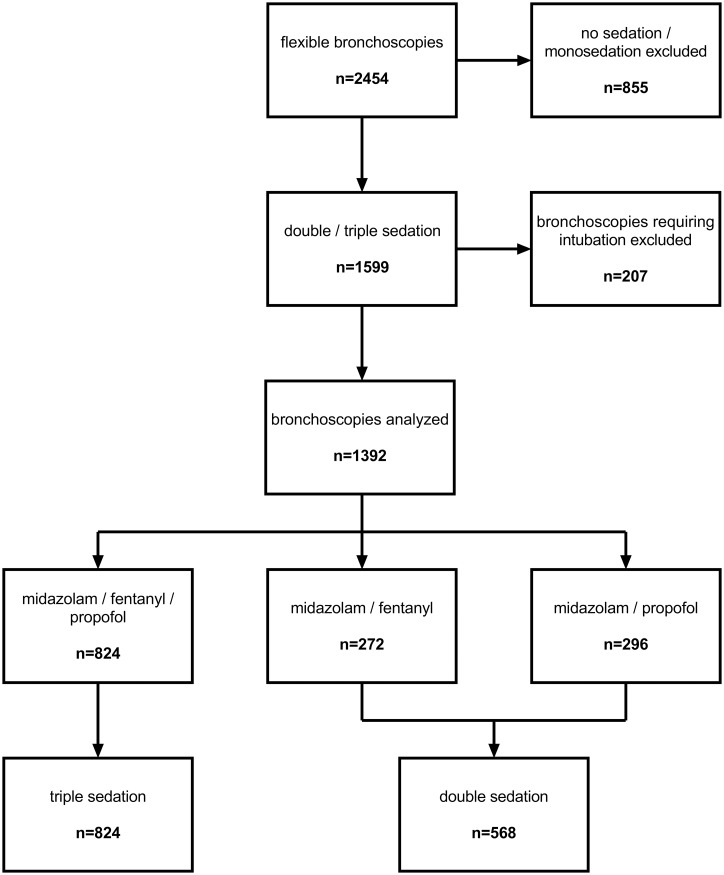
We carried out a retrospective analysis of bronchoscopies performed under triple (MFP) or double sedation (MF and MP) in an academic hospital. 1392 procedures were analyzed (MFP: n = 824; MF: n = 272; MP: n = 296). In particular, we compared the occurrence of complications and the dosage of administered sedative drugs between the groups.
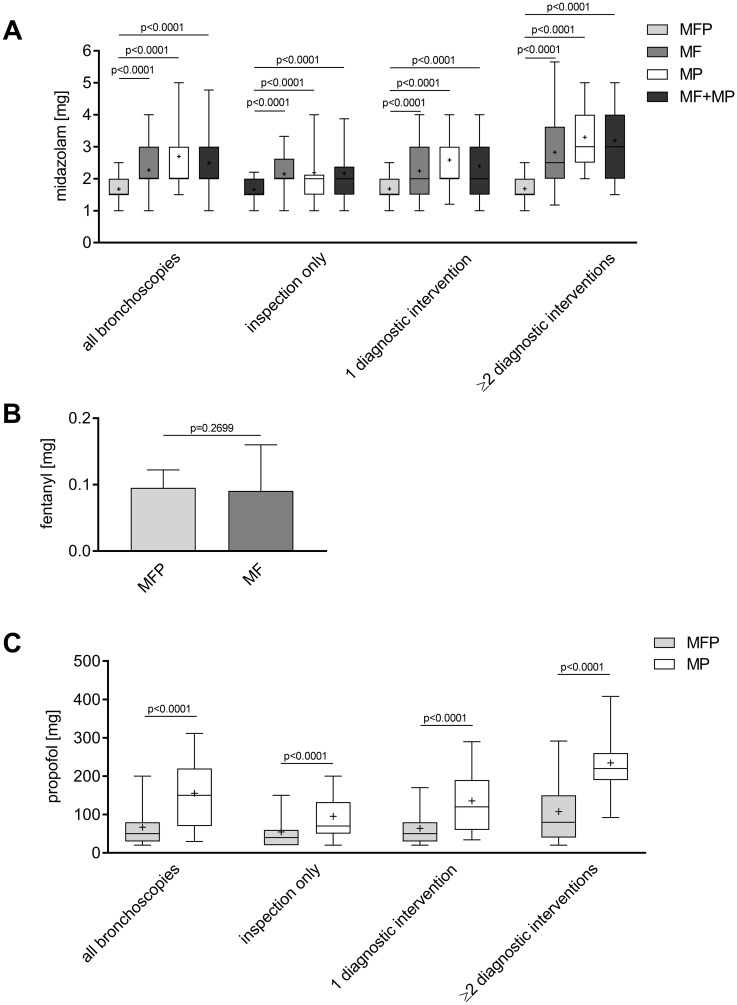
The occurrence of adverse events (MFP vs. MF: odds ratio (OR) 1.116 [95% CI 0.7741 to 1.604]; MFP vs. MP: OR 0.8296 [95% CI 0.5939 to 1.16] and severe adverse events (MFP vs. MF: OR 1.581 [95% CI 0.5594 to 4.336]; MFP vs. MP: OR 3.47 [95% CI 0.908 to 15.15]; all p>0.05) was similar in all groups. The dosage of midazolam was lower in the MFP compared to the MF or MP group (MFP vs. MF: Cohen's d 0.075; MFP vs. MP: Cohen's d 0.225; all p<0.001). In addition patients in the MFP group received significantly less propofol compared to the MP group (Cohen's d 1.22; p<0.001).
In summary we were able to demonstrate that triple sedation can safely be administered during flexible bronchoscopy and is associated with a reduced dosage of midazolam and propofol.
根据当前指南,可弯曲支气管镜检查通常在镇静状态下进行。此前已证明,例如咪达唑仑与丙泊酚联合或与阿片类药物联合镇静可能比仅使用一种镇静药物具有若干优势。然而,与咪达唑仑和芬太尼(MF)或咪达唑仑和丙泊酚(MP)镇静相比,咪达唑仑、芬太尼和丙泊酚联合镇静(MFP)的有效性和安全性知之甚少。
我们对一家学术医院中在三联镇静(MFP)或双联镇静(MF和MP)下进行的支气管镜检查进行了回顾性分析。分析了1392例手术(MFP:n = 824;MF:n = 272;MP:n = 296)。特别是,我们比较了各组之间并发症的发生率和所用镇静药物的剂量。
所有组中不良事件的发生率(MFP与MF:优势比(OR)1.116 [95%置信区间0.7741至1.604];MFP与MP:OR 0.8296 [95%置信区间0.5939至1.16])和严重不良事件的发生率(MFP与MF:OR 1.581 [95%置信区间0.5594至4.336];MFP与MP:OR 3.47 [95%置信区间0.908至15.15];所有p>0.05)相似。与MF或MP组相比,MFP组中咪达唑仑的剂量较低(MFP与MF:科恩d值0.075;MFP与MP:科恩d值0.225;所有p<0.001)。此外,与MP组相比,MFP组患者接受的丙泊酚明显更少(科恩d值1.22;p<0.001)。
总之,我们能够证明在可弯曲支气管镜检查期间可以安全地进行三联镇静,并且与咪达唑仑和丙泊酚剂量的减少相关。