Tremblay Sara, Hannah Ricci, Rawji Vishal, Rothwell John C
Sobell Department of Motor Neuroscience and Movement Disorders, UCL Institute of Neurology, London, UK.
Sobell Department of Motor Neuroscience and Movement Disorders, UCL Institute of Neurology, London, UK.
Brain Stimul. 2017 Jul-Aug;10(4):744-747. doi: 10.1016/j.brs.2017.03.009. Epub 2017 Mar 23.
Polarising currents can modulate membrane potentials in animals, affecting the after-effect of theta burst stimulation (TBS) on synaptic strength.
We examined whether a similar phenomenon could also be observed in human motor cortex (M1) using transcranial direct current stimulation (TDCS) during monophasic intermittent TBS (iTBS).
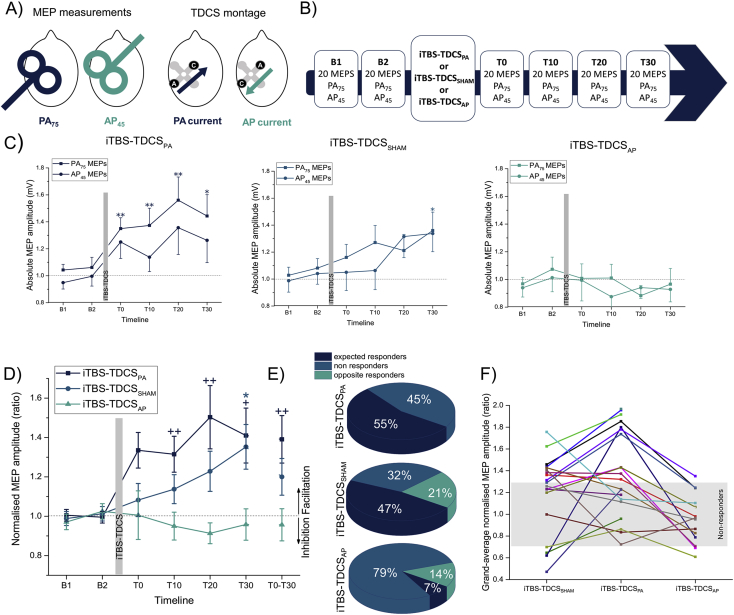
TDCS was applied during posterior-anterior iTBS using three different conditions: posterior-anterior TDCS (anode 3.5 cm posterior to M1, cathode 3.5 cm anterior to M1), anterior-posterior TDCS (cathode 3.5 cm posterior to M1, anode 3.5 cm anterior to M1), and sham TDCS.
When the direction of TDCS (posterior-anterior) matched the direction of the electrical field induced by iTBS, we found a 19% non-significant increase in excitability changes in comparison with iTBS combined with sham TDCS. When the TDCS was reversed (anterior-posterior), the excitatory effect of iTBS was abolished.
Our findings suggest that excitatory after-effects of iTBS can be modulated by directionally-specific TDCS.
极化电流可调节动物的膜电位,影响theta爆发刺激(TBS)对突触强度的后效应。
我们研究了在单相间歇性TBS(iTBS)期间使用经颅直流电刺激(TDCS)是否也能在人类运动皮层(M1)中观察到类似现象。
在前后向iTBS期间应用TDCS,采用三种不同条件:后前向TDCS(阳极位于M1后方3.5 cm,阴极位于M1前方3.5 cm)、前后向TDCS(阴极位于M1后方3.5 cm,阳极位于M1前方3.5 cm)和假TDCS。
当TDCS的方向(后前向)与iTBS诱导的电场方向匹配时,与iTBS联合假TDCS相比,我们发现兴奋性变化有19%的非显著性增加。当TDCS反向(前后向)时,iTBS的兴奋作用被消除。
我们的研究结果表明,iTBS的兴奋性后效应可被方向特异性TDCS调节。