Sobell Department of Motor Neuroscience and Movement Disorders, UCL Institute of Neurology, University College London, London, UK.
Sobell Department of Motor Neuroscience and Movement Disorders, UCL Institute of Neurology, University College London, London, UK.
Brain Stimul. 2018 Mar-Apr;11(2):289-298. doi: 10.1016/j.brs.2017.11.001. Epub 2017 Nov 7.
Measurements and models of current flow in the brain during transcranial Direct Current Stimulation (tDCS) indicate stimulation of regions in-between electrodes. Moreover, the folded cortex results in local fluctuations in current flow intensity and direction, and animal studies suggest current flow direction relative to cortical columns determines response to tDCS.
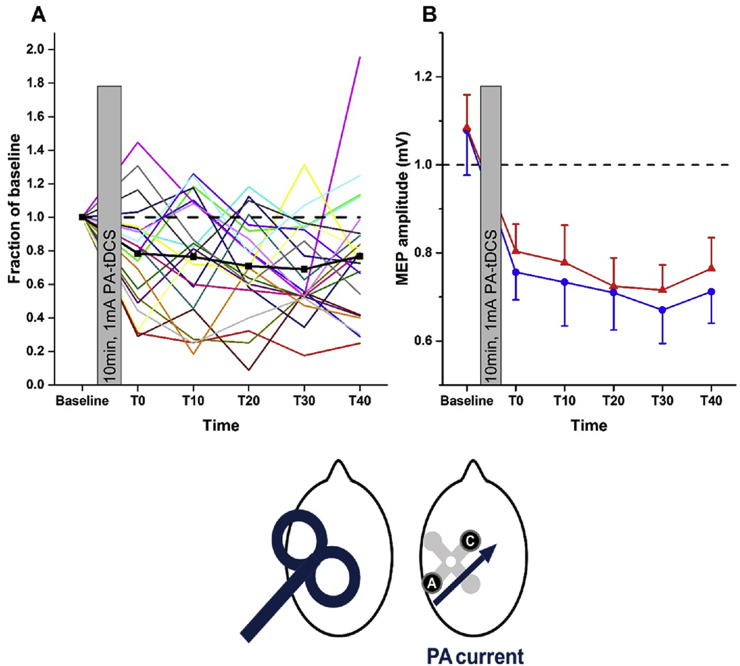
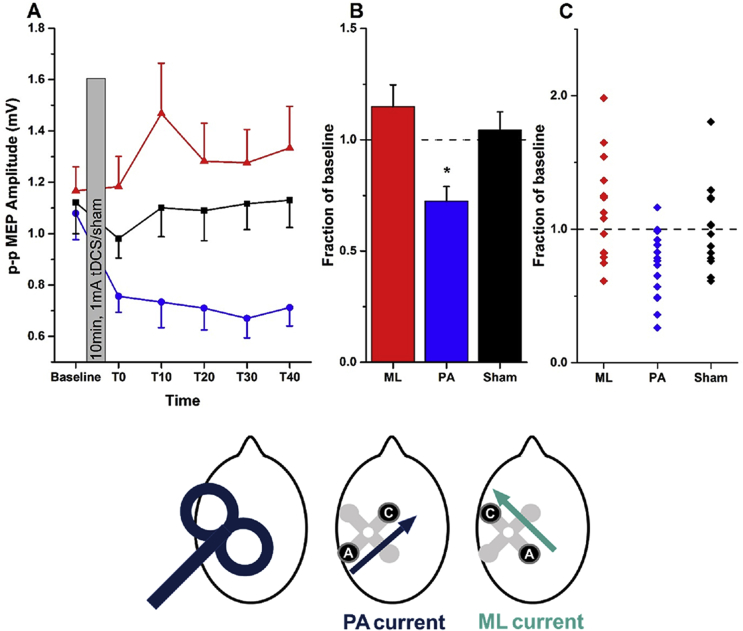
Here we test this idea by using Transcranial Magnetic Stimulation Motor Evoked Potentials (TMS-MEP) to measure changes in corticospinal excitability following tDCS applied with electrodes aligned orthogonal (across) or parallel to M1 in the central sulcus.
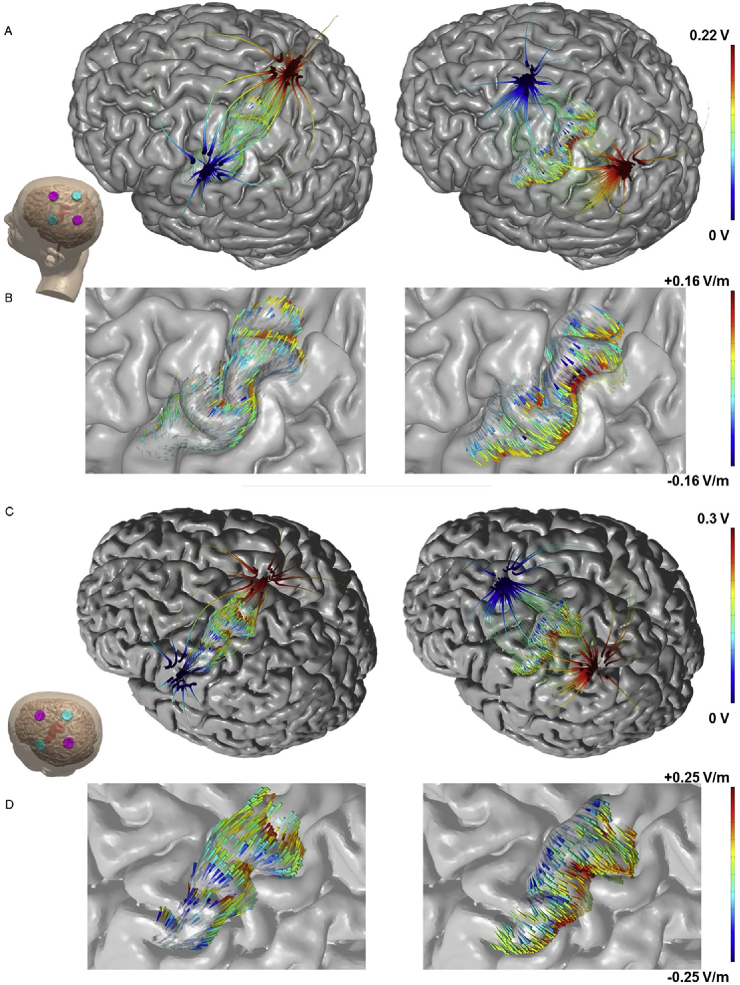
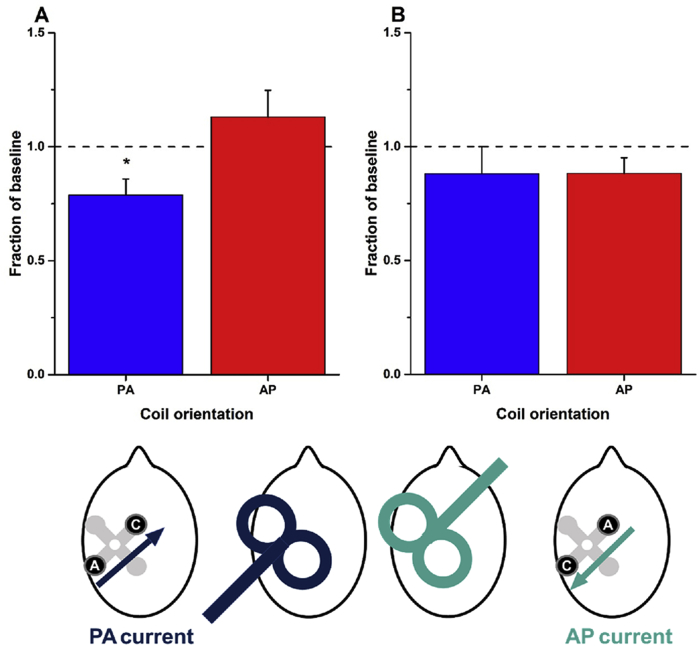
Current flow models predicted that the orthogonal electrode montage produces consistently oriented current across the hand region of M1 that flows along cortical columns, while the parallel electrode montage produces non-uniform current directions across the M1 cortical surface. We find that orthogonal, but not parallel, orientated tDCS modulates TMS-MEPs. We also show modulation is sensitive to the orientation of the TMS coil (PA or AP), which is thought to select different afferent pathways to M1.
Our results are consistent with tDCS producing directionally specific neuromodulation in brain regions in-between electrodes, but shows nuanced changes in excitability that are presumably current direction relative to column and axon pathway specific. We suggest that the direction of current flow through cortical target regions should be considered for targeting and dose-control of tDCS.
经颅直流电刺激(tDCS)过程中大脑内电流的测量和模型表明,刺激发生在电极之间的区域。此外,折叠的皮层导致电流强度和方向的局部波动,动物研究表明,相对于皮质柱的电流方向决定了 tDCS 的反应。
在这里,我们通过使用经颅磁刺激运动诱发电位(TMS-MEP)来测试这个想法,以测量在中央沟中与 M1 正交(交叉)或平行放置电极的 tDCS 后皮质脊髓兴奋性的变化。
电流流模型预测,正交电极模式会在 M1 的手部区域产生一致取向的电流,这些电流沿着皮质柱流动,而平行电极模式会在 M1 皮质表面产生非均匀的电流方向。我们发现,只有正交而不是平行定向的 tDCS 调节 TMS-MEP。我们还表明,调制对 TMS 线圈的取向(PA 或 AP)敏感,这被认为是选择不同的传入途径到 M1。
我们的结果与 tDCS 在电极之间的脑区产生定向特定的神经调节一致,但显示出兴奋性的细微变化,这可能与柱和轴突途径的电流方向有关。我们建议,应该考虑皮质靶区的电流方向,以实现 tDCS 的靶向和剂量控制。