Shipilina Daria, Serbyn Maksym, Ivanitskii Vladimir, Marova Irina, Backström Niclas
Department of Vertebrate Zoology Lomonosov Moscow State University Moscow Russia.
Department of Physics University of California Berkeley CA USA.
Ecol Evol. 2017 Mar 2;7(7):2169-2180. doi: 10.1002/ece3.2782. eCollection 2017 Apr.
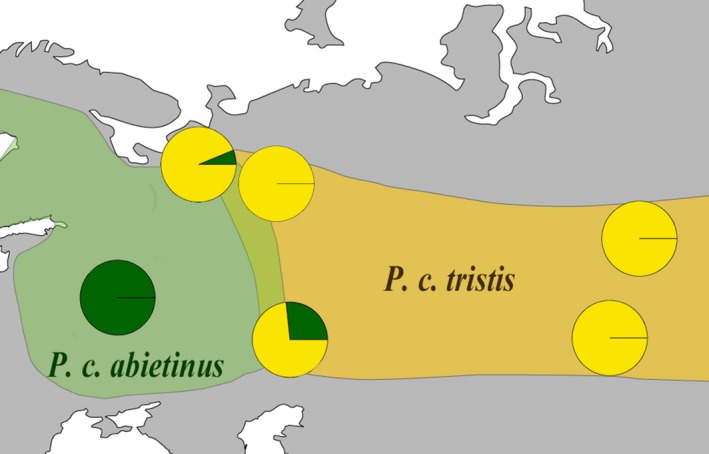
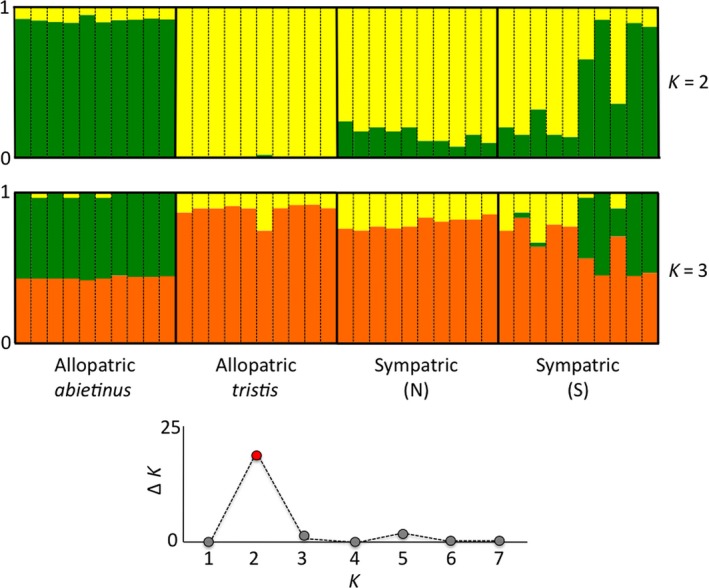
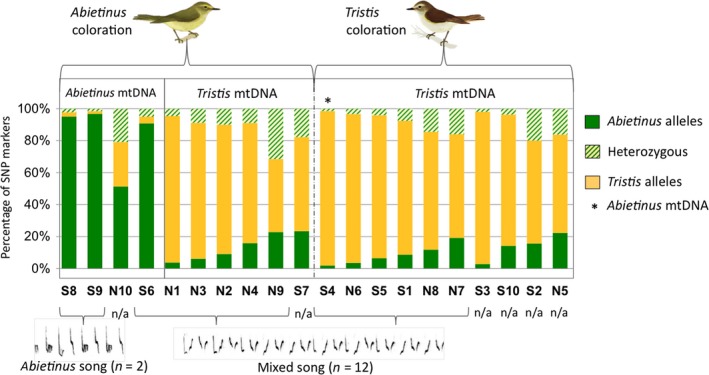
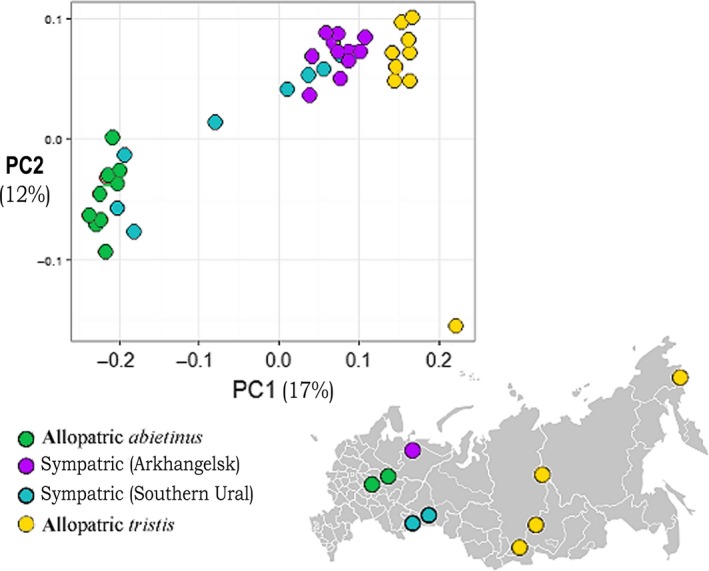
Characterizing patterns of evolution of genetic and phenotypic divergence between incipient species is essential to understand how evolution of reproductive isolation proceeds. Hybrid zones are excellent for studying such processes, as they provide opportunities to assess trait variation in individuals with mixed genetic background and to quantify gene flow across different genomic regions. Here, we combine plumage, song, mtDNA and whole-genome sequence data and analyze variation across a sympatric zone between the European and the Siberian chiffchaff () to study how gene exchange between the lineages affects trait variation. Our results show that chiffchaff within the sympatric region show more extensive trait variation than allopatric birds, with a large proportion of individuals exhibiting intermediate phenotypic characters. The genomic differentiation between the subspecies is lower in sympatry than in allopatry and sympatric birds have a mix of genetic ancestry indicating extensive ongoing and past gene flow. Patterns of phenotypic and genetic variation also vary between regions within the hybrid zone, potentially reflecting differences in population densities, age of secondary contact, or differences in mate recognition or mate preference. The genomic data support the presence of two distinct genetic clades corresponding to allopatric and and that genetic admixture is the force underlying trait variation in the sympatric region-the previously described subspecies ("") from the region is therefore not likely a distinct taxon. In addition, we conclude that subspecies identification based on appearance is uncertain as an individual with an apparently distinct phenotype can have a considerable proportion of the genome composed of mixed alleles, or even a major part of the genome introgressed from the other subspecies. Our results provide insights into the dynamics of admixture across subspecies boundaries and have implications for understanding speciation processes and for the identification of specific chiffchaff individuals based on phenotypic characters.
描绘初始物种之间遗传和表型差异的进化模式对于理解生殖隔离的进化过程至关重要。杂交区是研究此类过程的绝佳场所,因为它们提供了评估具有混合遗传背景个体的性状变异以及量化不同基因组区域间基因流动的机会。在这里,我们结合了羽毛、鸣声、线粒体DNA和全基因组序列数据,并分析了欧洲 chiffchaff 和西伯利亚 chiffchaff 在同域分布区的变异情况,以研究谱系间的基因交换如何影响性状变异。我们的结果表明,同域分布区内的chiffchaff比异域分布的鸟类表现出更广泛的性状变异,很大一部分个体呈现出中间表型特征。亚种间的基因组分化在同域分布中比在异域分布中更低,同域分布的鸟类具有混合的遗传血统,表明存在广泛的正在进行的和过去的基因流动。杂交区内不同区域的表型和遗传变异模式也有所不同,这可能反映了种群密度、二次接触时间、配偶识别或配偶偏好的差异。基因组数据支持存在两个与异域分布的 和 相对应的不同遗传分支,并且基因混合是同域分布区性状变异的基础——因此,该区域先前描述的亚种(“”)不太可能是一个独特的分类单元。此外,我们得出结论,基于外观的亚种鉴定是不确定的,因为具有明显不同表型的个体可能有相当比例的基因组由混合等位基因组成,甚至基因组的主要部分是从另一个亚种渗入的。我们的结果为跨亚种边界的混合动态提供了见解,并对理解物种形成过程以及基于表型特征识别特定的chiffchaff个体具有启示意义。