Kizirian Nathalie V, Goletzke Janina, Brodie Shannon, Atkinson Fiona S, Markovic Tania P, Ross Glynis P, Buyken Anette, Brand-Miller Jennie P
Charles Perkins Centre, The University of Sydney, Sydney, New South Wales, Australia; School of Life and Environmental Sciences, The University of Sydney, Sydney, New South Wales, Australia.
Charles Perkins Centre, The University of Sydney, Sydney, New South Wales, Australia; School of Life and Environmental Sciences, The University of Sydney, Sydney, New South Wales, Australia; IEL-Nutritional Epidemiology, University of Bonn, DONALD Study, Dortmund, Germany.
BMJ Open Diabetes Res Care. 2017 Mar 29;5(1):e000351. doi: 10.1136/bmjdrc-2016-000351. eCollection 2017.
Maternal glycemia plays a key role in fetal growth. We hypothesized that lower glycemic load (GL) meals (lower glycemic index, modestly lower carbohydrate) would substantially reduce day-long glucose variability in women at risk of gestational diabetes mellitus (GDM).
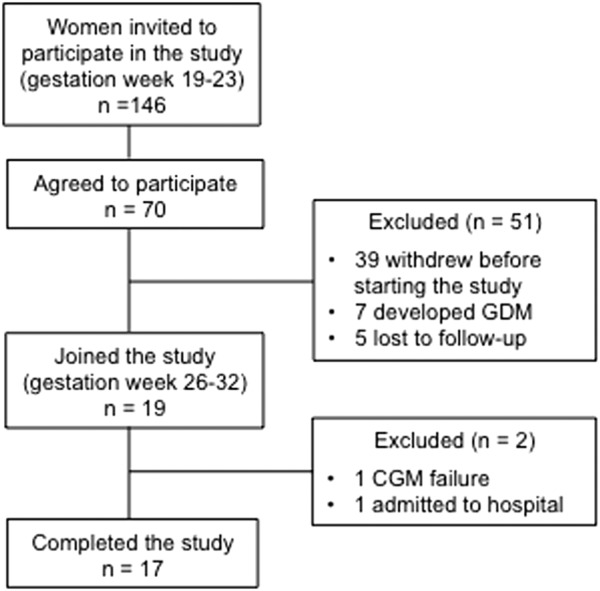
A crossover study of 17 women (mean±SD age 34.8±4 years; gestational weeks 29.3±1.3; body mass index 23.8±4.7 kg/m) who consumed a low GL or a high GL diet in random order, 1-day each, over 2 consecutive days. Diets were energy-matched and fiber-matched with 5 meals per 24 hours. All food was provided. Continuous glucose monitoring was used to assess diurnal glycemia.
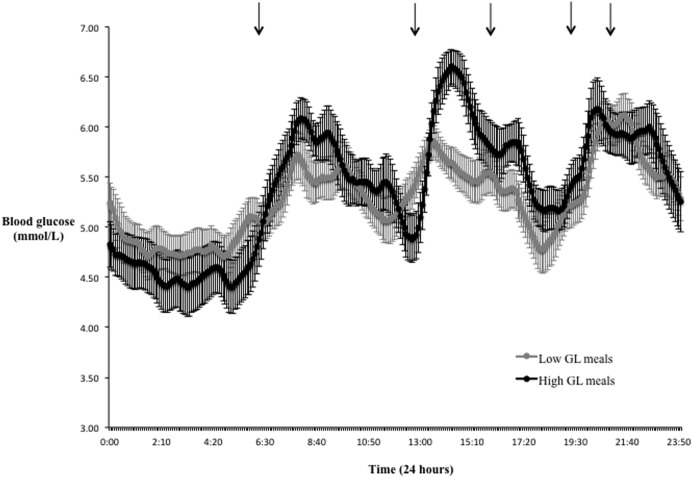
Maternal glucose levels were 51% lower on the low GL day with lower incremental area under the curve (iAUC±SEM 549±109 vs 1120±198 mmol/L min, p=0.015). Glycemic variability was significantly lower on the low GL day, as demonstrated by a lower average SD (0.7±0.1 vs 0.9±0.1, p<0.001) and lower mean amplitude of glycemic excursions (2.1±0.2 vs 2.7±0.2 mmol/L, p<0.001).
A lower GL meal plan in pregnancy acutely halves day-long maternal glucose levels and reduces glucose variability, providing further evidence to support the utility of a low GL diet in pregnancy.
母体血糖水平在胎儿生长过程中起着关键作用。我们假设,低血糖负荷(GL)饮食(较低的血糖生成指数、适度降低碳水化合物含量)能够显著降低妊娠期糖尿病(GDM)风险女性一整天的血糖变异性。
一项交叉研究,纳入17名女性(平均±标准差年龄34.8±4岁;孕周29.3±1.3;体重指数23.8±4.7kg/m²),她们在连续2天内随机依次食用低GL或高GL饮食,每种饮食各1天。饮食在能量和纤维方面进行匹配,每24小时提供5餐。所有食物均由研究方提供。采用持续葡萄糖监测来评估日间血糖水平。
在低GL日,母体血糖水平降低了51%,曲线下增量面积(iAUC±SEM)更低(549±109 vs 1120±198mmol/L·min,p = 0.015)。低GL日的血糖变异性显著更低,表现为平均标准差更低(0.7±0.1 vs 0.9±0.1,p < 0.001)以及血糖波动平均幅度更低(2.1±0.2 vs 2.7±0.2mmol/L,p < 0.001)。
孕期较低GL的饮食计划可使母体一整天的血糖水平急性减半并降低血糖变异性,为支持孕期低GL饮食的实用性提供了进一步证据。