Department of Microbiology, Medical University of Bialystok, Bialystok, Poland.
Department of Microbiology, Institute of Biology, University of Bialystok, Bialystok, Poland.
Sci Rep. 2017 Apr 13;7:46430. doi: 10.1038/srep46430.
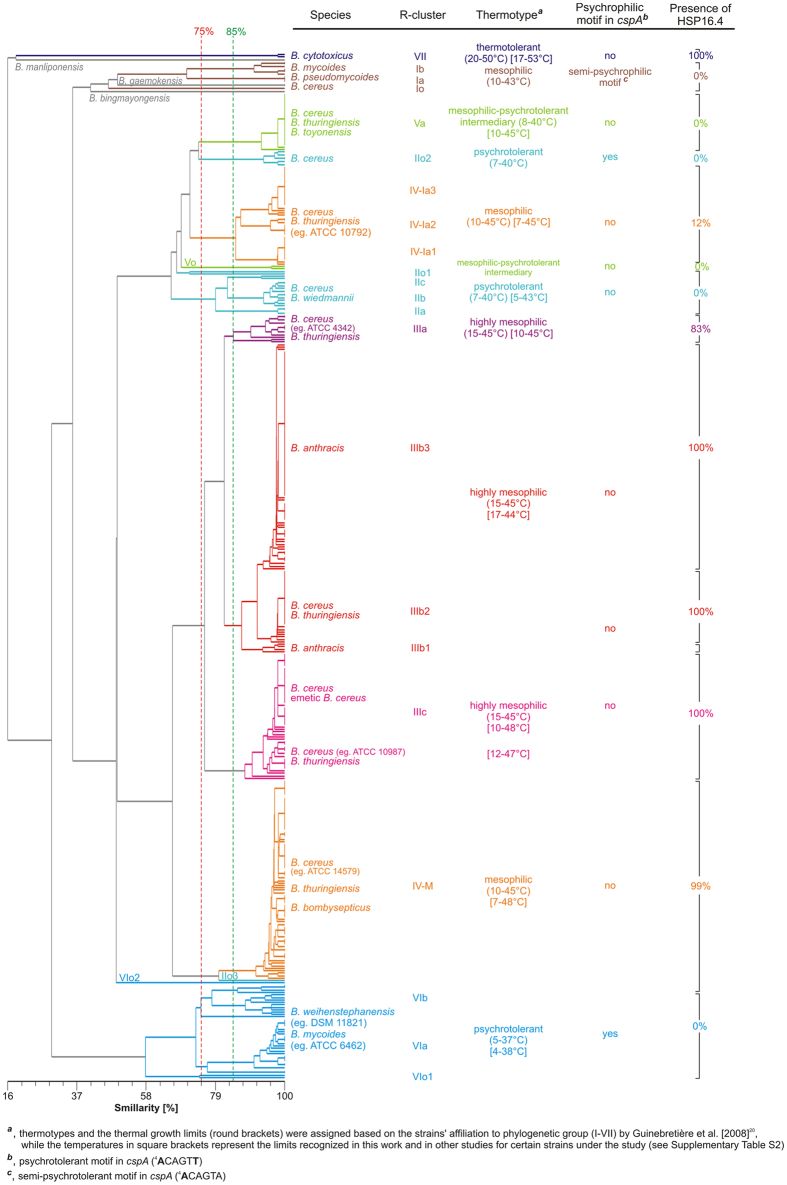
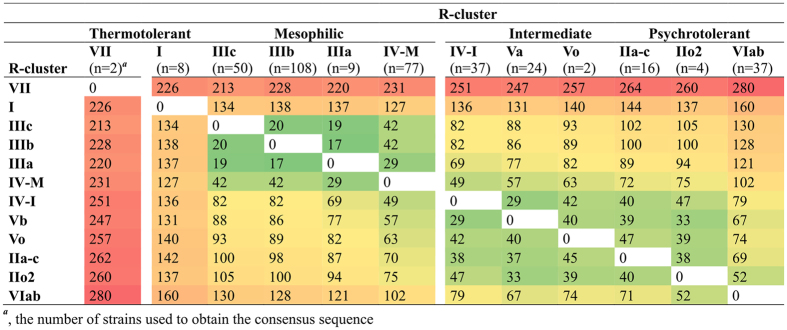
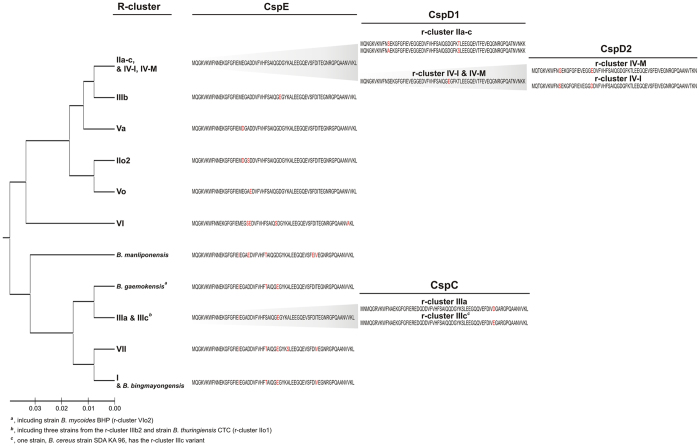
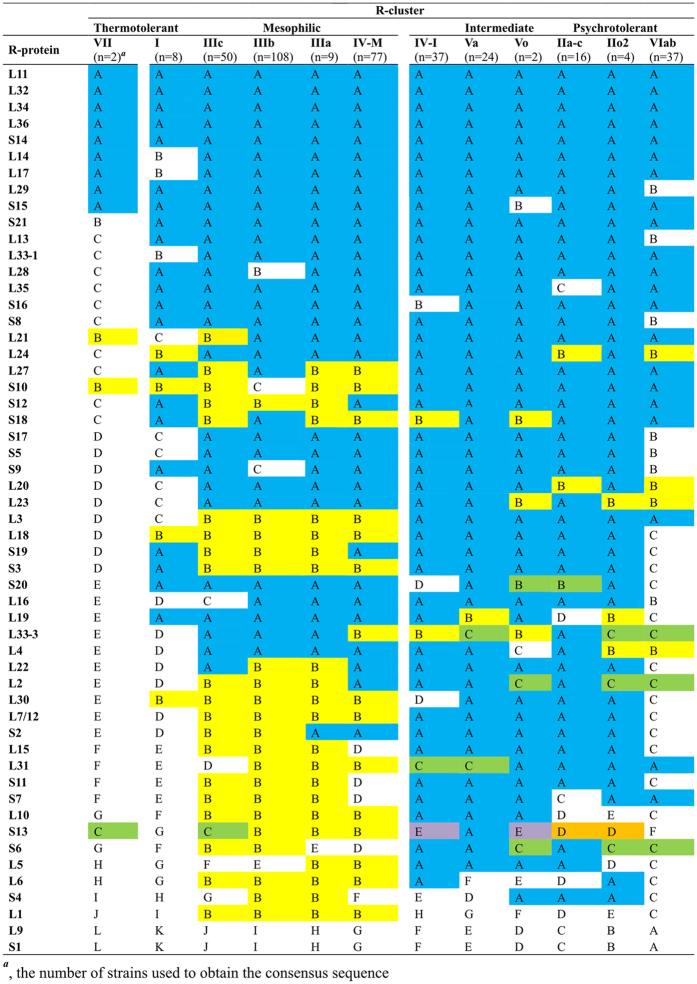
In this study we reconstructed the architecture of Bacillus cereus sensu lato population based on ribosomal proteins, and identified a link between the ribosomal proteins' variants and thermal groups (thermotypes) of the bacilli. The in silico phyloproteomic analysis of 55 ribosomal proteins (34 large and 21 small subunit r-proteins) of 421 strains, representing 14 well-established or plausible B. cereus sensu lato species, revealed several ribosomal clusters (r-clusters), which in general were well correlated with the strains' affiliation to phylogenetic/thermal groups I-VII. However, a conformity and possibly a thermal characteristic of certain phylogenetic groups, e.g. the group IV, were not supported by a distribution of the corresponding r-clusters, and consequently neither by the analysis of cold-shock proteins (CSPs) nor by a content of heat shock proteins (HSPs). Furthermore, a preference for isoleucine and serine over valine and alanine in r-proteins along with a lack of HSP16.4 were recognized in non-mesophilic thermotypes. In conclusion, we suggest that the observed divergence in ribosomal proteins may be connected with an adaptation of B. cereus sensu lato members to various thermal niches.
在本研究中,我们基于核糖体蛋白重建了芽孢杆菌属(Bacillus cereus sensu lato)种群的结构,并确定了核糖体蛋白变体与芽孢杆菌的热群(热型)之间的联系。对 421 株代表 14 种已确立或合理的芽孢杆菌属(Bacillus cereus sensu lato)物种的 55 种核糖体蛋白(34 种大亚基 r 蛋白和 21 种小亚基 r 蛋白)进行了计算机系统发育蛋白质组学分析,揭示了几个核糖体簇(r-clusters),这些簇通常与菌株在系统发育/热群 I-VII 的归属密切相关。然而,某些系统发育群的一致性和可能的热特性,例如群 IV,并没有被相应的 r-clusters 的分布所支持,因此也没有被冷休克蛋白(CSPs)的分析或热休克蛋白(HSPs)的含量所支持。此外,在非嗜温性热型中发现,核糖体蛋白中存在着亮氨酸和丙氨酸取代异亮氨酸和丝氨酸的偏好,以及缺乏 HSP16.4。总之,我们认为核糖体蛋白的这种观察到的差异可能与芽孢杆菌属(Bacillus cereus sensu lato)成员对各种热生境的适应有关。