Song Tae Jin, Kim Jinkwon, Song Dongbeom, Yoo Joonsang, Lee Hye Sun, Kim Yong Jae, Nam Hyo Suk, Heo Ji Hoe, Kim Young Dae
Department of Neurology, Yonsei University College of Medicine, Seoul, Korea.
Department of Neurology, Ewha Womans University School of Medicine, Seoul, Korea.
J Clin Neurol. 2017 Apr;13(2):187-195. doi: 10.3988/jcn.2017.13.2.187.
The recently developed total cerebral small-vessel disease (CSVD) score might appropriately reflect the total burden or severity of CSVD. We investigated whether the total CSVD score is associated with long-term outcomes during follow-up in patients with acute ischemic stroke.
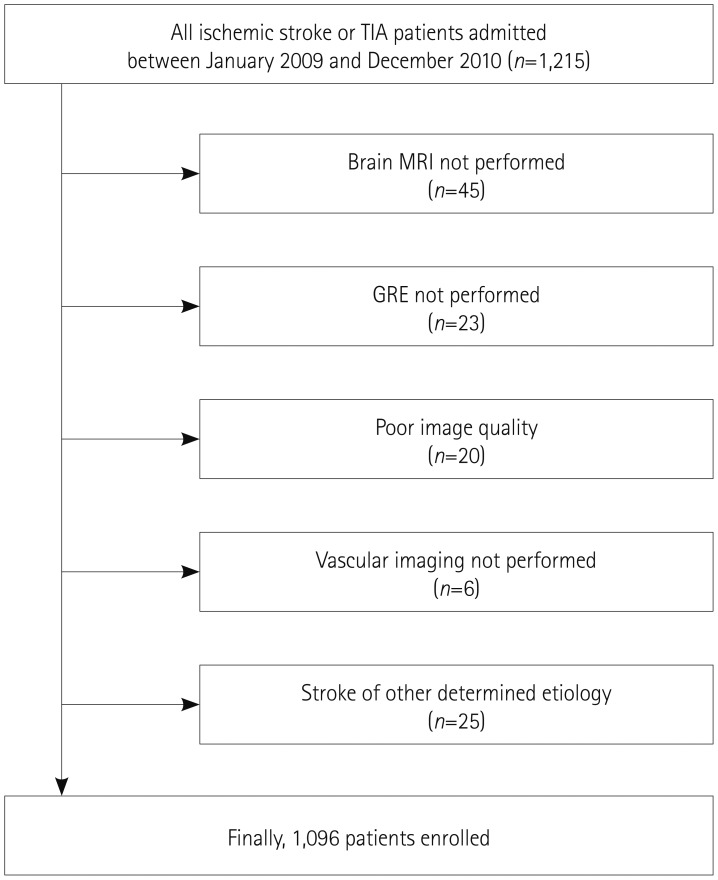
In total, 1,096 consecutive patients with acute ischemic stroke who underwent brain magnetic resonance imaging were enrolled. We calculated the total CSVD score for each patient after determining the burden of cerebral microbleeds (CMBs), high-grade white-matter hyperintensities (HWHs), high-grade perivascular spaces (HPVSs), and asymptomatic lacunar infarctions (ALIs). We recorded the date and cause of death for all of the patients using data from the Korean National Statistical Office. We compared the long-term mortality rate with the total CSVD score using Cox proportional-hazards models.
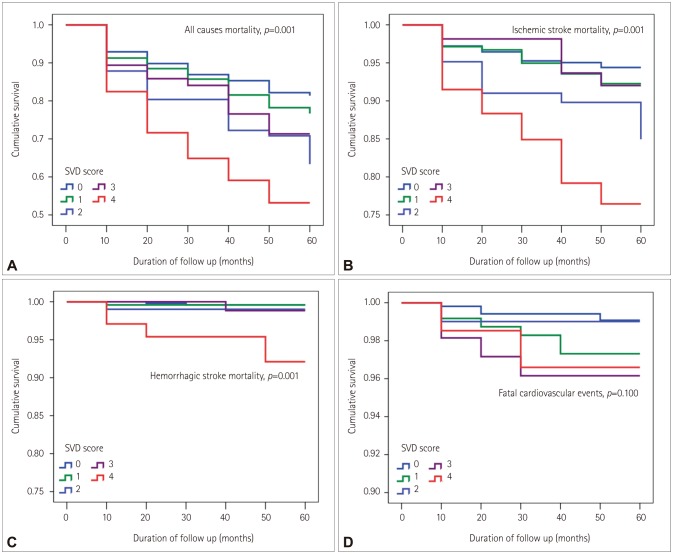
CMBs were found in 26.8% of the subjects (294/1,096), HWHs in 16.4% (180/1,096), HPVSs in 19.3% (211/1,096), and ALIs in 38.0% (416/1,096). After adjusting for age, sex, and variables that were significant at p<0.1 in the univariate analysis, the total CSVD score was independently associated with long-term death from all causes [hazard ratio (HR)=1.18 per point, 95% confidence interval (CI)=1.07-1.30], ischemic stroke (HR=1.20 per point, 95% CI=1.01-1.42), and hemorrhagic stroke (HR=2.05 per point, 95% CI=1.30-3.22), but not with fatal cardiovascular events (HR=1.17 per point, 95% CI=0.82-1.67).
The total CSVD score is a potential imaging biomarker for predicting mortality during follow-up in patients with acute ischemic stroke.
最近开发的全脑小血管疾病(CSVD)评分可能恰当地反映CSVD的总负担或严重程度。我们调查了急性缺血性卒中患者随访期间CSVD总分是否与长期预后相关。
总共纳入了1096例连续接受脑磁共振成像检查的急性缺血性卒中患者。在确定脑微出血(CMB)、高级别白质高信号(HWH)、高级别血管周围间隙(HPVS)和无症状腔隙性梗死(ALI)的负担后,我们计算了每位患者的CSVD总分。我们使用韩国国家统计局的数据记录了所有患者的死亡日期和原因。我们使用Cox比例风险模型比较了长期死亡率与CSVD总分。
26.8%的受试者(294/1096)发现有CMB,16.4%(180/1096)有HWH,19.3%(211/1096)有HPVS,38.0%(416/1096)有ALI。在对年龄、性别和单变量分析中p<0.1时有显著性的变量进行校正后,CSVD总分与各种原因导致的长期死亡独立相关[风险比(HR)=每增加1分1.18,95%置信区间(CI)=1.07-1.30]、缺血性卒中(HR=每增加1分1.20,95%CI=1.01-1.42)和出血性卒中(HR=每增加1分2.05,95%CI=1.30-3.22),但与致命性心血管事件无关(HR=每增加1分1.17,95%CI=0.82-1.67)。
CSVD总分是预测急性缺血性卒中患者随访期间死亡率的潜在影像学生物标志物。