Speier William, Deshpande Aniket, Cui Lucy, Chandravadia Nand, Roberts Dustin, Pouratian Nader
Department of Neurosurgery, University of California, Los Angeles, Los Angeles, CA, United States of America.
Department of Bioengineering, University of California, Los Angeles, Los Angeles, CA, United States of America.
PLoS One. 2017 Apr 13;12(4):e0175382. doi: 10.1371/journal.pone.0175382. eCollection 2017.
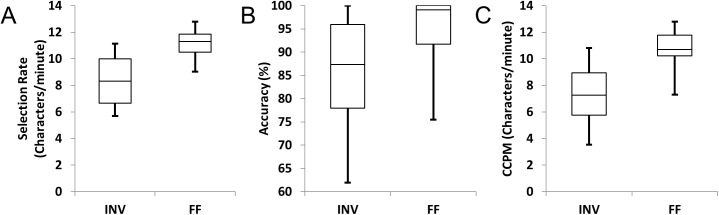
The P300 Speller is a common brain-computer interface communication system. There are many parallel lines of research underway to overcome the system's low signal to noise ratio and thereby improve performance, including using famous face stimuli and integrating language information into the classifier. While both have been shown separately to provide significant improvements, the two methods have not yet been implemented together to demonstrate that the improvements are complimentary. The goal of this study is therefore twofold. First, we aim to compare the famous faces stimulus paradigm with an existing alternative stimulus paradigm currently used in commercial systems (i.e., character inversion). Second, we test these methods with language model integration to assess whether different optimization approaches can be combined to further improve BCI communication. In offline analysis using a previously published particle filter method, famous faces stimuli yielded superior results to both standard and inverting stimuli. In online trials using the particle filter method, all 10 subjects achieved a higher selection rate when using the famous faces flashing paradigm than when using inverting flashes. The improvements achieved by these methods are therefore complementary and a combination yields superior results to either method implemented individually when tested in healthy subjects.
P300 拼写器是一种常见的脑机接口通信系统。目前有许多并行的研究方向,旨在克服该系统的低信噪比,从而提高其性能,包括使用名人面部刺激以及将语言信息整合到分类器中。虽然这两种方法已分别被证明能带来显著改进,但尚未将这两种方法结合起来以证明这些改进是互补的。因此,本研究有两个目标。首先,我们旨在将名人面部刺激范式与商业系统中目前使用的一种现有替代刺激范式(即字符反转)进行比较。其次,我们通过语言模型整合来测试这些方法,以评估不同的优化方法是否可以结合起来进一步改善脑机接口通信。在使用先前发表的粒子滤波方法进行的离线分析中,名人面部刺激产生的结果优于标准刺激和反转刺激。在使用粒子滤波方法进行的在线试验中,所有 10 名受试者在使用名人面部闪烁范式时的选择率都高于使用反转闪烁时的选择率。因此,这些方法所实现的改进是互补的,并且在健康受试者中进行测试时,将这两种方法结合起来产生的结果优于单独实施的任何一种方法。