Kim Hodam, Im Chang-Hwan
Department of Biomedical Engineering, Hanyang University, Seoul, South Korea.
Department of Electronic Engineering, Hanyang University, Seoul, South Korea.
Front Neuroinform. 2021 Oct 22;15:750839. doi: 10.3389/fninf.2021.750839. eCollection 2021.
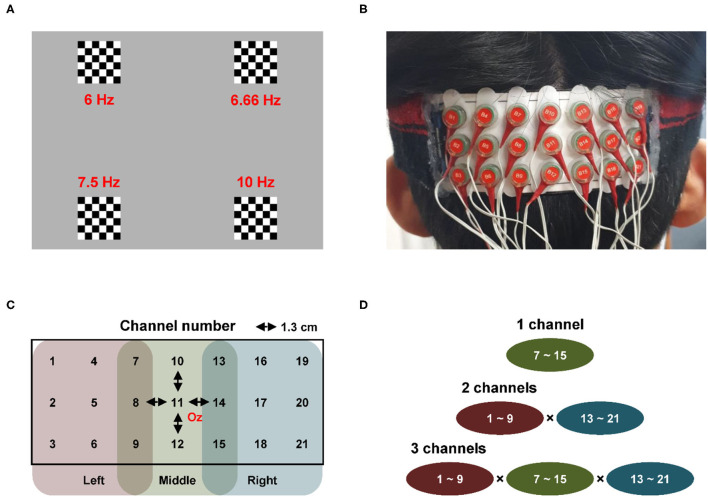
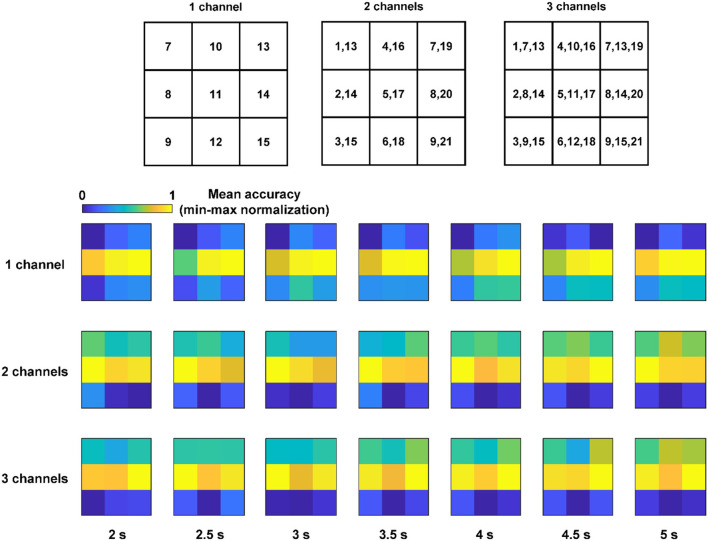
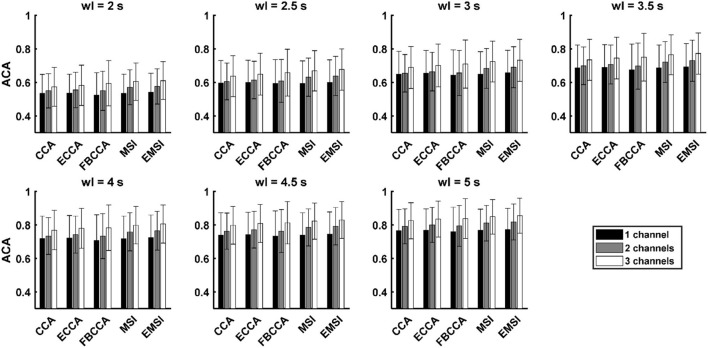
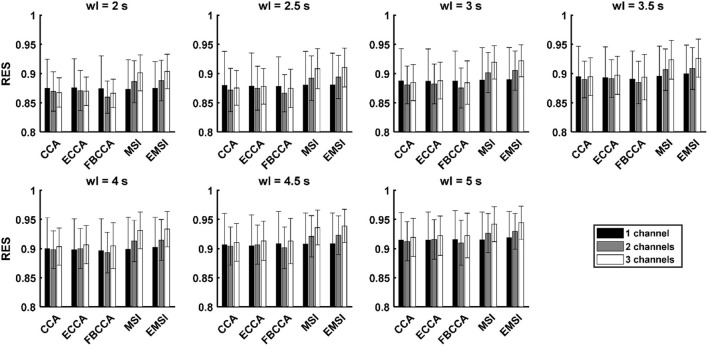
There remains an active investigation on elevating the classification accuracy and information transfer rate of brain-computer interfaces based on steady-state visual evoked potential. However, it has often been ignored that the performance of steady-state visual evoked potential (SSVEP)-based brain-computer interfaces (BCIs) can be affected through the minor displacement of the electrodes from their optimal locations in practical applications because of the mislocation of electrodes and/or concurrent use of electroencephalography (EEG) devices with external devices, such as virtual reality headsets. In this study, we evaluated the performance robustness of SSVEP-based BCIs with respect to the changes in electrode locations for various channel configurations and classification algorithms. Our experiments involved 21 participants, where EEG signals were recorded from the scalp electrodes densely attached to the occipital area of the participants. The classification accuracies for all the possible cases of electrode location shifts for various channel configurations (1-3 channels) were calculated using five training-free SSVEP classification algorithms, i.e., the canonical correlation analysis (CCA), extended CCA, filter bank CCA, multivariate synchronization index (MSI), and extended MSI (EMSI). Then, the performances of the BCIs were evaluated using two measures, i.e., the average classification accuracy (ACA) across the electrode shifts and robustness to the electrode shift (RES). Our results showed that the ACA increased with an increase in the number of channels regardless of the algorithm. However, the RES was enhanced with an increase in the number of channels only when MSI and EMSI were employed. While both ACA and RES values for the five algorithms were similar under the single-channel condition, both ACA and RES values for MSI and EMSI were higher than those of the other algorithms under the multichannel (i.e., two or three electrodes) conditions. In addition, EMSI outperformed MSI when comparing the ACA and RES values under the multichannel conditions. In conclusion, our results suggested that the use of multichannel configuration and employment of EMSI could make the performance of SSVEP-based BCIs more robust to the electrode shift from the optimal locations.
目前,关于提高基于稳态视觉诱发电位的脑机接口的分类准确率和信息传输率的研究仍在积极进行。然而,人们常常忽略的是,在实际应用中,由于电极位置错误和/或同时使用脑电图(EEG)设备与外部设备(如虚拟现实头戴式设备),基于稳态视觉诱发电位(SSVEP)的脑机接口(BCI)的性能可能会受到电极从其最佳位置的微小位移的影响。在本研究中,我们评估了基于SSVEP的BCI在各种通道配置和分类算法下,相对于电极位置变化的性能稳健性。我们的实验涉及21名参与者,从紧密附着在参与者枕部区域的头皮电极记录EEG信号。使用五种无需训练的SSVEP分类算法,即典型相关分析(CCA)、扩展CCA、滤波器组CCA、多变量同步指数(MSI)和扩展MSI(EMSI),计算了各种通道配置(1 - 3个通道)下所有可能的电极位置偏移情况的分类准确率。然后,使用两种指标评估BCI的性能,即跨电极偏移的平均分类准确率(ACA)和对电极偏移的稳健性(RES)。我们的结果表明,无论采用何种算法,ACA都随着通道数量的增加而提高。然而,只有在使用MSI和EMSI时,RES才会随着通道数量的增加而增强。虽然在单通道条件下,五种算法的ACA和RES值相似,但在多通道(即两个或三个电极)条件下,MSI和EMSI的ACA和RES值均高于其他算法。此外,在多通道条件下比较ACA和RES值时,EMSI的表现优于MSI。总之,我们的结果表明,使用多通道配置和采用EMSI可以使基于SSVEP的BCI的性能对电极从最佳位置的偏移更加稳健。