Zacher Meghan, Bayly Megan, Brennan Emily, Dono Joanne, Miller Caroline, Durkin Sarah, Scollo Michelle, Wakefield Melanie
Cancer Council Victoria, Melbourne, Victoria, Australia.
South Australian Health and Medical Research Institute, Adelaide, South Australia, Australia.
Tob Control. 2015 Apr;24(Suppl 2):ii94-ii97. doi: 10.1136/tobaccocontrol-2014-051826. Epub 2015 Feb 25.
We observed tobacco pack display and smoking at outdoor venues over three summers to assess changes in their prevalence following Australia's introduction of plain tobacco packaging with larger pictorial health warnings.
Between January and April 2012 (preplain packaging (PP)), 2013 (early post-PP) and 2014 (1 year post-PP), we counted patrons, smokers and tobacco packs at cafés, restaurants and bars with outdoor seating. Pack type (branded, plain or unknown) and orientation were noted. Rates of active smoking, pack display and pack orientation were analysed using multilevel Poisson regression.
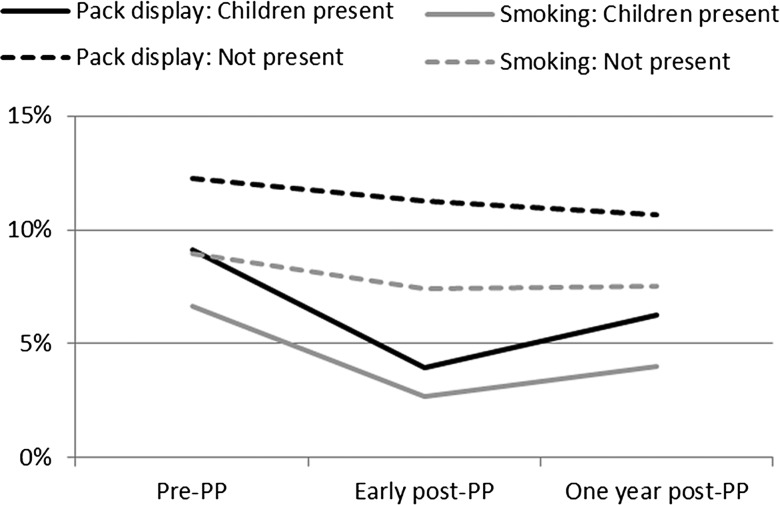
Prevalence of pack display among patrons declined from pre-PP (1 pack per 8.7 patrons) to early post-PP (1 pack per 10.4), and remained low 1 year post-PP (1 pack per 10.3). This appeared to be driven by a sustained decline in active smoking post-PP (pre-PP: 8.4% of patrons were smoking; early post-PP: 6.4%; 1 year post-PP: 6.8%). Notably, active smoking declined more in venues with children present than in those without. While early post-PP, plain packs were less often displayed face-up (74.0%) and more often concealed (8.9%) than branded packs pre-PP (face-up: 85.2%; concealed: 4.0%), this was not sustained 1 year post-PP (face-up: 85.7%; concealed: 4.4%). Also, external case use increased from pre-PP (1.2%) to early post-PP (3.5%), but returned to pre-PP levels 1 year post-PP (1.9%).
This study demonstrated a sustained reduction in visibility of tobacco products and smoking in public, particularly in the presence of children, from pre-PP to 1 year post-PP. This effect is likely to reduce smoking-related social norms, thereby weakening an important influence on smoking uptake and better supporting quit attempts.
我们在三个夏天观察了户外场所的烟草包装展示及吸烟情况,以评估澳大利亚引入带有更大图片健康警示的素面烟草包装后,其流行率的变化。
在2012年1月至4月(素面包装前(PP))、2013年(素面包装后早期)和2014年(素面包装后1年)期间,我们对设有户外座位的咖啡馆、餐馆和酒吧的顾客、吸烟者及烟草包装进行了计数。记录包装类型(品牌、素面或不明)及摆放方向。使用多水平泊松回归分析主动吸烟率、包装展示率及包装摆放方向。
顾客中包装展示的流行率从素面包装前(每8.7名顾客有1个包装)降至素面包装后早期(每10.4名顾客有1个包装),并在素面包装后1年保持在较低水平(每10.3名顾客有1个包装)。这似乎是由素面包装后主动吸烟率的持续下降所驱动(素面包装前:8.4%的顾客在吸烟;素面包装后早期:6.4%;素面包装后1年:6.8%)。值得注意的是,有儿童在场的场所中主动吸烟率的下降幅度大于无儿童的场所。虽然在素面包装后早期,与素面包装前的品牌包装相比,素面包装正面朝上展示的频率较低(74.0%),隐藏的频率较高(8.9%)(正面朝上:85.2%;隐藏:4.0%),但在素面包装后1年这一情况并未持续(正面朝上:85.7%;隐藏:4.4%)。此外,外包装的使用从素面包装前的1.2%增至素面包装后早期的3.5%,但在素面包装后1年又回到了素面包装前的水平(1.9%)。
本研究表明,从素面包装前到素面包装后1年,烟草制品在公共场所的可见度及吸烟情况持续下降,尤其是在有儿童在场的情况下。这种效果可能会减少与吸烟相关的社会规范,从而削弱对吸烟行为的一个重要影响,并更好地支持戒烟尝试。