Flythe Jennifer E, Hilbert Johnathan, Kshirsagar Abhijit V, Gilet Constance A
University of North Carolina Kidney Center, Division of Nephrology and Hypertension, Department of Medicine, UNC School of Medicine, Chapel Hill, NC, USA.
Am J Nephrol. 2017;45(5):400-408. doi: 10.1159/000470917. Epub 2017 Apr 14.
Thirty-day hospital readmissions are common among maintenance dialysis patients. Prior studies have evaluated easily measurable readmission risk factors such as comorbid conditions, laboratory results, and hospital discharge day. We undertook this prospective study to investigate the associations between hospital-assessed depression, health literacy, social support, and self-rated health (separately) and 30-day hospital readmission among dialysis patients.
Participants were recruited from the University of North Carolina Hospitals, 2014-2016. Validated depression, health literacy, social support, and self-rated health screening instruments were administered during index hospitalizations. Multivariable logistic regression models with 30-day readmission as the dependent outcome were used to examine readmission risk factors.
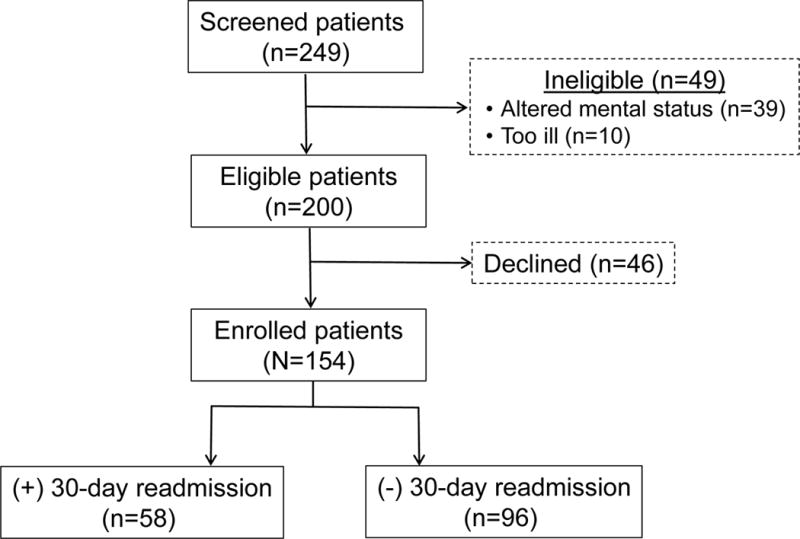
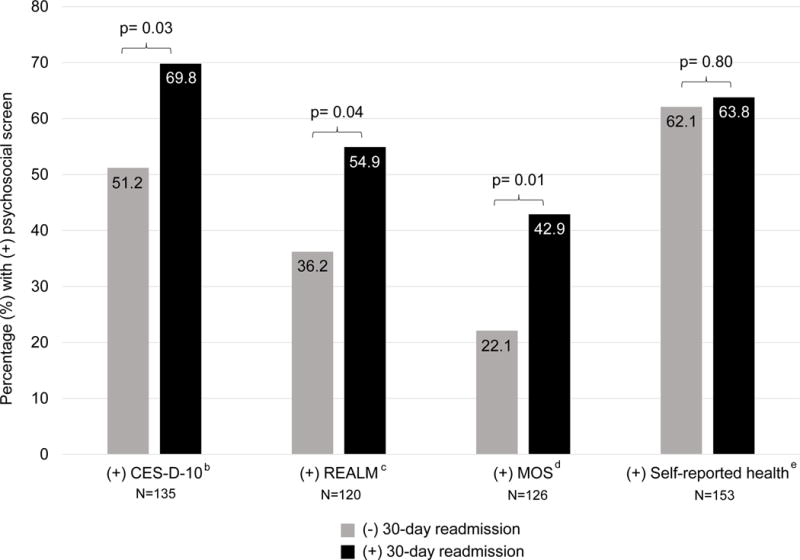
Of the 154 participants, 58 (37.7%) had a 30-day hospital readmission. In unadjusted analyses, individuals with positive screening for depression, lower health literacy, and poorer social support were more likely to have a 30-day readmission (vs. negative screening). Positive depression screening and poorer social support remained significantly associated with 30-day readmission in models adjusted for race, heart failure, admitting service, weekend discharge day, and serum albumin: adjusted OR (95% CI) 2.33 (1.02-5.15) for positive depressive symptoms and 2.57 (1.10-5.91) for poorer social support. The area under the receiver operating characteristic curve (AUC) of the multivariable model adjusted for social support status was significantly greater than the AUC of the multivariable model without social support status (test for equality; p value = 0.04).
Poor social support and depressive symptoms identified during hospitalizations may represent targetable readmission risk factors among dialysis patients. Our findings suggest that hospital-based assessments of select psychosocial factors may improve readmission risk prediction.
维持性透析患者30天内再次入院情况很常见。既往研究评估了易于测量的再入院风险因素,如合并症、实验室检查结果和出院日。我们开展这项前瞻性研究,以调查医院评估的抑郁、健康素养、社会支持和自评健康(分别)与透析患者30天内再次入院之间的关联。
2014年至2016年从北卡罗来纳大学医院招募参与者。在首次住院期间使用经过验证的抑郁、健康素养、社会支持和自评健康筛查工具。以30天再入院作为因变量,采用多变量逻辑回归模型来检查再入院风险因素。
154名参与者中,58名(37.7%)在30天内再次入院。在未调整分析中,抑郁筛查呈阳性、健康素养较低和社会支持较差的个体更有可能在30天内再次入院(与筛查呈阴性者相比)。在对种族、心力衰竭、入院科室、周末出院日和血清白蛋白进行调整的模型中,抑郁筛查呈阳性和社会支持较差仍与30天再入院显著相关:抑郁症状阳性的调整后比值比(95%置信区间)为2.33(1.02 - 5.15),社会支持较差的为2.57(1.10 - 5.91)。根据社会支持状况调整的多变量模型的受试者工作特征曲线下面积(AUC)显著大于未考虑社会支持状况的多变量模型(平等性检验;p值 = 0.04)。
住院期间发现的社会支持差和抑郁症状可能是透析患者可针对的再入院风险因素。我们的研究结果表明,基于医院对特定心理社会因素的评估可能会改善再入院风险预测。