Knoedler Joseph R, Subramani Arasakumar, Denver Robert J
Neuroscience Graduate Program, The University of Michigan, Ann Arbor, MI, 48109, USA.
Current address: Department of Psychiatry and Behavioral Sciences, Stanford University, Stanford, CA, 94305, USA.
BMC Genomics. 2017 Apr 13;18(1):299. doi: 10.1186/s12864-017-3640-7.
Krüppel-like factor 9 (Klf9) is a zinc finger transcription factor that functions in neural cell differentiation, but little is known about its genomic targets or mechanism of action in neurons.
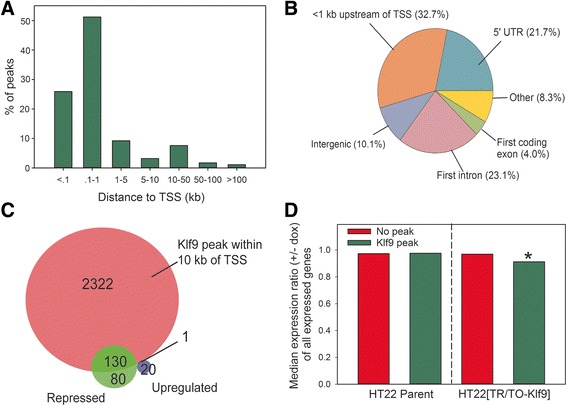
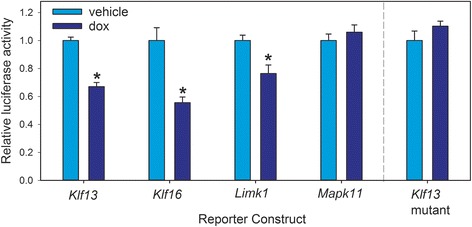
We used the mouse hippocampus-derived neuronal cell line HT22 to identify genes regulated by Klf9, and we validated our findings in mouse hippocampus. We engineered HT22 cells to express a Klf9 transgene under control of the tetracycline repressor, and used RNA sequencing to identify genes modulated by Klf9. We found 217 genes repressed and 21 induced by Klf9. We also engineered HT22 cells to co-express biotin ligase and a Klf9 fusion protein containing an N-terminal biotin ligase recognition peptide. Using chromatin-streptavidin precipitation (ChSP) sequencing we identified 3,514 genomic regions where Klf9 associated. Seventy-five percent of these were within 1 kb of transcription start sites, and Klf9 associated in chromatin with 60% of the repressed genes. We analyzed the promoters of several repressed genes containing Klf9 ChSP peaks using transient transfection reporter assays and found that Klf9 repressed promoter activity, which was abolished after mutation of Sp/Klf-like motifs. Knockdown or knockout of Klf9 in HT22 cells caused dysregulation of Klf9 target genes. Chromatin immunoprecipitation assays showed that Klf9 associated in chromatin from mouse hippocampus with genes identified by ChSP sequencing on HT22 cells, and expression of Klf9 target genes was dysregulated in the hippocampus of neonatal Klf9-null mice. Gene ontology analysis revealed that Klf9 genomic targets include genes involved in cystokeletal remodeling, Wnt signaling and inflammation.
We have identified genomic targets of Klf9 in hippocampal neurons and created a foundation for future studies on how it functions in chromatin, and regulates neuronal morphology and survival across the lifespan.
Krüppel样因子9(Klf9)是一种锌指转录因子,在神经细胞分化中发挥作用,但其在神经元中的基因组靶点或作用机制尚不清楚。
我们使用源自小鼠海马体的神经元细胞系HT22来鉴定受Klf9调控的基因,并在小鼠海马体中验证了我们的发现。我们构建了HT22细胞,使其在四环素阻遏物的控制下表达Klf9转基因,并使用RNA测序来鉴定受Klf9调节的基因。我们发现有217个基因被Klf9抑制,21个基因被Klf9诱导。我们还构建了HT22细胞,使其共表达生物素连接酶和一种含有N端生物素连接酶识别肽的Klf9融合蛋白。使用染色质-链霉亲和素沉淀(ChSP)测序,我们鉴定出3514个Klf9相关的基因组区域。其中75%位于转录起始位点的1 kb范围内,Klf9在染色质中与60%的受抑制基因相关。我们使用瞬时转染报告基因分析方法分析了几个含有Klf9 ChSP峰的受抑制基因的启动子,发现Klf9抑制了启动子活性,而在Sp/Klf样基序发生突变后这种抑制作用消失。在HT22细胞中敲低或敲除Klf9会导致Klf9靶基因的失调。染色质免疫沉淀分析表明,Klf9在小鼠海马体的染色质中与通过HT22细胞ChSP测序鉴定的基因相关,并且在新生Klf9基因敲除小鼠的海马体中,Klf9靶基因的表达失调。基因本体分析显示,Klf9的基因组靶点包括参与细胞骨架重塑、Wnt信号传导和炎症的基因。
我们已经鉴定出海马神经元中Klf9的基因组靶点,并为未来研究其在染色质中的功能以及在整个生命周期中调节神经元形态和存活奠定了基础。