Vilmi-Kerälä Tiina, Lauhio Anneli, Tervahartiala Taina, Palomäki Outi, Uotila Jukka, Sorsa Timo, Palomäki Ari
School of Medicine, University of Tampere, Tampere, Finland.
Department of Obstetrics and Gynecology, Tampere University Hospital, Box 2000, 33521, Tampere, Finland.
Cardiovasc Diabetol. 2017 Apr 13;16(1):49. doi: 10.1186/s12933-017-0530-x.
Gestational diabetes mellitus (GDM) has significant implications for the future health of the mother. Some clinical studies have suggested subclinical inflammation and vascular dysfunction after GDM. We aimed to study whether concentrations of high-sensitivity C-reactive protein (hsCRP), tissue inhibitor of metalloproteinase-1 (TIMP-1), matrix metalloproteinase-8 (MMP-8) and -9, as well as values of arterial stiffness differ between women with and without a history of GDM a few years after delivery. We also investigated possible effects of obesity on the results.
We studied two cohorts-120 women with a history of GDM and 120 controls-on average 3.7 years after delivery. Serum concentrations of hsCRP were determined by immunonephelometric and immunoturbidimetric methods, MMP-8 by immunofluorometric assay, and MMP-9 and TIMP-1 by enzyme-linked immunosorbent assays. Pulse wave velocity (PWV) was determined using the foot-to-foot velocity method from carotid and femoral waveforms by using a SphygmoCor device. Arterial compliance was measured non-invasively by an HDI/PulseWave™CR-2000 arterial tonometer. All 240 women were also included in subgroup analyses to study the effect of obesity on the results. Multiple linear regression analyses were performed with adjustment for confounding factors.
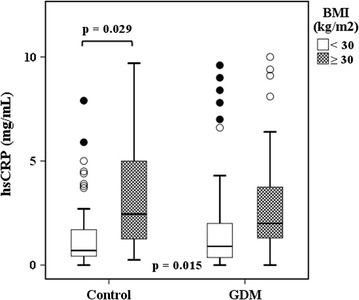
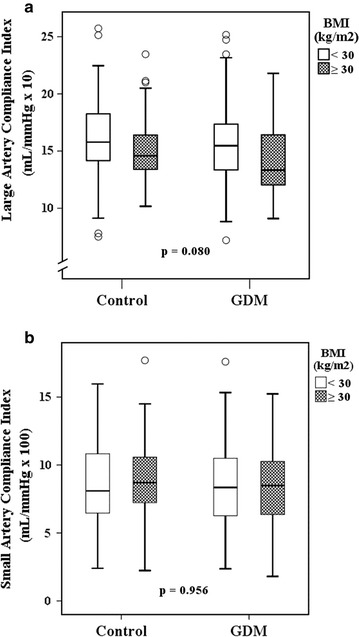
PWV after pregnancy complicated by GDM was significantly higher than after normal pregnancy, 6.44 ± 0.83 (SD) vs. 6.17 ± 0.74 m/s (p = 0.009). Previous GDM was also one of the significant determinants of PWV in multiple linear regression analyses. On the other hand, compliance indices of both large (p = 0.092) and small (p = 0.681) arteries did not differ between the study cohorts. Serum TIMP-1 levels were significantly increased after previous GDM (p = 0.020). However, no differences were found in the serum levels of MMP-8, MMP-9 or hsCRP. In subgroup analyses, there were significantly higher concentrations of hsCRP (p = 0.015) and higher PWV (p < 0.001) among obese women compared with non-obese ones.
PWV values were significantly higher after GDM compared with normoglycemic pregnancies and were associated with prolonged TIMP-1 upregulation. Cardiovascular risk factors were more common in participants with high BMI than in those with previous GDM.
妊娠期糖尿病(GDM)对母亲未来的健康有重大影响。一些临床研究表明,GDM后存在亚临床炎症和血管功能障碍。我们旨在研究分娩几年后,有和没有GDM病史的女性之间,高敏C反应蛋白(hsCRP)、金属蛋白酶组织抑制剂-1(TIMP-1)、基质金属蛋白酶-8(MMP-8)和-9的浓度以及动脉僵硬度值是否存在差异。我们还研究了肥胖对结果可能产生的影响。
我们研究了两个队列——120名有GDM病史的女性和120名对照者——平均在分娩后3.7年。hsCRP的血清浓度通过免疫比浊法和免疫散射比浊法测定,MMP-8通过免疫荧光测定法测定,MMP-9和TIMP-1通过酶联免疫吸附测定法测定。使用SphygmoCor设备通过足-足速度法从颈动脉和股动脉波形测定脉搏波速度(PWV)。通过HDI/PulseWave™CR-2000动脉血压计无创测量动脉顺应性。所有240名女性也纳入亚组分析,以研究肥胖对结果的影响。进行多线性回归分析并对混杂因素进行校正。
GDM合并妊娠后的PWV显著高于正常妊娠后,分别为6.44±0.83(标准差)与6.17±0.74米/秒(p=0.009)。在多线性回归分析中,既往GDM也是PWV的重要决定因素之一。另一方面,研究队列之间大(p=0.092)、小(p=0.681)动脉的顺应性指数没有差异。既往GDM后血清TIMP-1水平显著升高(p=0.020)。然而,MMP-8、MMP-9或hsCRP的血清水平没有差异。在亚组分析中,肥胖女性的hsCRP浓度显著更高(p=0.015),PWV也更高(p<0.001)。
与血糖正常的妊娠相比,GDM后的PWV值显著更高,并且与TIMP-1上调时间延长有关。高BMI参与者的心血管危险因素比既往有GDM的参与者更常见。