Lehmer Carina, Oeckl Patrick, Weishaupt Jochen H, Volk Alexander E, Diehl-Schmid Janine, Schroeter Matthias L, Lauer Martin, Kornhuber Johannes, Levin Johannes, Fassbender Klaus, Landwehrmeyer Bernhard, Schludi Martin H, Arzberger Thomas, Kremmer Elisabeth, Flatley Andrew, Feederle Regina, Steinacker Petra, Weydt Patrick, Ludolph Albert C, Edbauer Dieter, Otto Markus
German Center for Neurodegenerative Diseases (DZNE) and Munich Cluster for System Neurology (SyNergy), Munich, Germany.
Department of Neurology, Ulm University Hospital, Ulm, Germany.
EMBO Mol Med. 2017 Jul;9(7):859-868. doi: 10.15252/emmm.201607486.
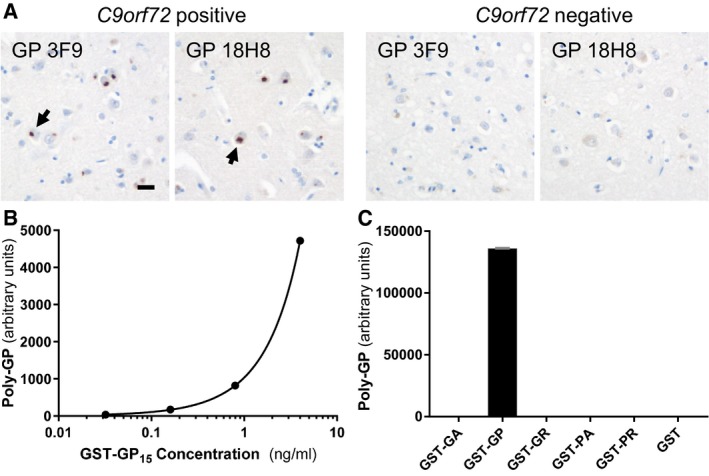
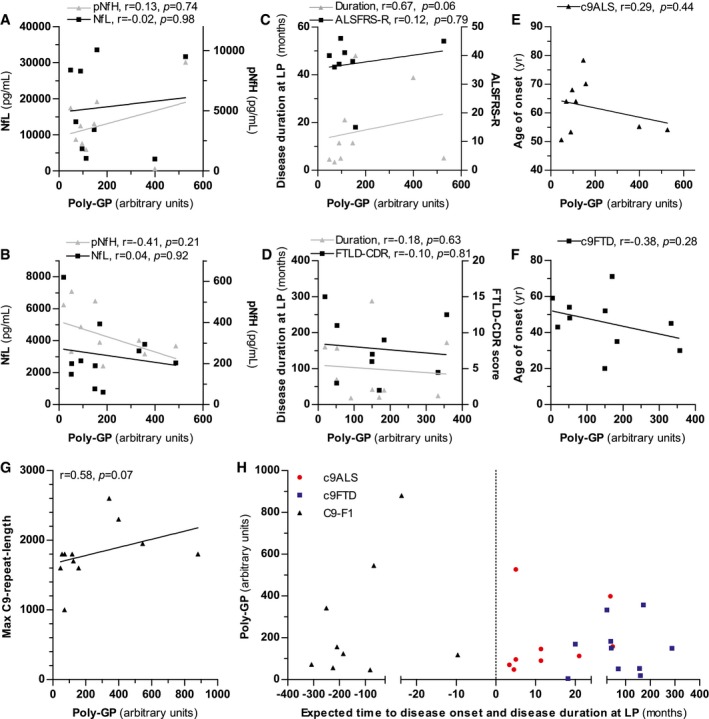
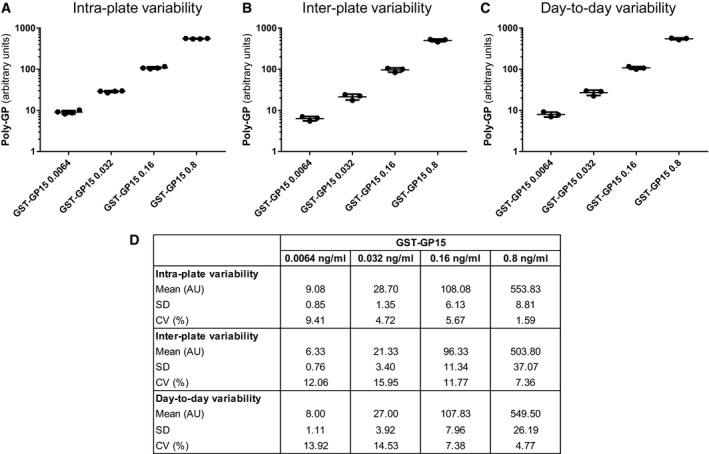
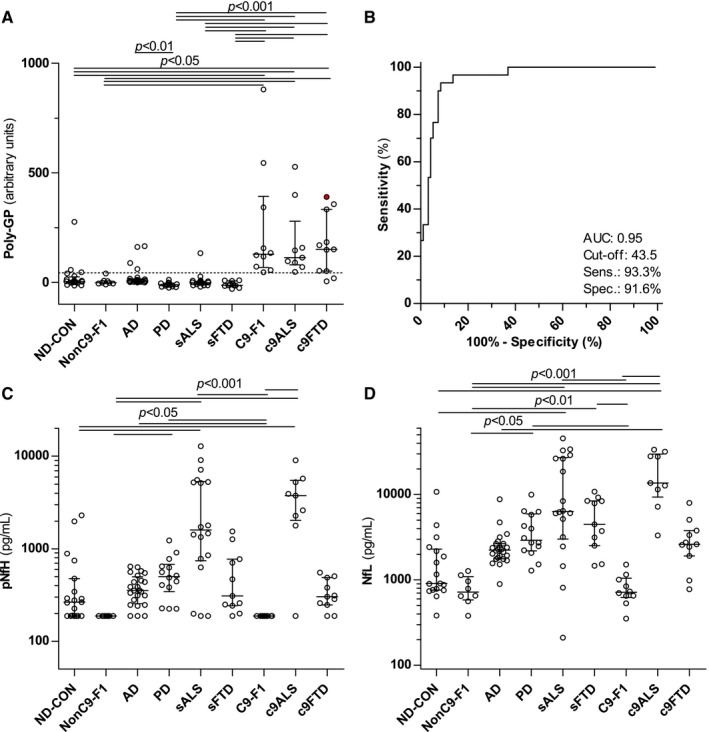
The GGGGCC repeat expansion is a major cause of amyotrophic lateral sclerosis and frontotemporal dementia (c9ALS/FTD). Non-conventional repeat translation results in five dipeptide repeat proteins (DPRs), but their clinical utility, overall significance, and temporal course in the pathogenesis of c9ALS/FTD are unclear, although animal models support a gain-of-function mechanism. Here, we established a poly-GP immunoassay from cerebrospinal fluid (CSF) to identify and characterize patients. Significant poly-GP levels were already detectable in asymptomatic mutation carriers compared to healthy controls and patients with other neurodegenerative diseases. The poly-GP levels in asymptomatic carriers were similar to symptomatic c9ALS/FTD cases. Poly-GP levels were not correlated with disease onset, clinical scores, and CSF levels of neurofilaments as a marker for axonal damage. Poly-GP determination in CSF revealed a mutation carrier in our cohort and may thus be used as a diagnostic marker in addition to genetic testing to screen patients. Presymptomatic expression of poly-GP and likely other DPR species may contribute to disease onset and thus represents an alluring therapeutic target.
GGGGCC重复序列扩增是肌萎缩侧索硬化症和额颞叶痴呆(c9ALS/FTD)的主要病因。非传统的重复序列翻译会产生五种二肽重复蛋白(DPRs),尽管动物模型支持功能获得机制,但它们在c9ALS/FTD发病机制中的临床效用、总体意义和时间进程尚不清楚。在此,我们建立了一种从脑脊液(CSF)中检测聚甘氨酰胺(poly-GP)的免疫测定法,以识别和表征患者。与健康对照和其他神经退行性疾病患者相比,在无症状突变携带者中已经可以检测到显著的聚甘氨酰胺水平。无症状携带者中的聚甘氨酰胺水平与有症状的c9ALS/FTD病例相似。聚甘氨酰胺水平与疾病发作、临床评分以及作为轴突损伤标志物的脑脊液神经丝水平无关。脑脊液中聚甘氨酰胺的测定在我们的队列中发现了一名突变携带者,因此除基因检测外,还可作为诊断标志物用于筛查患者。聚甘氨酰胺以及可能的其他DPR种类的症状前表达可能促成疾病发作,因此是一个诱人的治疗靶点。