Alberer Martin, Schlenker Nicklas, Bauer Malkin, Helfrich Kerstin, Mengele Carolin, Löscher Thomas, Nothdurft Hans Dieter, Bretzel Gisela, Beissner Marcus
Department of Infectious Diseases and Tropical Medicine, Medical Centre, Ludwig-Maximilians-University (LMU), Munich, Germany.
Can J Infect Dis Med Microbiol. 2017;2017:3472537. doi: 10.1155/2017/3472537. Epub 2017 Mar 16.
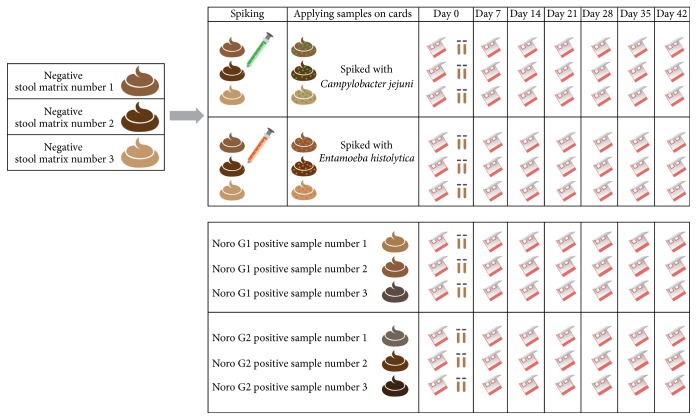
. Up to 30% of international travelers are affected by travelers' diarrhea (TD). Reliable data on the etiology of TD is lacking. Sufficient laboratory capacity at travel destinations is often unavailable and transporting conventional stool samples to the home country is inconvenient. We evaluated the use of Hemoccult cards for stool sampling combined with a multiplex PCR for the detection of model viral, bacterial, and protozoal TD pathogens. . Following the creation of serial dilutions for each model pathogen, last positive dilution steps (LPDs) and thereof calculated last positive sample concentrations (LPCs) were compared between conventional stool samples and card samples. Furthermore, card samples were tested after a prolonged time interval simulating storage during a travel duration of up to 6 weeks. . The LPDs/LPCs were comparable to testing of conventional stool samples. After storage on Hemoccult cards, the recovery rate was 97.6% for , 100% for . , 97.6% for norovirus GI, and 100% for GII. Detection of expected pathogens was possible at weekly intervals up to 42 days. . Stool samples on Hemoccult cards stored at room temperature can be used in combination with a multiplex PCR as a reliable tool for testing of TD pathogens.
高达30%的国际旅行者会受到旅行者腹泻(TD)的影响。目前缺乏关于TD病因的确切数据。旅行目的地往往没有足够的实验室检测能力,而且将传统粪便样本运回本国也不方便。我们评估了使用便隐血卡进行粪便采样并结合多重PCR检测典型病毒、细菌和原生动物TD病原体的方法。在为每种典型病原体创建系列稀释液后,比较了传统粪便样本和卡片样本之间的最后阳性稀释步骤(LPDs)及其计算得出的最后阳性样本浓度(LPCs)。此外,在模拟长达6周旅行期间的储存时间间隔延长后,对卡片样本进行了检测。LPDs/LPCs与传统粪便样本检测结果相当。在便隐血卡上储存后, 的回收率为97.6%, 的回收率为100%,诺如病毒GI的回收率为97.6%,GII的回收率为100%。在长达42天的时间内,每周都能检测到预期的病原体。室温下储存在便隐血卡上的粪便样本可与多重PCR结合使用,作为检测TD病原体的可靠工具。