Nemoto Takayuki K, Ohara-Nemoto Yuko
Department of Oral Molecular Biology, Course of Medical and Dental Sciences, Nagasaki University Graduate School of Biomedical Sciences, Japan.
Jpn Dent Sci Rev. 2016 Feb;52(1):22-29. doi: 10.1016/j.jdsr.2015.08.002. Epub 2015 Sep 26.
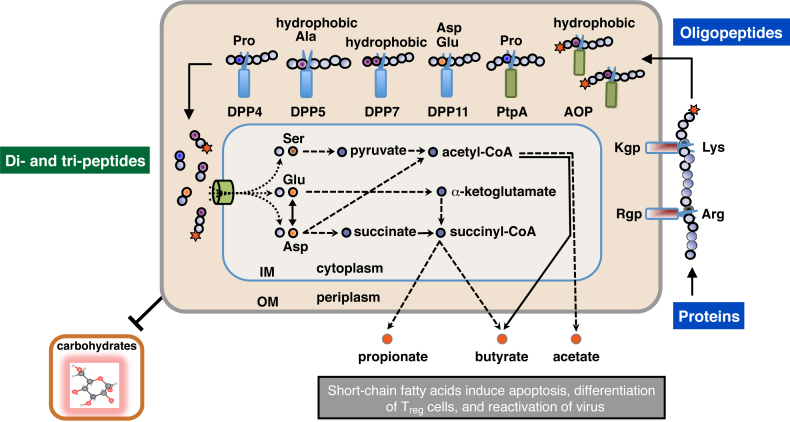
, an asaccharolytic bacterium, utilizes amino acids as energy and carbon sources. Since amino acids are incorporated into the bacterial cells mainly as di- and tri-peptides, exopeptidases including dipeptidyl-peptidase (DPP) and tripeptidyl-peptidase are considered to be prerequisite components for their metabolism. We recently discovered DPP11, DPP5, and acylpeptidyl oligopeptidase in addition to previously reported DPP4, DPP7, and prolyl tripeptidyl peptidase A. DPP11 is a novel enzyme specific for acidic P1 residues (Asp and Glu) and distributed ubiquitously in eubacteria, while DPP5 is preferential for the hydrophobic P1 residue and the first entity identified in prokaryotes. Recently, acylpeptidyl oligopeptidase with a preference for hydrophobic P1 residues was found to release N-terminally blocked di- and tri-peptides. Furthermore, we also demonstrated that gingipains R and K contribute to P1-basic dipeptide production. These observations implicate that most, if not all, combinations of di- and tri-peptides are produced from extracellular oligopeptides even with an N-terminal modification. Here, we review exopeptidases mainly in regard to their enzymatic characteristics. These exopeptidases with various substrate specificities benefit for obtaining energy and carbon sources from the nutritionally limited subgingival environment.
一种不分解糖类的细菌利用氨基酸作为能量和碳源。由于氨基酸主要以二肽和三肽的形式被纳入细菌细胞,包括二肽基肽酶(DPP)和三肽基肽酶在内的外肽酶被认为是其代谢的必备成分。我们最近除了先前报道的DPP4、DPP7和脯氨酰三肽基肽酶A之外,还发现了DPP11、DPP5和酰基肽基寡肽酶。DPP11是一种对酸性P1残基(天冬氨酸和谷氨酸)具有特异性的新型酶,在真细菌中普遍分布,而DPP5则优先作用于疏水性P1残基,是在原核生物中鉴定出的首个此类酶。最近发现,偏好疏水性P1残基的酰基肽基寡肽酶可释放N端被封闭的二肽和三肽。此外,我们还证明牙龈蛋白酶R和K有助于生成P1碱性二肽。这些观察结果表明,即使存在N端修饰,大多数(如果不是全部)二肽和三肽组合也是由细胞外寡肽产生的。在此,我们主要就外肽酶的酶学特性进行综述。这些具有各种底物特异性的外肽酶有利于从营养有限的龈下环境中获取能量和碳源。