Song Hyerim, Lim Do Young, Jung Jae In, Cho Han Jin, Park So Young, Kwon Gyoo Taik, Kang Young-Hee, Lee Ki Won, Choi Myung-Sook, Park Jung Han Yoon
Department of Food Science and Nutrition, Hallym University, Chuncheon 24252, Republic of Korea.
The Hormel Institute, University of Minnesota, Austin, MN 55912, USA.
Oncotarget. 2017 May 9;8(19):32027-32042. doi: 10.18632/oncotarget.16757.
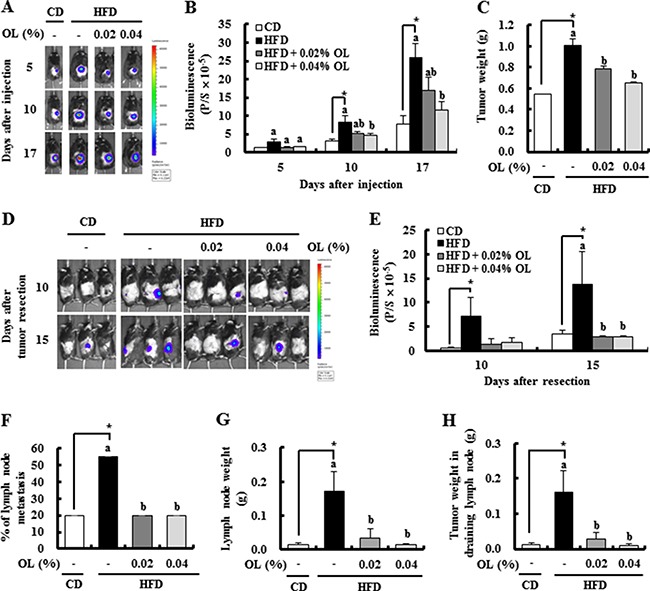
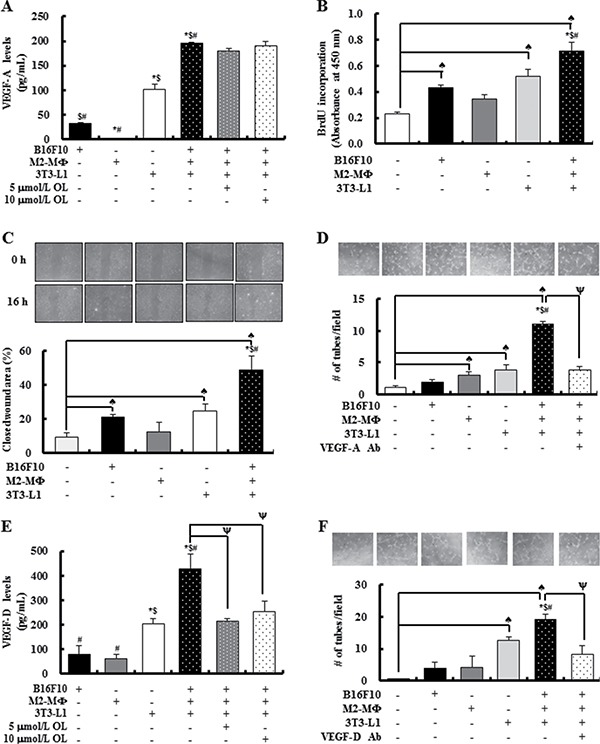
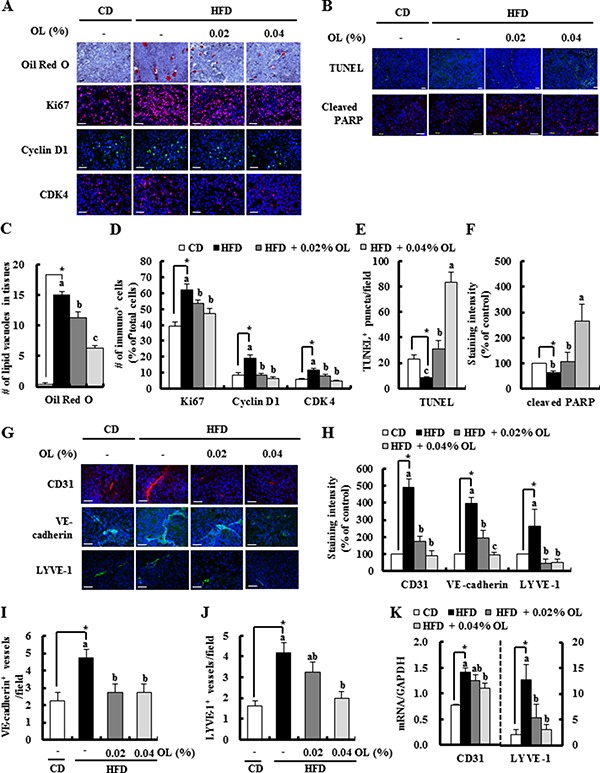
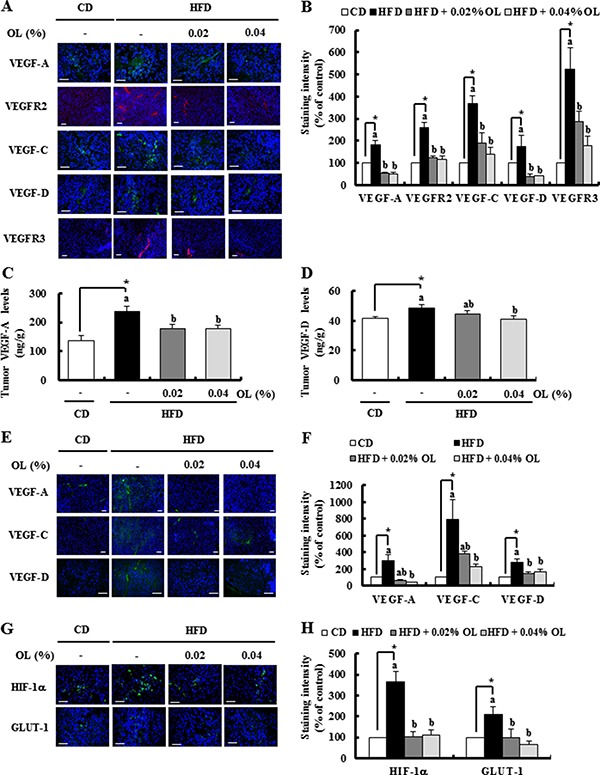
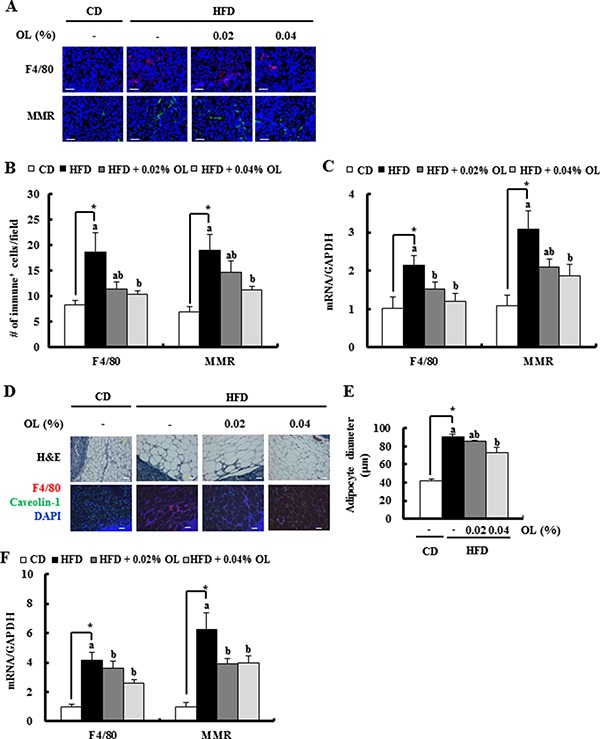
Previously, we reported that high-fat-diet (HFD)-induced obesity stimulates melanoma progression in the B16F10 allograft model. In this study, we examined whether oleuropein (OL), the most abundant phenolic compound in olives, inhibits HFD-induced melanoma progression. Four-week-old male C57BL/6N mice were fed a HFD-diet with or without OL. After 16 weeks of feeding, B16F10-luc cells were subcutaneously injected and the primary tumor was resected 3 weeks later. OL suppressed HFD-induced solid tumor growth. In the tumor tissues, OL reduced HFD-induced expression of angiogenesis (CD31, VE-cadherin, VEGF-A, and VEGFR2), lymphangiogenesis (LYVE-1, VEGF-C, VEGF-D, and VEGFR3), and hypoxia (HIF-1α and GLUT-1) markers as well as HFD-induced increases in lipid vacuoles and M2 macrophages (MΦs). All animals were euthanized 2.5 weeks after tumor resection. OL suppressed HFD-induced increases in lymph node (LN) metastasis; expression of VEGF-A, VEGF-C, and VEGF-D in the LN; and M2-MΦs and the size of adipocytes in adipose tissues surrounding LNs. Co-culture results revealed that the crosstalk between B16F10s, M2-MΦs, and differentiated 3T3-L1 cells under hypoxic conditions increased the secretion of VEGF-A and -D, which stimulated tube formation and migration of endothelial cells (HUVECs) and lymphatic endothelial cells (LEC), respectively. Additionally, OL directly inhibited the differentiation of 3T3-L1 preadipocytes and tube formation by HUVECs and LECs. The overall results indicated that dietary OL inhibits lipid and M2-MΦ accumulation in HFD-fed mice, which contributes to decreases in VEGF secretion, thereby leading to inhibition of angiogenesis and lymphangiogenesis.
此前,我们报道过在B16F10同种异体移植模型中,高脂饮食(HFD)诱导的肥胖会刺激黑色素瘤进展。在本研究中,我们检测了橄榄中含量最丰富的酚类化合物橄榄苦苷(OL)是否能抑制HFD诱导的黑色素瘤进展。给四周龄雄性C57BL/6N小鼠喂食含或不含OL的HFD饮食。喂食16周后,皮下注射B16F10-luc细胞,3周后切除原发性肿瘤。OL抑制了HFD诱导的实体瘤生长。在肿瘤组织中,OL降低了HFD诱导的血管生成(CD31、血管内皮钙黏蛋白、血管内皮生长因子A [VEGF-A]和血管内皮生长因子受体2 [VEGFR2])、淋巴管生成(淋巴管内皮透明质酸受体1 [LYVE-1]、VEGF-C、VEGF-D和血管内皮生长因子受体3 [VEGFR3])以及缺氧(缺氧诱导因子-1α [HIF-1α]和葡萄糖转运蛋白1 [GLUT-1])标志物的表达,以及HFD诱导的脂质空泡和M2巨噬细胞(MΦs)的增加。肿瘤切除2.5周后对所有动物实施安乐死。OL抑制了HFD诱导的淋巴结(LN)转移增加、LN中VEGF-A、VEGF-C和VEGF-D的表达,以及LN周围脂肪组织中M2-MΦs和脂肪细胞大小的增加。共培养结果显示,在缺氧条件下,B16F10细胞、M2-MΦs和分化的3T3-L1细胞之间的相互作用增加了VEGF-A和VEGF-D的分泌,分别刺激了内皮细胞(人脐静脉内皮细胞 [HUVECs])和成淋巴管内皮细胞(LEC)的管腔形成和迁移。此外,OL直接抑制了3T3-L1前脂肪细胞的分化以及HUVECs和LEC的管腔形成。总体结果表明,饮食中的OL抑制了HFD喂养小鼠中脂质和M2-MΦ的积累,这有助于减少VEGF分泌,从而导致血管生成和淋巴管生成受到抑制。