Apfelbeck Beate, Mortega Kim G, Flinks Heiner, Illera Juan Carlos, Helm Barbara
Institute of Biodiversity, Animal Health and Comparative Medicine, University of Glasgow, Glasgow, Scotland, G12 8QQ, UK.
Terrestrial Ecology Research Group, Department of Ecology and Ecosystemmanagement, Technische Universität München, School of Life Sciences Weihenstephan, D-85354, Freising, Germany.
BMC Evol Biol. 2017 Apr 17;17(1):101. doi: 10.1186/s12862-017-0944-9.
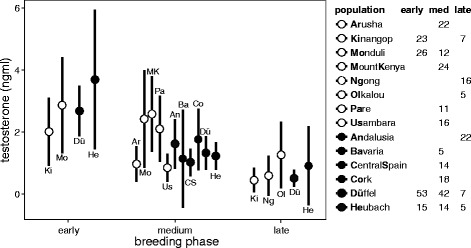
Testosterone facilitates physiological, morphological, and behavioral changes required for breeding in male vertebrates. However, testosterone concentrations and the link between its seasonal changes and those in reproductive behaviors vary greatly among species. To better understand the impact of tropical and temperate environments and life history factors on this variation, we have compared testosterone, territorial behavior and song performance across sequential stages of the breeding season in males of 16 closely related taxa of East African tropical and West European temperate stonechats (Saxicola spp), which all breed during a short breeding season, but differ in migratory behavior, seasonal territory-acquisition and pace of life.
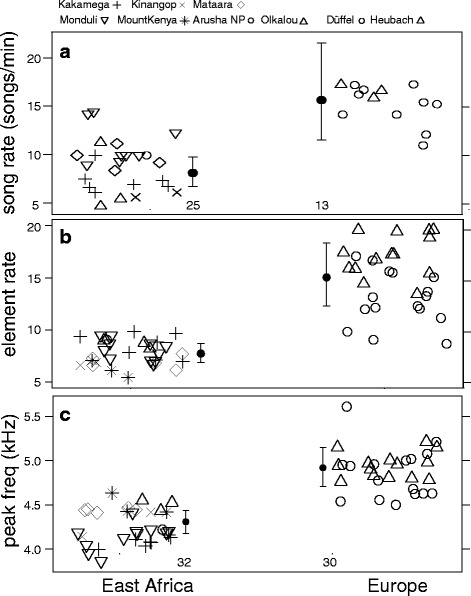
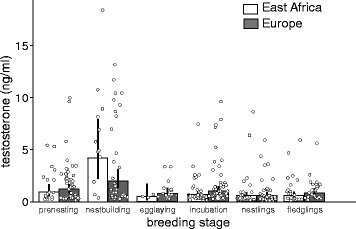
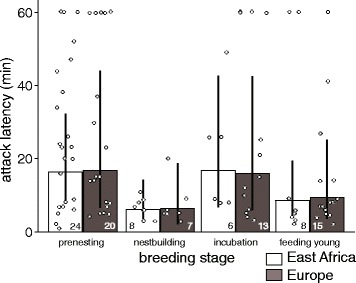
We found that generally, the profiles of testosterone and territorial behavior were similar across latitudes. African stonechats with a slow pace of life had equally high peak testosterone concentrations and responded as aggressively to an intruder as European stonechats with a fast pace of life. However, song performance at the beginning of the breeding season was lower in African than in European stonechats. The differences in song performance were not associated with variation in testosterone levels between tropical and temperate stonechats.
The results suggest a very similar role for testosterone as a mediator of high intensity territorial aggression during the fertile period of females in tropical and temperate stonechats, which all are highly seasonal, locally synchronous breeders. A potential explanation may be high risk of extra-pair copulations which has been associated with synchronous breeding. Interestingly, an association was not consistent for song performance. Our data suggest that song performance can be disassociated from peak testosterone levels depending on its role in breeding behavior. Despite similar testosterone levels, European males, which early in the breeding season acquire territories and mates, showed greater song performance than African stonechats, which maintain year-round territories and pair-bonds. Taken together, our study comparing related taxa of old world songbirds suggests that short breeding seasons may be a major selective force for high peak testosterone levels during breeding regardless of latitude and pace of life, but that particular behaviors, in our case song, can be uncoupled from peak testosterone levels.
睾酮促进雄性脊椎动物繁殖所需的生理、形态和行为变化。然而,睾酮浓度及其季节性变化与生殖行为变化之间的联系在不同物种间差异很大。为了更好地理解热带和温带环境以及生活史因素对这种差异的影响,我们比较了东非热带和西欧温带的16种近缘类群的雄性石䳭(石䳭属)在繁殖季节连续阶段的睾酮水平、领地行为和鸣叫表现,这些石䳭都在短繁殖季节繁殖,但在迁徙行为、季节性领地获取和生活节奏方面存在差异。
我们发现,一般来说,睾酮水平和领地行为的变化趋势在不同纬度地区相似。生活节奏缓慢的非洲石䳭的睾酮峰值浓度与生活节奏快的欧洲石䳭一样高,并且对入侵者的反应同样激烈。然而,在繁殖季节开始时,非洲石䳭的鸣叫表现低于欧洲石䳭。鸣叫表现的差异与热带和温带石䳭之间睾酮水平的差异无关。
结果表明,在热带和温带石䳭雌性的繁殖期,睾酮作为高强度领地攻击行为的调节因子发挥着非常相似的作用,这些石䳭都是高度季节性、局部同步繁殖的物种。一个可能的解释是,与同步繁殖相关的额外配对交配风险较高。有趣的是,鸣叫表现与睾酮水平之间的关联并不一致。我们的数据表明,鸣叫表现可能与其在繁殖行为中的作用有关,而与睾酮峰值水平无关。尽管睾酮水平相似,但在繁殖季节早期就获取领地和配偶的欧洲雄性石䳭的鸣叫表现比全年都有领地和配偶关系的非洲石䳭更强。综上所述,我们对旧大陆鸣禽近缘类群的比较研究表明,短繁殖季节可能是导致繁殖期间睾酮峰值水平高的主要选择压力,无论纬度和生活节奏如何,但特定行为(在我们的研究中是鸣叫)可能与睾酮峰值水平脱钩。