Chiu Wang Zheng, Donker Kaat Laura, Boon Agnita J W, Kamphorst Wouter, Schleicher Axel, Zilles Karl, van Swieten John C, Palomero-Gallagher Nicola
Department of Neurology, Erasmus Medical Centre, Rotterdam, The Netherlands.
Department of Neuropathology, Vrije Universiteit Medical Centre, Amsterdam, The Netherlands.
Alzheimers Res Ther. 2017 Apr 17;9(1):28. doi: 10.1186/s13195-017-0259-5.
Progressive supranuclear palsy (PSP) with a frontal presentation, characterized by cognitive deficits and behavioral changes, has been recognized as an early clinical picture, distinct from the classical so-called Richardson and parkinsonism presentations. The midcingulate cortex is associated with executive and attention tasks and has consistently been found to be impaired in imaging studies of patients with PSP. The aim of the present study was to determine alterations in neurotransmission underlying the pathophysiology of PSP, as well as their significance for clinically identifiable PSP subgroups.
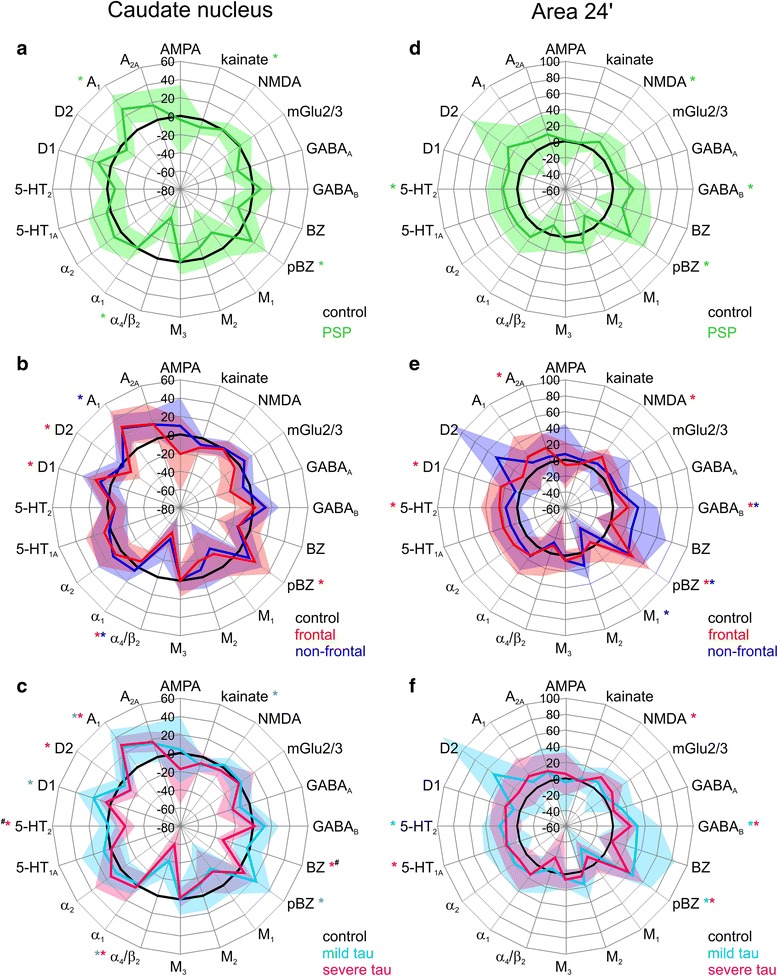
In vitro receptor autoradiography was used to quantify densities of 20 different receptors in the caudate nucleus and midcingulate area 24' of patients with PSP (n = 16) and age- and sex-matched control subjects (n = 14).
Densities of γ-aminobutyric acid type B, peripheral benzodiazepine, serotonin receptor type 2, and N-methyl-D-aspartate receptors were significantly higher in area 24' of patients with PSP, where tau impairment was stronger than in the caudate nucleus. Kainate and nicotinic cholinergic receptor densities were significantly lower, and adenosine receptor type 1 (A) receptors significantly higher, in the caudate nucleus of patients with PSP. Receptor fingerprints also segregated PSP subgroups when clinical parameters such as occurrence of frontal presentation and tau pathology severity were taken into consideration.
We demonstrate, for the first time to our knowledge, that kainate and A receptors are altered in PSP and that clinically identifiable PSP subgroups differ at the neurochemical level. Numerous receptors were altered in the midcingulate cortex, further suggesting that it may prove to be a key region in PSP. Finally, we add to the evidence that nondopaminergic systems play a role in the pathophysiology of PSP, thus highlighting potential novel treatment strategies.
以认知缺陷和行为改变为特征的额叶型进行性核上性麻痹(PSP)已被视为一种早期临床症状,有别于经典的所谓理查森型和帕金森型表现。扣带回中部皮质与执行和注意力任务相关,并且在PSP患者的影像学研究中一直发现其存在功能受损。本研究的目的是确定PSP病理生理学背后神经传递的改变,以及它们对临床上可识别的PSP亚组的意义。
采用体外受体放射自显影术对16例PSP患者及14例年龄和性别匹配的对照者的尾状核和扣带回中部24区的20种不同受体密度进行量化。
PSP患者24区的γ-氨基丁酸B型、外周苯二氮䓬、5-羟色胺2型受体和N-甲基-D-天冬氨酸受体密度显著更高,此处tau蛋白损伤比尾状核更强。PSP患者尾状核中的红藻氨酸和烟碱型胆碱能受体密度显著更低,而1型腺苷受体(A1)密度显著更高。当考虑到如额叶表现的出现和tau蛋白病理严重程度等临床参数时,受体特征也能区分PSP亚组。
据我们所知,我们首次证明红藻氨酸和A1受体在PSP中发生改变,并且临床上可识别的PSP亚组在神经化学水平上存在差异。扣带回中部皮质中有多种受体发生改变,进一步表明它可能是PSP的关键区域。最后,我们补充了非多巴胺能系统在PSP病理生理学中起作用的证据,从而突出了潜在的新治疗策略。