Hause Anne M, Henke David M, Avadhanula Vasanthi, Shaw Chad A, Tapia Lorena I, Piedra Pedro A
Department of Molecular Virology and Microbiology, Baylor College of Medicine, Houston, Texas, United States of America.
Department of Translational Biology and Molecular Medicine, Baylor College of Medicine, Houston, Texas, United States of America.
PLoS One. 2017 Apr 17;12(4):e0175792. doi: 10.1371/journal.pone.0175792. eCollection 2017.
The fusion (F) protein of RSV is the major vaccine target. This protein undergoes a conformational change from pre-fusion to post-fusion. Both conformations share antigenic sites II and IV. Pre-fusion F has unique antigenic sites p27, ø, α2α3β3β4, and MPE8; whereas, post-fusion F has unique antigenic site I. Our objective was to determine the antigenic variability for RSV/A and RSV/B isolates from contemporary and historical genotypes compared to a historical RSV/A strain.
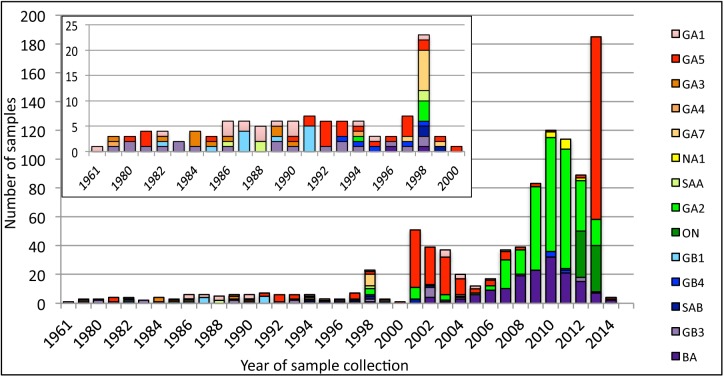
The F sequences of isolates from GenBank, Houston, and Chile (N = 1,090) were used for this analysis. Sequences were compared pair-wise to a reference sequence, a historical RSV/A Long strain. Variability (calculated as %) was defined as changes at each amino acid (aa) position when compared to the reference sequence. Only aa at antigenic sites with variability ≥5% were reported.
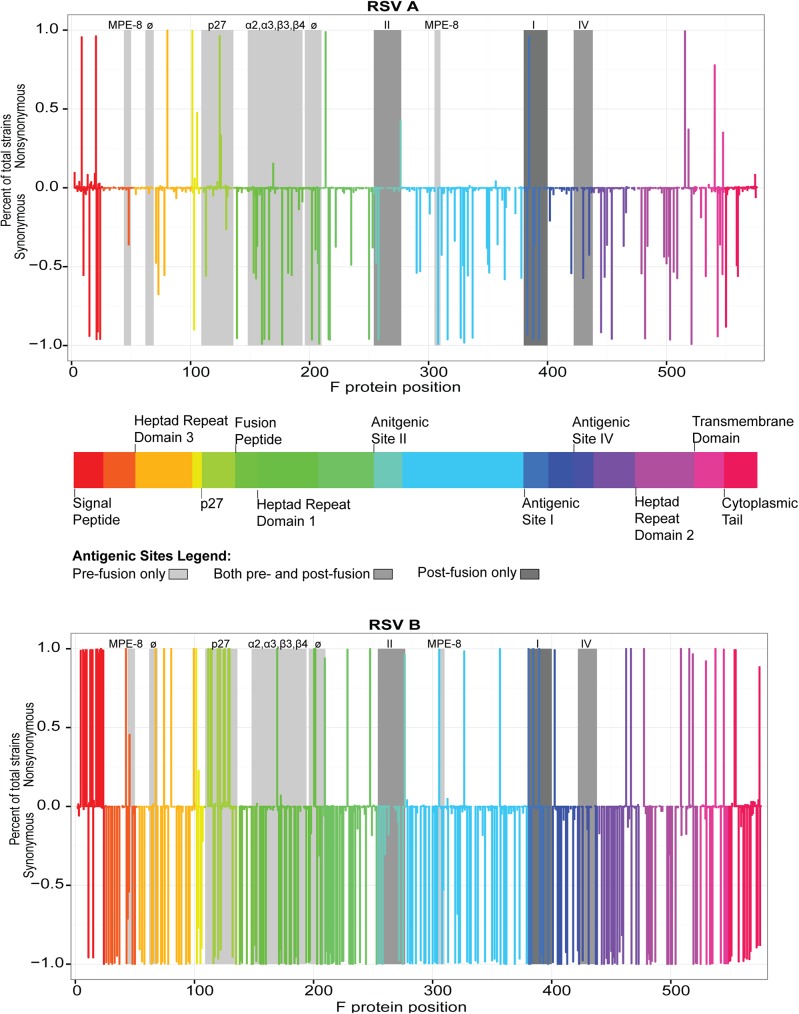
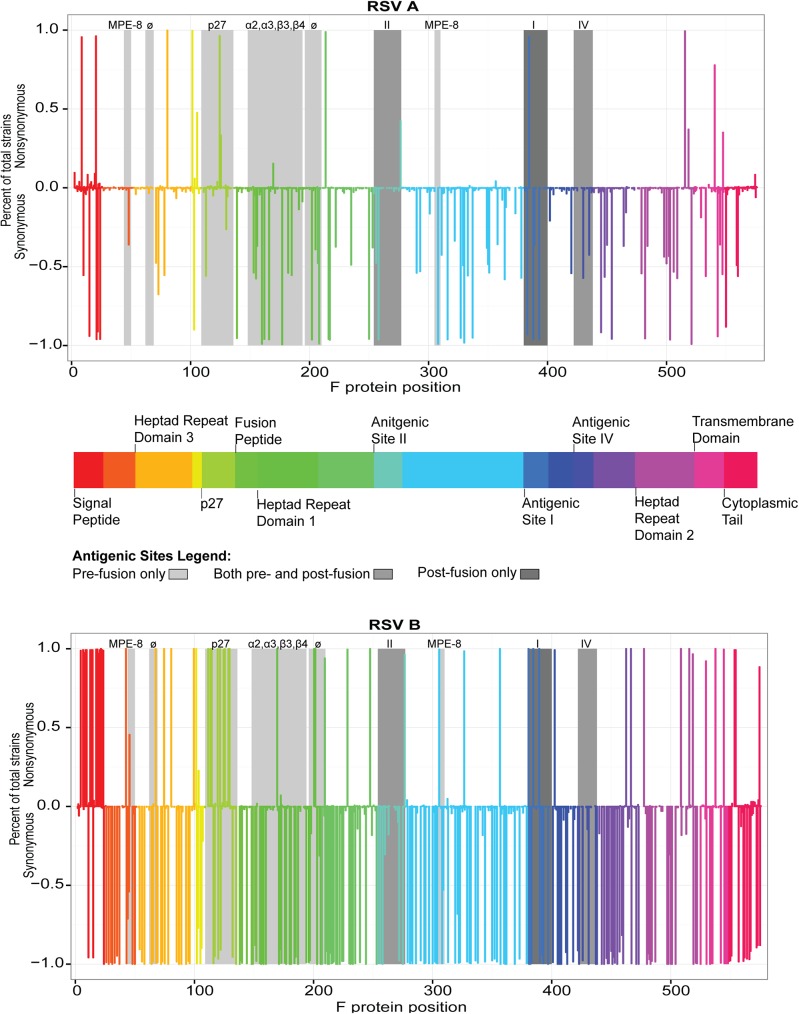
A total of 1,090 sequences (822 RSV/A and 268 RSV/B) were analyzed. When compared to the reference F, those domains with the greatest number of non-synonymous changes included the signal peptide, p27, heptad repeat domain 2, antigenic site ø, and the transmembrane domain. RSV/A subgroup had 7 aa changes in the antigenic sites: site I (N = 1), II (N = 1), p27 (N = 4), α2α3β3β4(AM14) (N = 1), ranging in frequency from 7-91%. In comparison, RSV/B had 19 aa changes in antigenic sites: I (N = 3), II (N = 1), p27 (N = 9), ø (N = 4), α2α3β3β4(AM14) (N = 1), and MPE8 (N = 1), ranging in frequency from 79-100%.
Although antigenic sites of RSV F are generally well conserved, differences are observed when comparing the two subgroups to the reference RSV/A Long strain. Further, these discrepancies are accented in the antigenic sites in pre-fusion F of RSV/B isolates, often occurring with a frequency of 100%. This could be of importance if a monovalent F protein from the historical GA1 genotype of RSV/A is used for vaccine development.
呼吸道合胞病毒(RSV)的融合(F)蛋白是主要的疫苗靶点。该蛋白会经历从融合前构象到融合后构象的转变。两种构象共享抗原位点II和IV。融合前F蛋白具有独特的抗原位点p27、ø、α2α3β3β4和MPE8;而融合后F蛋白具有独特的抗原位点I。我们的目标是确定与一株历史RSV/A毒株相比,当代和历史基因型的RSV/A和RSV/B分离株的抗原变异性。
本分析使用了来自GenBank、休斯顿和智利的分离株(N = 1090)的F序列。将序列与参考序列(一株历史RSV/A Long毒株)进行两两比较。变异性(以%计算)定义为与参考序列相比时每个氨基酸(aa)位置的变化。仅报告变异性≥5%的抗原位点的氨基酸。
共分析了1090个序列(822个RSV/A和268个RSV/B)。与参考F蛋白相比,非同义变化数量最多的结构域包括信号肽、p27、七肽重复结构域2、抗原位点ø和跨膜结构域。RSV/A亚组在抗原位点有7个氨基酸变化:位点I(N = 1)、II(N = 1)、p27(N = 4)、α2α3β3β4(AM14)(N = 1),频率范围为7% - 91%。相比之下,RSV/B在抗原位点有19个氨基酸变化:I(N = 3)、II(N = 1)、p27(N = 9)、ø(N = 4)、α2α3β3β4(AM14)(N = 1)和MPE8(N = 1),频率范围为79% - 100%。
尽管RSV F蛋白的抗原位点通常保守性良好,但将两个亚组与参考RSV/A Long毒株比较时仍观察到差异。此外,这些差异在RSV/B分离株融合前F蛋白的抗原位点更为突出,常以100%的频率出现。如果使用来自历史RSV/A GA1基因型的单价F蛋白进行疫苗研发,这可能具有重要意义。